Prime Minister Mark Carney Directs Federal Ministers to Detail Mandate Performance Ahead of Cabinet Retreat
In a notable departure from routine pre-budget funding requests, Prime Minister Mark Carney ordered federal cabinet ministers to deliver direct accountability assessments tracking core mandate benchmarks ahead of next week’s cabinet retreat.
Choseno Civic News Desk September 5, 2026 2 min read CA
OTTAWA — Prime Minister Mark Carney has issued a directive across the federal cabinet requiring all ministers to submit comprehensive, data-driven progress assessments detailing measurable deliverables across their respective portfolios prior to convening for an intensive national cabinet retreat at the end of next week.
The requirement marks a significant institutional departure from conventional pre-budget cabinet protocols in Ottawa. Under standard operating procedures, departmental ministers typically submit project wish lists and funding appeals directly to the Minister of Finance and the Treasury Board of Canada Secretariat ahead of autumn fiscal planning. Instead, the prime minister’s office has instituted direct executive performance reviews, requiring ministers to demonstrate tangible progress against key performance indicators and priorities established in their ministerial mandate letters.
According to senior government officials familiar with the process, the direct reporting mechanism is designed to enforce rigorous departmental accountability, eliminate bureaucratic redundancies, and align federal expenditures with measurable economic growth targets. Briefings submitted over the coming days will focus heavily on accelerating housing construction pipelines, streamlining clean energy infrastructure permitting, expanding trade corridors, and modernizing federal service delivery.
Prime Minister Carney, whose extensive economic background includes serving as governor of the Bank of Canada and the Bank of England, has emphasized fiscal discipline, productivity growth, and delivery metrics since assuming executive office. The directive signals that future ministerial budget allocations will be closely tied to demonstrated execution capacity rather than traditional departmental baseline growth.
"Canadians expect a government that delivers concrete outcomes with discipline, urgency, and transparency," government officials said in Ottawa. "Prime Minister Carney has made clear that every department must demonstrate clear value for public dollars, meet key performance milestones, and focus relentlessly on driving productivity and lowering costs for Canadian families."
Opposition members in the House of Commons expressed skepticism regarding the internal review, arguing that top-down performance audits cannot substitute for decisive parliamentary action on economic competitiveness, federal deficit reduction, and cross-border trade resilience. Conservative and New Democratic Party critics indicated they intend to press ministers on specific departmental benchmarks when Parliament reconvenes for the autumn legislative sitting.
The upcoming retreat will serve as the strategic launchpad for the federal government’s autumn legislative agenda, where cabinet is expected to finalize priority economic legislation, regulatory modernization frameworks, and autumn fiscal updates before facing parliamentary scrutiny in the House of Commons.
Rate the people mentioned in this article

Related Coverage in Federal Governance
See all Federal Governance newsFederal Governance
CA Sep 5, 2026
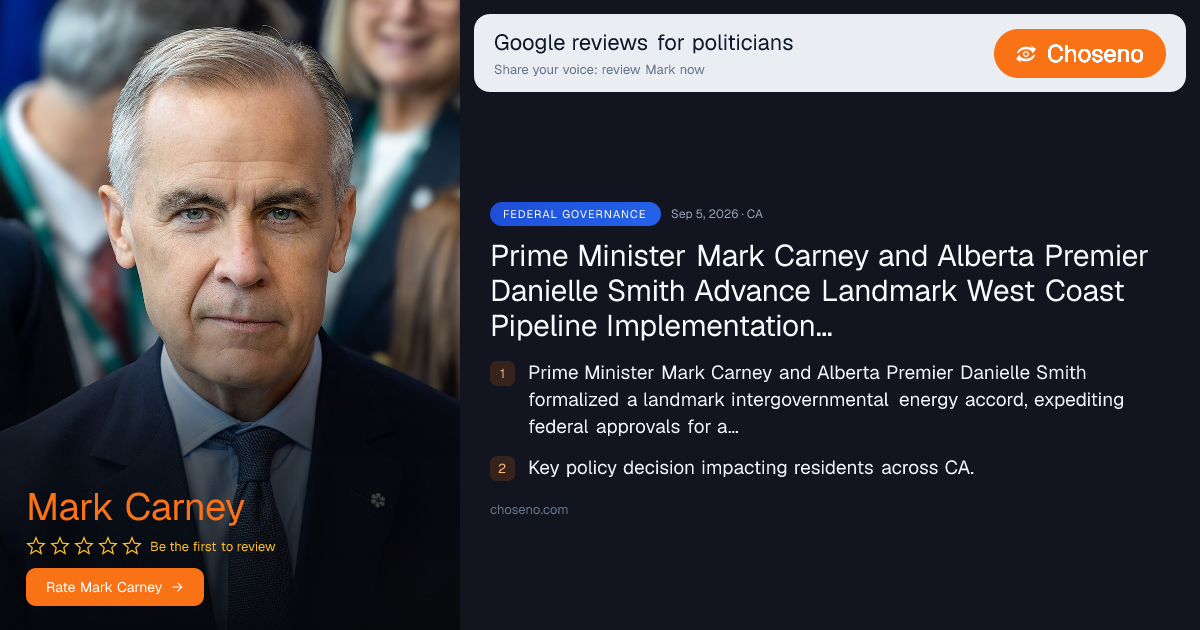
Prime Minister Mark Carney Pledges Expanded Federal Support for Wildfire Readiness During Northern Ontario Visit
Touring a regional wildfire management facility in Thunder Bay, Prime Minister Mark Carney affirmed that Ottawa must expand interagency coordination and equipment investments to confront severe climate-driven wildfire seasons.
Read full article
Federal Governance
CA Sep 5, 2026
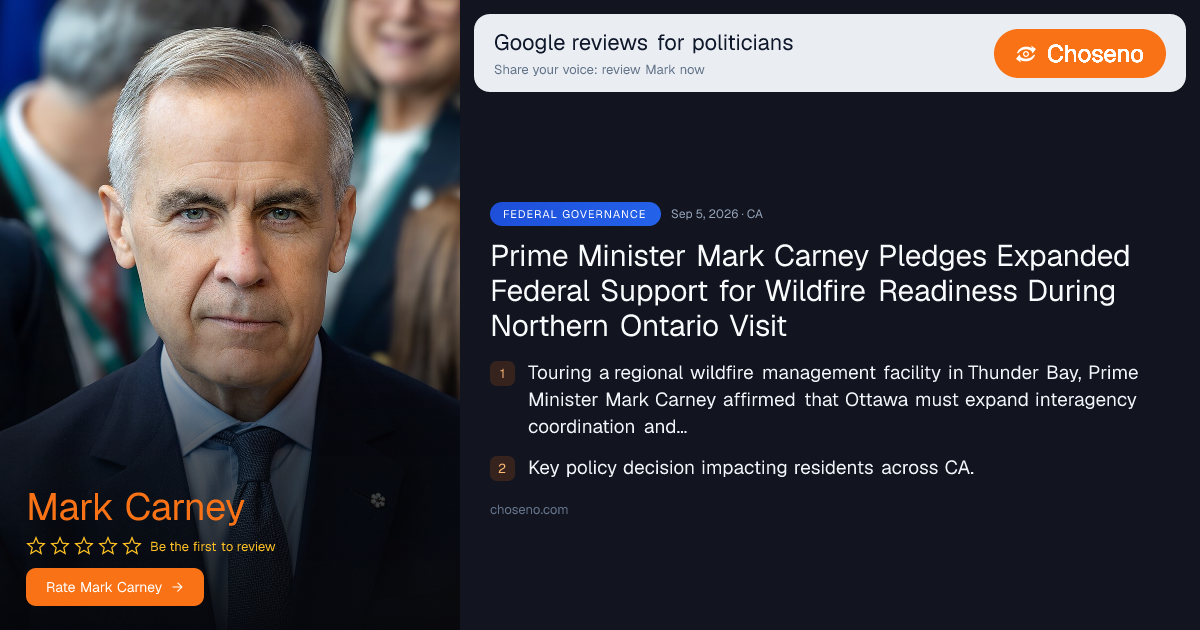
Prime Minister Mark Carney and Alberta Premier Danielle Smith Advance Landmark West Coast Pipeline Implementation Agreement
Prime Minister Mark Carney and Alberta Premier Danielle Smith formalized a landmark intergovernmental energy accord, expediting federal approvals for a million-barrel-per-day West Coast oil pipeline corridor with Indigenous equity participation.
Read full article