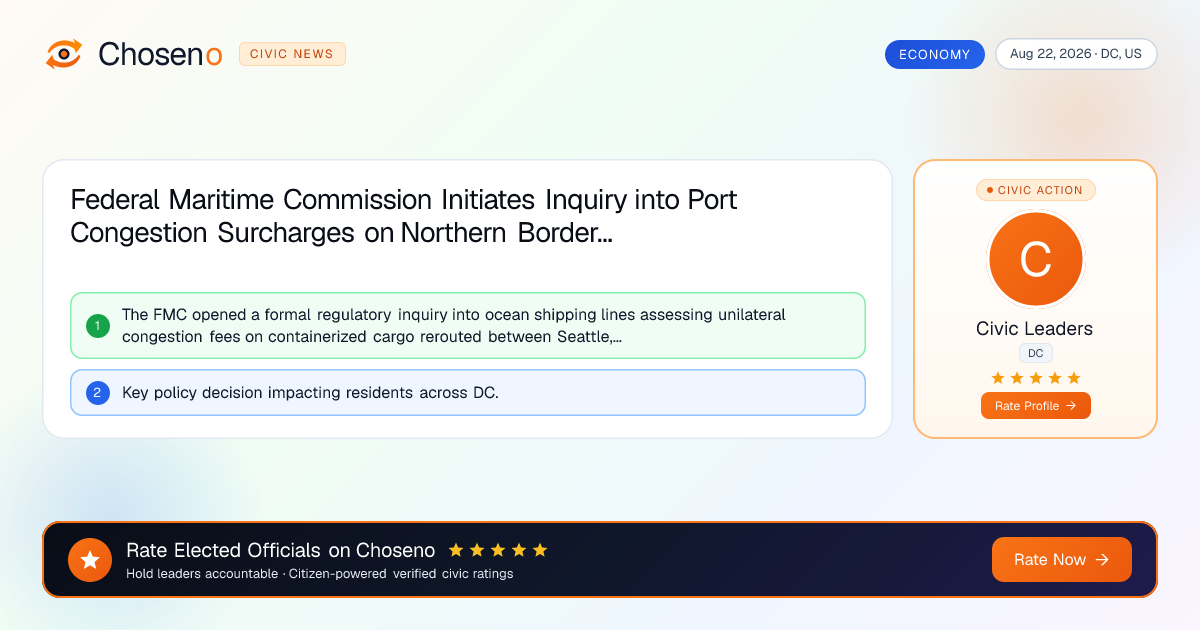
Ottawa Mobilizes $25 Billion Trade Defense Package as U.S. 50% Tariffs Take Effect
Prime Minister Mark Carney established a $25-billion federal contingency facility to protect domestic manufacturers and agricultural exporters after bilateral trade talks collapsed in Washington.
Choseno Civic News Desk August 23, 2026 2 min read ON, CA
★ Choseno Civic Briefing
Key Leaders
OTTAWA, ON — Prime Minister Mark Carney announced an immediate $25-billion federal export stabilization package early Sunday morning following the implementation of steep 50% tariffs by the United States on approximately $20 billion worth of Canadian industrial goods, lumber, and agricultural equipment. The emergency facility is designed to provide bridge liquidity and market-diversification grants to Canadian firms directly impacted by the sudden border duties enacted over the weekend.
Statutory Framework and Liquidity Facility
The stabilization fund, coordinated through Export Development Canada (EDC) and the Business Development Bank of Canada (BDC), establishes three distinct financing streams. First, $12 billion is earmarked for working-capital guarantees to ensure supply chains remain solvent without immediate workforce reductions. Second, $8 billion will fund non-repayable re-tooling grants for manufacturers adapting production lines for European, Indo-Pacific, and Latin American export standards. The remaining $5 billion constitutes an agricultural stabilization reserve administered by Farm Credit Canada.
Finance Minister officials confirmed that the support measures operate independently of Canada's planned retaliatory countermeasures, which are scheduled to apply dollar-for-dollar duties starting September 8, 2026, across U.S. steel, dairy, electronic appliances, and specialized machinery.
Regional and Industrial Impact
The economic friction is anticipated to concentrate most heavily across Ontario's automotive and advanced tooling corridor, Quebec's aerospace and aluminum smelters, and British Columbia's forestry sector. Canadian commercial trucking associations reported immediate delays at major land crossings including the Ambassador Bridge in Windsor and the Peace Arch crossing in Surrey as customs brokers recalibrated valuation schedules.
Business organizations, including the Canadian Chamber of Commerce and the Canadian Federation of Independent Business (CFIB), welcomed the liquidity buffer but warned that prolonged border tariffs could trim annualized GDP growth by 0.6 percentage points if unresolved prior to the fourth quarter.
Accountability and Next Steps
Parliament's Standing Committee on International Trade has called an extraordinary sitting for Tuesday to examine the distribution criteria of the $25-billion fund and review the legal avenues available under the World Trade Organization (WTO) dispute resolution mechanisms. Deputy Prime Minister Chrystia Freeland and Trade Minister Dominic LeBlanc are scheduled to testify regarding ongoing outreach to allied trading partners.
Sources
Rate the people mentioned in this article

Related Coverage in Economy
See all Economy newsEconomy
US Aug 23, 2026
Ohio Small Business Coalitions Rally Behind Local Retailer in Buc-ee's Trademark Dispute
Community leaders and independent business owners in central Ohio voiced strong support for a local family mini-mart facing federal trademark litigation from Texas-based chain Buc-ee's.
Read full article
Economy
CA Aug 22, 2026
Manitoba Pledges Direct Rail and Grain Subsidies as Kinew Rallies Western Premiers Against Trade Penalties
Premier Wab Kinew committed provincial logistics subsidies to reroute prairie agricultural shipments to Churchill and Vancouver ports, affirming full alignment with federal trade posture.
Read full article

Economy
US Aug 22, 2026
Federal Maritime Commission Initiates Inquiry into Port Congestion Surcharges on Northern Border Corridors
The FMC opened a formal regulatory inquiry into ocean shipping lines assessing unilateral congestion fees on containerized cargo rerouted between Seattle, Vancouver, and Detroit corridors.
Read full article