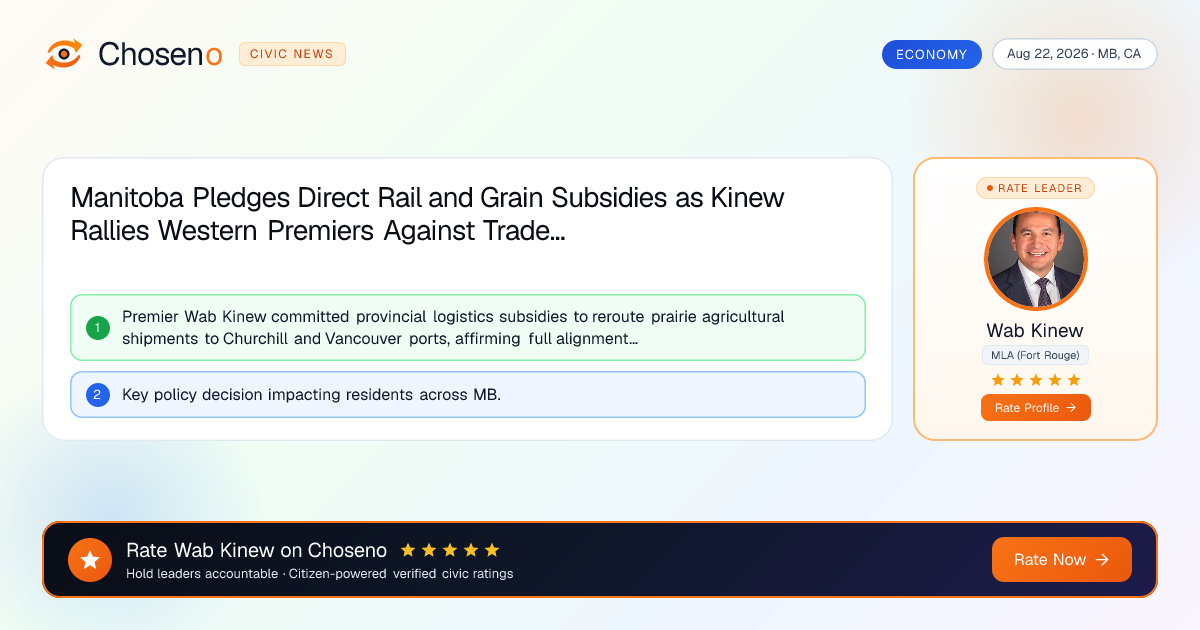
Manitoba Pledges Direct Rail and Grain Subsidies as Kinew Rallies Western Premiers Against Trade Penalties
Premier Wab Kinew committed provincial logistics subsidies to reroute prairie agricultural shipments to Churchill and Vancouver ports, affirming full alignment with federal trade posture.
Choseno Civic News Desk August 22, 2026 1 min read MB, CA
★ Choseno Civic Briefing
Key Leaders
WINNIPEG, MB — Manitoba Premier Wab Kinew convened an emergency briefing with prairie agricultural leaders and freight carriers on Saturday evening, pledging immediate provincial freight assistance and reaffirming Western Canada's united front against unilateral trade barriers.
Grain Logistics and Port Subsidies
Under the Manitoba Export Resiliency Protocol, the provincial executive approved $45 million in freight offsets to subsidize rail tariffs for grain producers redirecting pulse crops, canola, and wheat through the Port of Churchill and West Coast marine terminals. The initiative directly offsets the elevated intermodal shipping rates incurred by prairie growers unable to access traditional Midwestern U.S. rail corridors.
Kinew emphasized that Western Canadian resources remain essential global commodities and that logistical diversification will insulate producers from retaliatory volatility. Provincial grain elevators across southern Manitoba will receive expedited clearance protocols coordinated with Canadian Pacific Kansas City (CPKC) and Canadian National Railway (CN).
Impact on Agricultural Producers and Municipalities
Manitoba grain farmers and rural municipalities face an estimated $120 million in pending export commitments that were negotiated under prior border frameworks. The subsidy guarantees that producers who locked in forward contracts prior to August 20 will not bear the cost of emergency freight rerouting.
Municipal leaders in Brandon, Portage la Prairie, and Dauphin praised the provincial intervention, noting that local tax bases rely heavily on stable commodity movement during peak harvest season.
Next Steps and Western Premiers Conference
Premier Kinew confirmed he has scheduled a multilateral conference call with Alberta Premier Danielle Smith and Saskatchewan Premier Scott Moe to harmonize cross-provincial corridor fees and ensure seamless interprovincial freight movements. The Manitoba Legislative Assembly will review emergency appropriations when it reconvenes next month.
Sources
Rate the people mentioned in this article
Related Coverage in Economy
See all Economy newsEconomy
CA Aug 23, 2026
Ottawa Mobilizes $25 Billion Trade Defense Package as U.S. 50% Tariffs Take Effect
Prime Minister Mark Carney established a $25-billion federal contingency facility to protect domestic manufacturers and agricultural exporters after bilateral trade talks collapsed in Washington.
Read full article
Economy
US Aug 23, 2026
Ohio Small Business Coalitions Rally Behind Local Retailer in Buc-ee's Trademark Dispute
Community leaders and independent business owners in central Ohio voiced strong support for a local family mini-mart facing federal trademark litigation from Texas-based chain Buc-ee's.
Read full article
Economy
US Aug 22, 2026
Federal Maritime Commission Initiates Inquiry into Port Congestion Surcharges on Northern Border Corridors
The FMC opened a formal regulatory inquiry into ocean shipping lines assessing unilateral congestion fees on containerized cargo rerouted between Seattle, Vancouver, and Detroit corridors.
Read full article