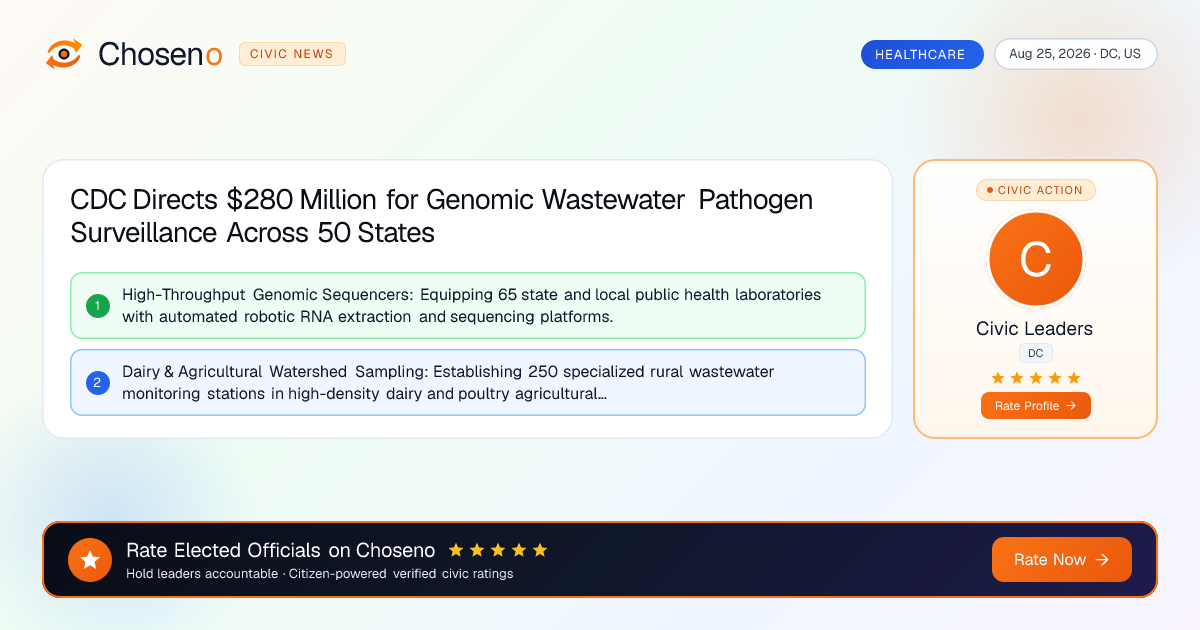
CDC Directs $280 Million for Genomic Wastewater Pathogen Surveillance Across 50 States
Centers for Disease Control and Prevention Director Mandy Cohen allocates $280 million to expand the National Wastewater Surveillance System to 1,500 municipal treatment utilities for early avian influenza and respiratory pathogen detection.
Choseno Public Health & Science Bureau August 25, 2026 2 min read DC, US
★ Choseno Civic Briefing
Key Leaders
ATLANTA — Centers for Disease Control and Prevention (CDC) Director Mandy Cohen announced on Monday the distribution of $280 million in public health infrastructure grants to expand the National Wastewater Surveillance System (NWSS) across 1,500 municipal wastewater treatment utilities, covering more than 210 million Americans across all fifty states, tribal nations, and territories.
The investment installs automated high-throughput digital droplet PCR (ddPCR) and next-generation metagenomic sequencing hardware at municipal sewage treatment plants, providing early-warning detection of community viral transmission—including Highly Pathogenic Avian Influenza (H5N1), novel SARS-CoV-2 variants, respiratory syncytial virus (RSV), and antimicrobial-resistant superbugs—up to two weeks before clinical hospitalizations occur.
Pioneering Non-Invasive, Population-Level Epidemiology Wastewater epidemiology provides unbiased, community-wide public health telemetry without requiring individual clinical testing or healthcare insurance access, allowing public health agencies to deploy antiviral treatments, monoclonal antibodies, and hospital staffing buffers in advance of surge peaks.
"Wastewater testing is one of the most powerful, cost-effective early warning systems in modern medicine," CDC Director Mandy Cohen said in Atlanta. "Viruses shed in wastewater days before an infected person develops symptoms or visits a doctor. By expanding our genomic sequencing network to 1,500 municipal water plants, we are giving our state and local health officials the real-time data they need to detect emerging outbreaks early, protect vulnerable seniors in nursing homes, and keep our communities safe."
Surveillance Capabilities and Data Infrastructure The $280 million funding package supports:
- High-Throughput Genomic Sequencers: Equipping 65 state and local public health laboratories with automated robotic RNA extraction and sequencing platforms.
- Dairy & Agricultural Watershed Sampling: Establishing 250 specialized rural wastewater monitoring stations in high-density dairy and poultry agricultural basins.
- Open-Access CDC Data Dashboard: Integrating real-time viral concentration maps into public dashboards for healthcare systems and local clinicians.
Epidemiologists, municipal water directors, and hospital emergency directors praised the CDC's expanded funding, emphasizing that population-level wastewater monitoring represents the future of disease prevention.
Related Coverage in Healthcare
See all Healthcare newsHealthcare
US Aug 25, 2026
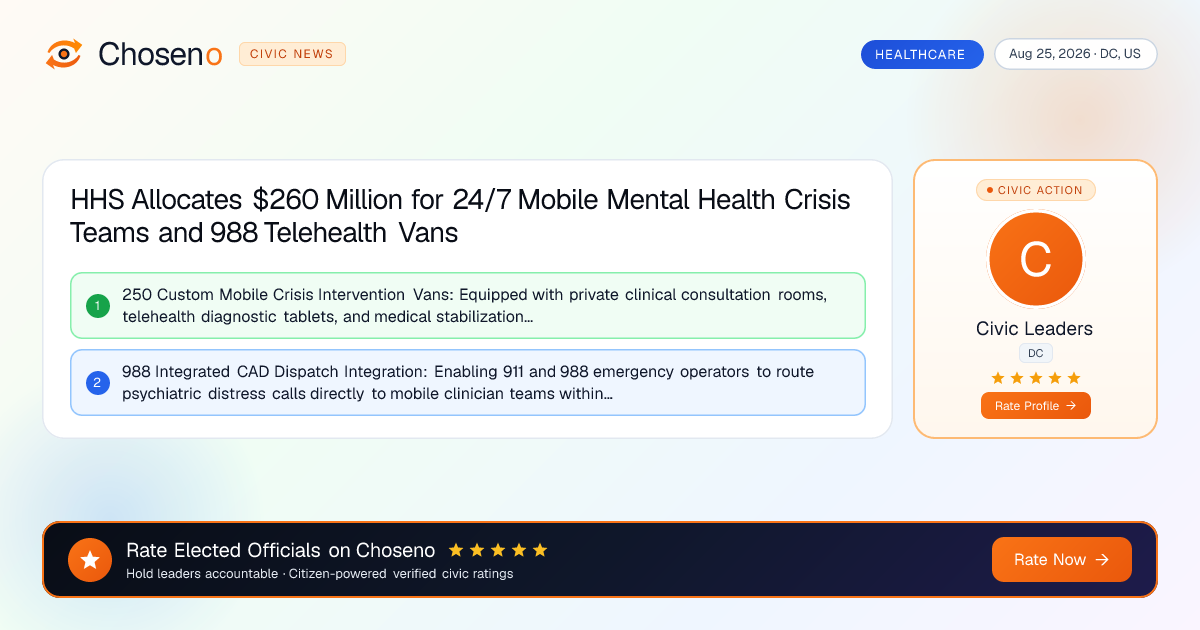
HHS Allocates $260 Million for 24/7 Mobile Mental Health Crisis Teams and 988 Telehealth Vans
Health and Human Services Secretary Xavier Becerra and SAMHSA announce $260 million in federal behavioral health grants to deploy 250 mobile crisis response vans staffed with mental health clinicians and peer specialists nationwide.
Read full article
Healthcare
US Aug 25, 2026
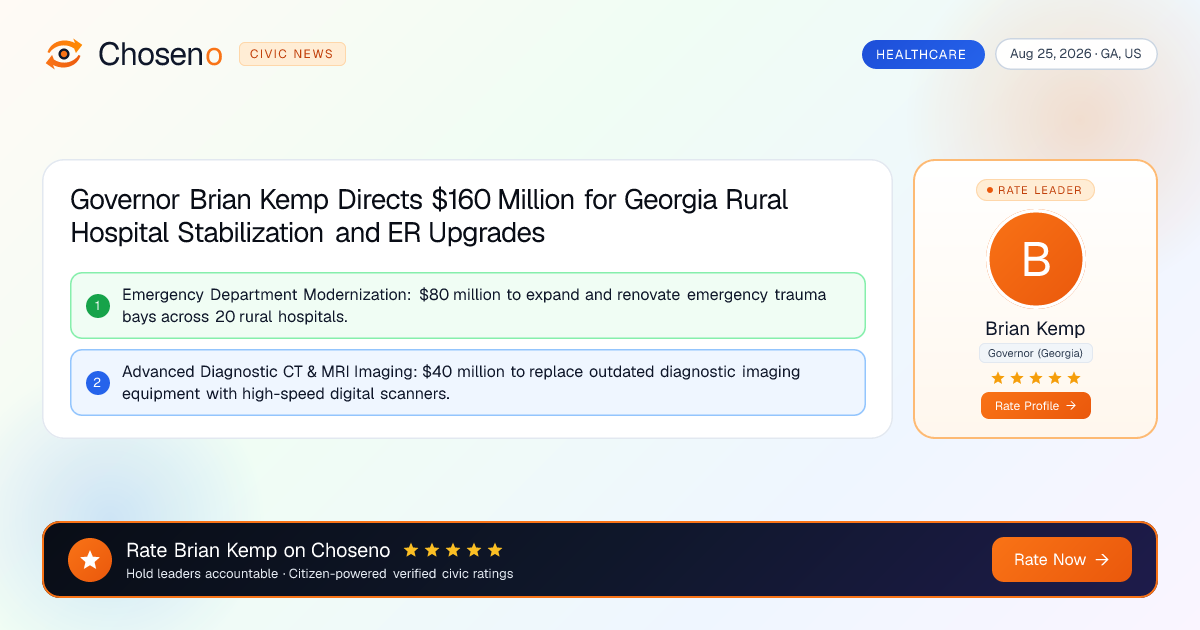
Governor Brian Kemp Directs $160 Million for Georgia Rural Hospital Stabilization and ER Upgrades
Georgia Governor Brian Kemp and the Georgia Department of Community Health award $160 million in Rural Hospital Stabilization grants to modernize emergency departments and recruit diagnostic specialists in twenty rural Georgia counties.
Read full article
Healthcare
US Aug 25, 2026
Governor Gavin Newsom Directs $350 Million for California Senior Care Hubs and In-Home Support
California Governor Gavin Newsom signs Assembly Bill 1820, appropriating $350 million from the Master Plan for Aging to construct forty community-based geriatric health hubs and increase wages for 100,000 in-home supportive care workers.
Read full article