Congressional Hemp Regulation Faces Legislative Hurdle Upon Return From Recess
House Republicans are preparing to address stopgap funding legislation that includes contentious provisions regarding hemp regulation. This legislative maneuver carries significant implications for the agricultural and retail sectors as lawmakers attempt to avoid potential government shutdown scenarios.
Choseno Civic News Desk August 28, 2026 1 min read DC, US
Dateline: Washington, D.C.
As Congress prepares to reconvene following the August recess, legislative focus has shifted toward the passage of stopgap funding measures. According to reporting by The Hill Politics, House Republicans are tasked with navigating a complex policy landscape regarding hemp regulation that previously presented significant challenges for the Senate.
Policy & Taxpayer Impact
The primary legislative challenge involves the inclusion of hemp-related provisions within broader government funding bills. For taxpayers and the agricultural sector, the outcome of these negotiations will determine the regulatory framework for hemp products, potentially impacting market access, product safety standards, and federal oversight of the industry.
Political & Legal Stakes
The political stakes are high as lawmakers attempt to secure stopgap funding to prevent a government shutdown. The inclusion of controversial hemp language creates a legislative minefield, as failure to reach a consensus could delay essential funding bills and complicate the broader legislative agenda for the remainder of the session.
The Debate
Proponents of stricter hemp regulation often cite the need for enhanced consumer safety and clearer legal distinctions between hemp and other cannabis products. Conversely, critics and industry advocates argue that overly restrictive measures could stifle economic growth, burden small businesses, and create unnecessary regulatory hurdles for a sector that has operated under established federal guidelines since the legalization of hemp.
Public Accountability Context
Citizens should monitor how their representatives approach these funding negotiations, as the integration of specific policy riders into must-pass spending bills is a common legislative tactic. The ability of Congress to resolve these disputes without compromising the stability of government operations remains a key indicator of legislative functionality as the fiscal year deadline approaches.
Related Coverage in Politics
See all Politics newsPolitics
US Aug 28, 2026
Federal Judge Overturns Pentagon Blacklisting of AI Firm Anthropic
A federal judge has ruled that the Pentagon's decision to blacklist AI company Anthropic was unconstitutional, citing violations of the First Amendment and Due Process. The ruling forces a re-evaluation of how the Department of Defense manages supply chain risk designations regarding private technology firms.
Read full article
Politics
US Aug 28, 2026
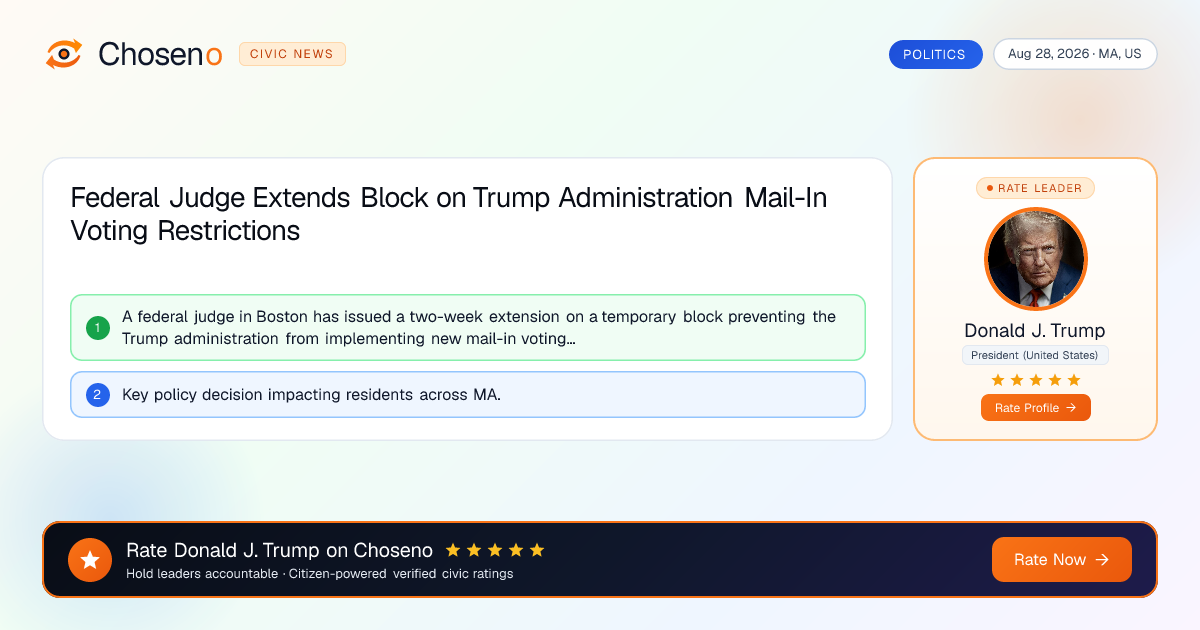
Federal Judge Extends Block on Trump Administration Mail-In Voting Restrictions
A federal judge in Boston has issued a two-week extension on a temporary block preventing the Trump administration from implementing new mail-in voting restrictions. This judicial intervention maintains current election procedures, impacting administrative costs and operational planning for state election officials ahead of the November midterms.
Read full article
Politics
US Aug 28, 2026
U.S. Central Command Confirms Removal of Iranian Sea Mines in Strait of Hormuz
The U.S. military has successfully cleared all Iranian sea mines from established international transit routes within the Strait of Hormuz. This operation aims to restore maritime security in a critical global trade corridor, though the specific financial costs of the deployment have not been disclosed.
Read full article