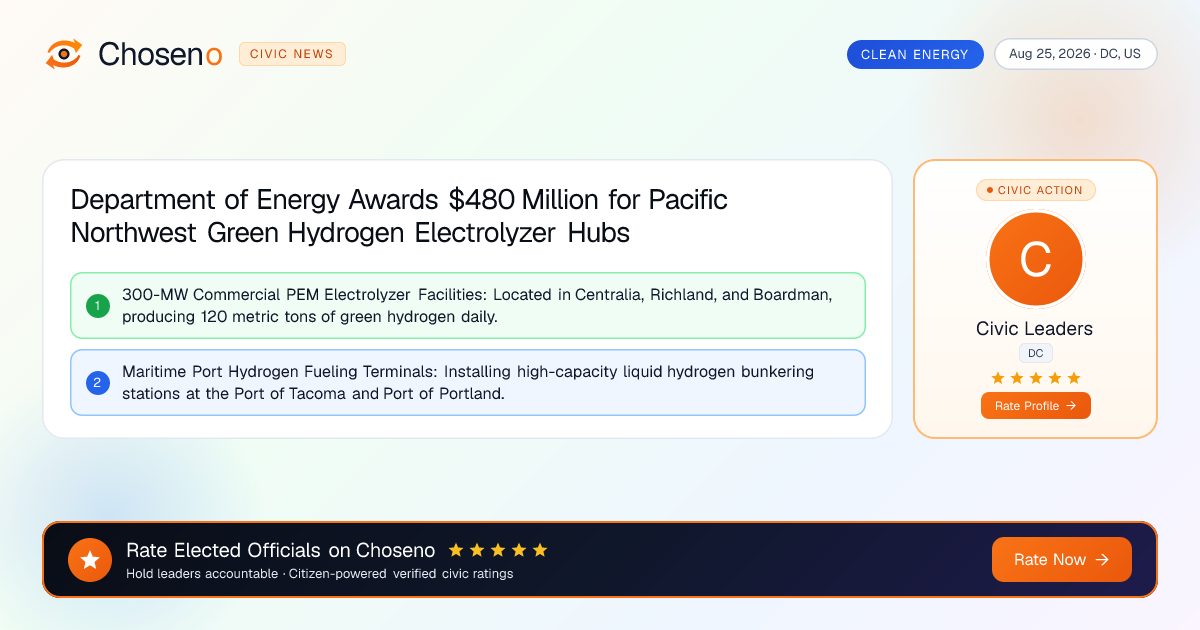
Department of Energy Awards $480 Million for Pacific Northwest Green Hydrogen Electrolyzer Hubs
Energy Secretary Jennifer Granholm awards $480 million to construct multi-megawatt green hydrogen production facilities powered by renewable hydro and wind energy in Washington and Oregon.
Choseno Federal Energy Desk August 25, 2026 2 min read DC, US
★ Choseno Civic Briefing
Key Leaders
RICHLAND, Wash. — Secretary of Energy Jennifer Granholm announced on Monday the distribution of $480 million in Phase 1 implementation grants through the Regional Clean Hydrogen Hubs Program (H2Hubs) to construct commercial-scale green hydrogen production electrolyzers, cryogenic storage terminals, and industrial pipeline manifolds across the Pacific Northwest Hydrogen Hub (PNW H2) in Washington, Oregon, and Montana.
The regional hub, managed in partnership with public utility districts, tribal nations, and industrial manufacturers, utilizes low-cost zero-carbon hydroelectricity from the Columbia River basin and regional wind energy to power 300 megawatts of Proton Exchange Membrane (PEM) electrolyzers, manufacturing zero-emission green hydrogen for heavy transportation, clean fertilizer production, and maritime vessels.
Decarbonizing Heavy Industry and Maritime Shipping Heavy industries—including chemical refining, agricultural fertilizer synthesis, and maritime cargo shipping—cannot practically be electrified with batteries alone, requiring high-energy-density green hydrogen molecules to displace fossil fuels.
"The Pacific Northwest has some of the cleanest electricity on earth, and we are harnessing that clean energy to lead the global green hydrogen revolution," Secretary Jennifer Granholm said at the Pacific Northwest National Laboratory in Richland. "This $480 million investment puts clean hydrogen production to work in heavy manufacturing, ports, and long-haul trucking, cleaning up our air, creating thousands of high-wage union energy careers, and establishing America as the clean fuel capital of the world."
Hub Infrastructure Allocations The $480 million award finances:
- 300-MW Commercial PEM Electrolyzer Facilities: Located in Centralia, Richland, and Boardman, producing 120 metric tons of green hydrogen daily.
- Maritime Port Hydrogen Fueling Terminals: Installing high-capacity liquid hydrogen bunkering stations at the Port of Tacoma and Port of Portland.
- Agricultural Ammonia Production Conversion: Retrofitting regional chemical fertilizer plants to synthesize zero-carbon green ammonia from electrolytic hydrogen.
Building trades unions, tribal council leaders, and regional utility executives commended the federal awards, highlighting that green hydrogen infrastructure provides high-wage careers in rural industrial communities.
Related Coverage in Clean Energy
See all Clean Energy newsClean Energy
US Aug 25, 2026
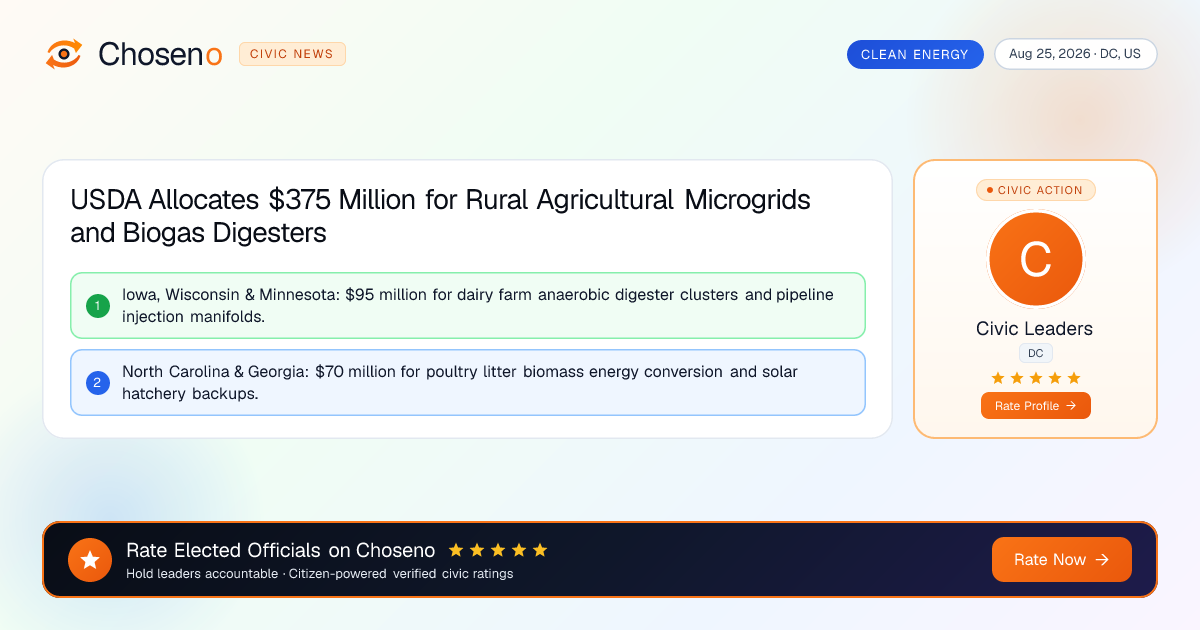
USDA Allocates $375 Million for Rural Agricultural Microgrids and Biogas Digesters
Agriculture Secretary Tom Vilsack awards $375 million through the Rural Energy for America Program to construct on-farm anaerobic methane digesters and solar-battery microgrids across 600 rural dairy and crop farms.
Read full article
Clean Energy
CA Aug 25, 2026
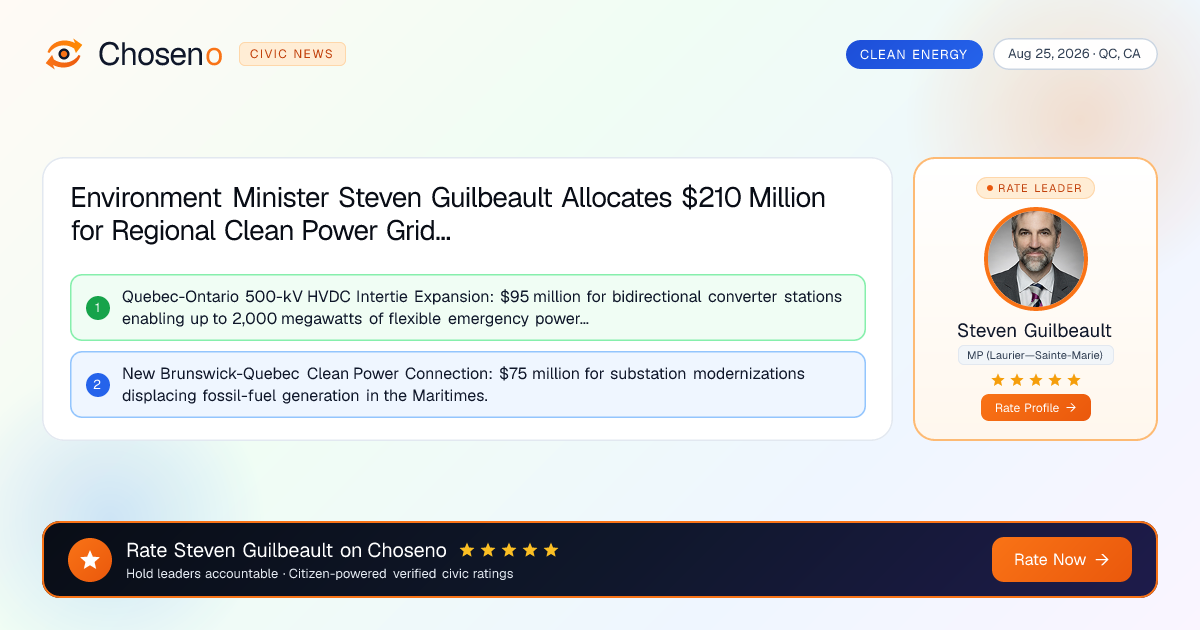
Environment Minister Steven Guilbeault Allocates $210 Million for Regional Clean Power Grid Interconnections
Environment Minister Steven Guilbeault announces $210 million under the Smart Renewables and Electrification Pathways Program to construct interprovincial clean transmission interties connecting Quebec, Ontario, and New Brunswick.
Read full article
Clean Energy
CA Aug 25, 2026
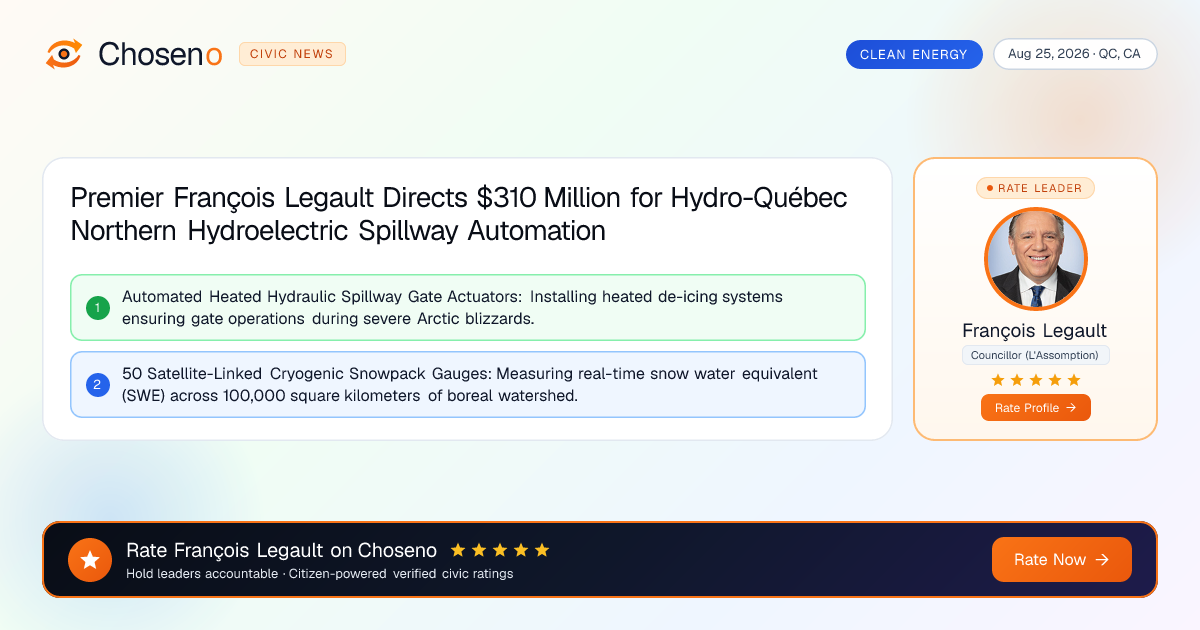
Premier François Legault Directs $310 Million for Hydro-Québec Northern Hydroelectric Spillway Automation
Quebec Premier François Legault and Economy Minister Pierre Fitzgibbon announce a $310 million capital contract through Hydro-Québec to automate remote flood spillway gates and install AI water level sensors at the Caniapiscau Reservoir.
Read full article