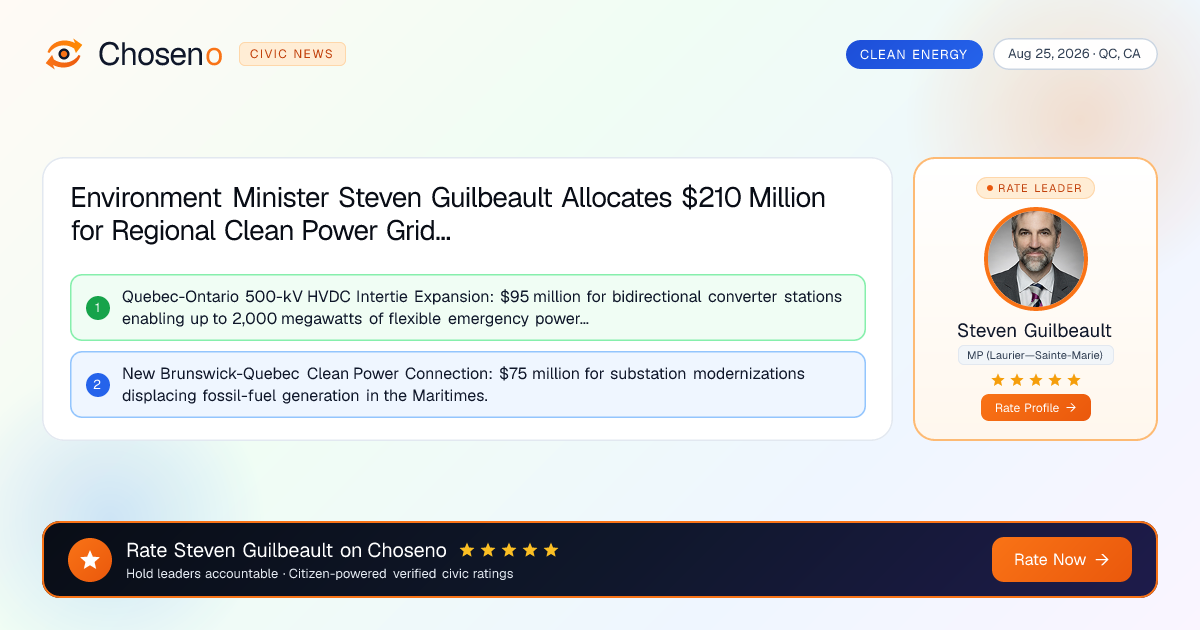
Environment Minister Steven Guilbeault Allocates $210 Million for Regional Clean Power Grid Interconnections
Environment Minister Steven Guilbeault announces $210 million under the Smart Renewables and Electrification Pathways Program to construct interprovincial clean transmission interties connecting Quebec, Ontario, and New Brunswick.
Choseno Environmental Policy Desk August 25, 2026 2 min read QC, CA
★ Choseno Civic Briefing
Key Leaders
MONTREAL — Minister of Environment and Climate Change Steven Guilbeault announced on Monday the distribution of $210 million in federal clean grid investments through the Smart Renewables and Electrification Pathways Program (SREPs) to engineer and construct high-voltage direct current (HVDC) converter substations and bidirectional regional transmission interties connecting the provincial electrical grids of Quebec, Ontario, and New Brunswick.
The interprovincial transmission expansion enables the dynamic bilateral exchange of zero-emission electricity, allowing Quebec's immense hydroelectric reservoir storage to back up Ontario's nuclear and wind generation, while transmitting clean power eastward to eliminate coal and heavy oil generation in Atlantic Canada.
Connecting Canadian Grids to Achieve a 100% Net-Zero Electricity System Canada's electricity grid is historically fragmented into east-west provincial silos with greater transmission capacity flowing south to the United States than between neighboring provinces. Building robust interprovincial interties allows regions with abundant hydro storage to act as natural clean batteries for neighboring provinces.
"Canada is blessed with some of the cleanest electricity resources on earth, but we must connect our provinces so clean power can flow wherever and whenever it is needed," Minister Steven Guilbeault said in Montreal. "By investing $210 million into interprovincial transmission lines and smart grid substations, we are creating a united, resilient Canadian clean energy grid that lowers household electricity bills, phases out polluting fossil fuels, and powers our clean industrial economy with reliable, made-in-Canada electricity."
Regional Grid Interconnection Projects Funded The $210 million package finances:
- Quebec-Ontario 500-kV HVDC Intertie Expansion: $95 million for bidirectional converter stations enabling up to 2,000 megawatts of flexible emergency power transfers.
- New Brunswick-Quebec Clean Power Connection: $75 million for substation modernizations displacing fossil-fuel generation in the Maritimes.
- Automated Smart Grid Dynamic Line Rating Sensors: $40 million to install real-time transmission line thermal sensors maximizing current capacity across interprovincial boundaries.
Provincial utility executives, renewable energy developers, and electrical engineering federations commended the federal investment, highlighting that regional grid integration is the most cost-effective path to achieving deep national decarbonization.
Rate the people mentioned in this article

Related Coverage in Clean Energy
See all Clean Energy newsClean Energy
US Aug 25, 2026
Department of Energy Directs $420 Million for Mid-Atlantic Subsea HVDC Offshore Grid Interties
Energy Secretary Jennifer Granholm and the Department of Energy announce $420 million in Grid Resilience and Innovation Grants to construct high-voltage direct current (HVDC) subsea transmission links connecting offshore wind leases off New Jersey, New York, and Delaware to the PJM regional grid.
Read full article
Clean Energy
US Aug 25, 2026
Mayor Michelle Wu Directs $60 Million for Boston Public Schools Solar and Heat Pump Retrofits
Boston Mayor Michelle Wu and City Council authorize $60 million from the municipal capital budget to install commercial rooftop solar arrays, high-efficiency geothermal heat pumps, and modern ventilation systems across 20 public school buildings.
Read full article
Clean Energy
US Aug 25, 2026
Governor Jay Inslee Directs $170 Million for Hybrid-Electric Puget Sound Ferries
Washington Governor Jay Inslee and WSDOT allocate $170 million in Climate Commitment Act revenue to build two 144-car hybrid-electric passenger-vehicle ferries and install rapid shore-charging terminals across Puget Sound.
Read full article