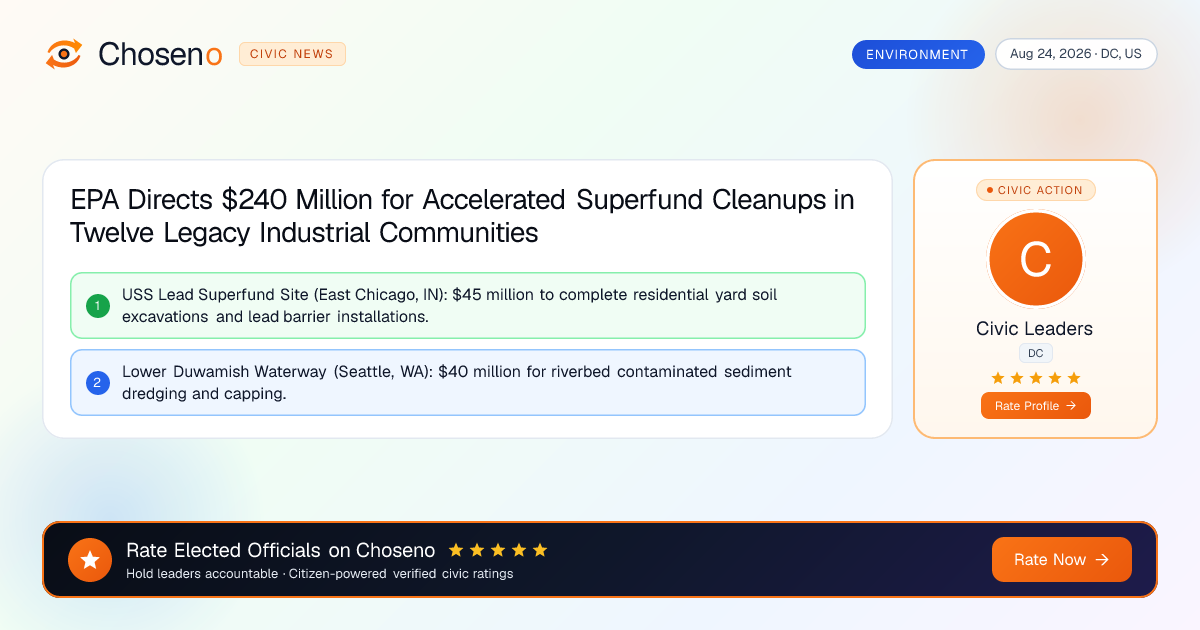
EPA Directs $240 Million for Accelerated Superfund Cleanups in Twelve Legacy Industrial Communities
Environmental Protection Agency Administrator Michael Regan allocates $240 million from the Bipartisan Infrastructure Law to clean up contaminated soil, lead smelter slag, and toxic groundwater plumes at twelve high-priority Superfund sites.
Choseno Environmental Policy Desk August 24, 2026 2 min read DC, US
★ Choseno Civic Briefing
Key Leaders
WASHINGTON — Environmental Protection Agency (EPA) Administrator Michael Regan announced on Monday the distribution of $240 million in federal infrastructure funding to initiate and accelerate physical environmental remediation across twelve long-neglected National Priorities List (Superfund) toxic waste sites.
The investments, financed through reinstated chemical excise taxes under the Bipartisan Infrastructure Law, target historic lead smelters, chemical manufacturing dumps, and abandoned wood treatment facilities located in historically disadvantaged communities across ten states.
Eliminating Generational Toxic Exposure for 500,000 Residents More than 500,000 Americans live within one mile of the twelve funded sites, where toxic heavy metals such as arsenic, lead, polychlorinated biphenyls (PCBs), and trichloroethylene (TCE) have contaminated residential backyards and municipal drinking water aquifers for decades.
"No community in America should have to live in the shadow of toxic industrial pollution left behind by corporate polluters," EPA Administrator Michael Regan said during an announcement in East Chicago, Indiana. "With this $240 million investment, we are putting heavy excavation equipment to work to remove hundreds of thousands of tons of contaminated soil, clean up local groundwater, and return blighted industrial properties back to productive community and economic use."
High-Priority Remediation Sites Funded Major project allocations include:
- USS Lead Superfund Site (East Chicago, IN): $45 million to complete residential yard soil excavations and lead barrier installations.
- Lower Duwamish Waterway (Seattle, WA): $40 million for riverbed contaminated sediment dredging and capping.
- Diamond Head Oil Refinery (Kearny, NJ): $30 million for deep chemical stabilization and groundwater extraction wells.
- Tar Creek Superfund Site (Ottawa County, OK): $35 million for chat pile excavation and wetland restoration.
- Eight additional industrial sites in Alabama, Missouri, Ohio, Pennsylvania, and Texas receiving between $10 million and $25 million.
Local mayors, environmental justice organizers, and public health physicians praised the funding, noting that Superfund remediation directly lowers childhood blood lead levels and unlocks downtown economic redevelopment.
Related Coverage in Environment
See all Environment newsEnvironment
US Aug 25, 2026
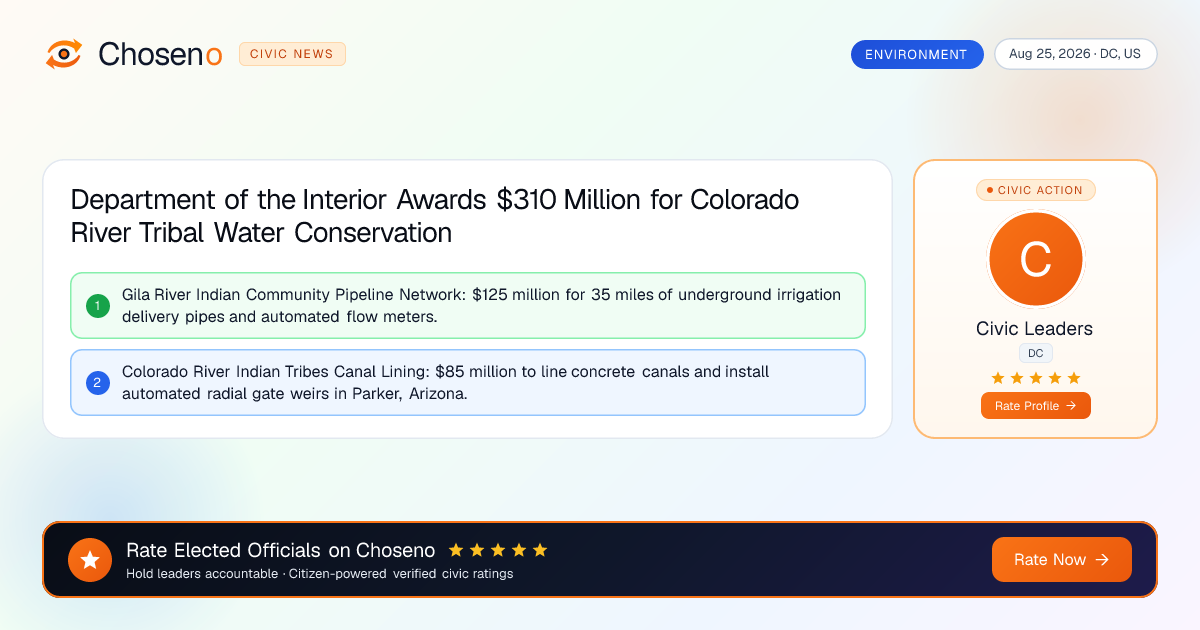
Department of the Interior Awards $310 Million for Colorado River Tribal Water Conservation
Interior Secretary Deb Haaland directs $310 million in Inflation Reduction Act funds to construct closed-pipe irrigation systems and groundwater storage facilities across five Colorado River Indian tribes in Arizona and California.
Read full article
Environment
US Aug 25, 2026
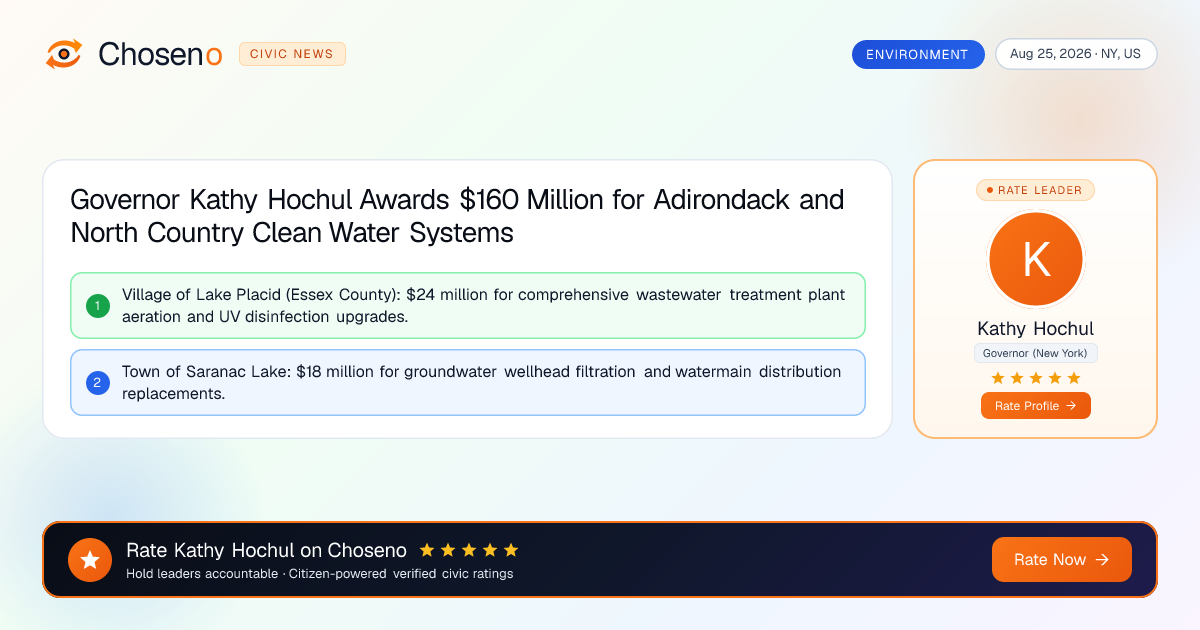
Governor Kathy Hochul Awards $160 Million for Adirondack and North Country Clean Water Systems
New York Governor Kathy Hochul directs $160 million in state clean water grants to construct advanced wastewater treatment plants and drinking water filtration facilities across twenty-two North Country and Adirondack communities.
Read full article
Environment
CA Aug 25, 2026
Premier David Eby Allocates $130 Million for Indigenous-Led Wild Salmon Watershed Restoration
British Columbia Premier David Eby and Water Minister Nathan Cullen announce $130 million from the BC Salmon Restoration and Innovation Fund to remove 300 fish passage barrier culverts and restore vital spawning rivers.
Read full article