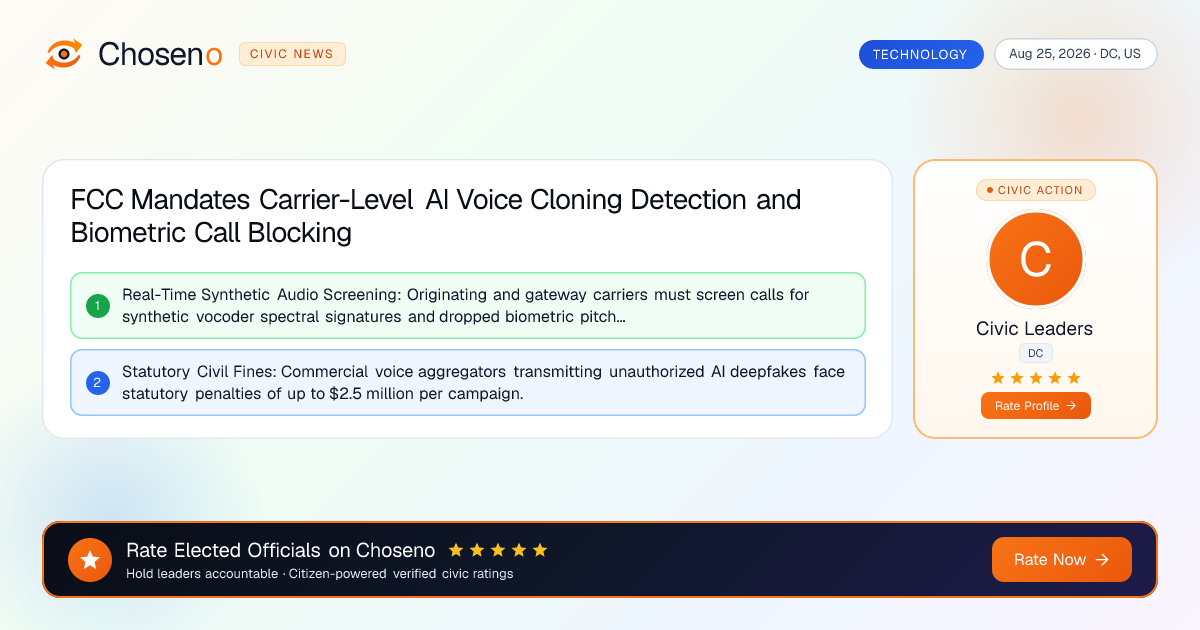
FCC Mandates Carrier-Level AI Voice Cloning Detection and Biometric Call Blocking
Federal Communications Commission Chair Jessica Rosenworcel issues a binding regulatory order requiring telecommunications carriers to deploy real-time acoustic AI voice-cloning detection algorithms on public switched networks.
Choseno Federal Communications Bureau August 25, 2026 2 min read DC, US
★ Choseno Civic Briefing
Key Leaders
WASHINGTON — Federal Communications Commission (FCC) Chair Jessica Rosenworcel announced on Monday the formal adoption of a landmark regulatory order requiring all major telecommunications carriers, VoIP providers, and intermediate gateway operators to deploy real-time machine learning algorithms to detect and block synthetic AI-generated voice clones, unauthorized deepfakes, and spoofed biometric audio across the public switched telephone network.
The regulatory mandate expands the FCC's STIR/SHAKEN call authentication framework, directing carriers to analyze packet-level acoustic telemetry at ingress gateways to identify synthetic audio artifacts and instantly drop deceptive calls before they reach consumer handsets.
Protecting Americans from Weaponized AI Impersonation Scams Surging advancements in generative voice cloning software allow fraudsters to replicate a family member's or public official's voice using as little as three seconds of audio scraped from social media, resulting in hundreds of millions in financial losses through grandparent extortion scams and fraudulent financial transfers.
"Artificial intelligence voice cloning has weaponized robocalls, turning telephone fraud into an intimate, terrifying scam that targets our most vulnerable seniors and families," FCC Chair Jessica Rosenworcel said in Washington. "Today's binding order requires telephone carriers to put carrier-grade acoustic AI defenses on their networks to detect synthetic voice artifacts in real time, drop fraudulent deepfake calls before phones ring, and hold bad actors accountable under federal law."
Key Regulatory Enforcement Provisions Under the finalized FCC order:
- Real-Time Synthetic Audio Screening: Originating and gateway carriers must screen calls for synthetic vocoder spectral signatures and dropped biometric pitch cues.
- 24-Hour Mandatory Gateway Disconnection: Requiring tier-1 carriers to sever network interconnects with upstream providers originating unauthenticated synthetic voice traffic within 24 hours of notification.
- Statutory Civil Fines: Commercial voice aggregators transmitting unauthorized AI deepfakes face statutory penalties of up to $2.5 million per campaign.
Consumer advocacy groups, cybersecurity researchers, and state attorneys general praised the FCC's decisive rules, noting that network-level filtering stops automated scams before vulnerable consumers can be deceived.
Related Coverage in Technology
See all Technology newsTechnology
US Aug 25, 2026
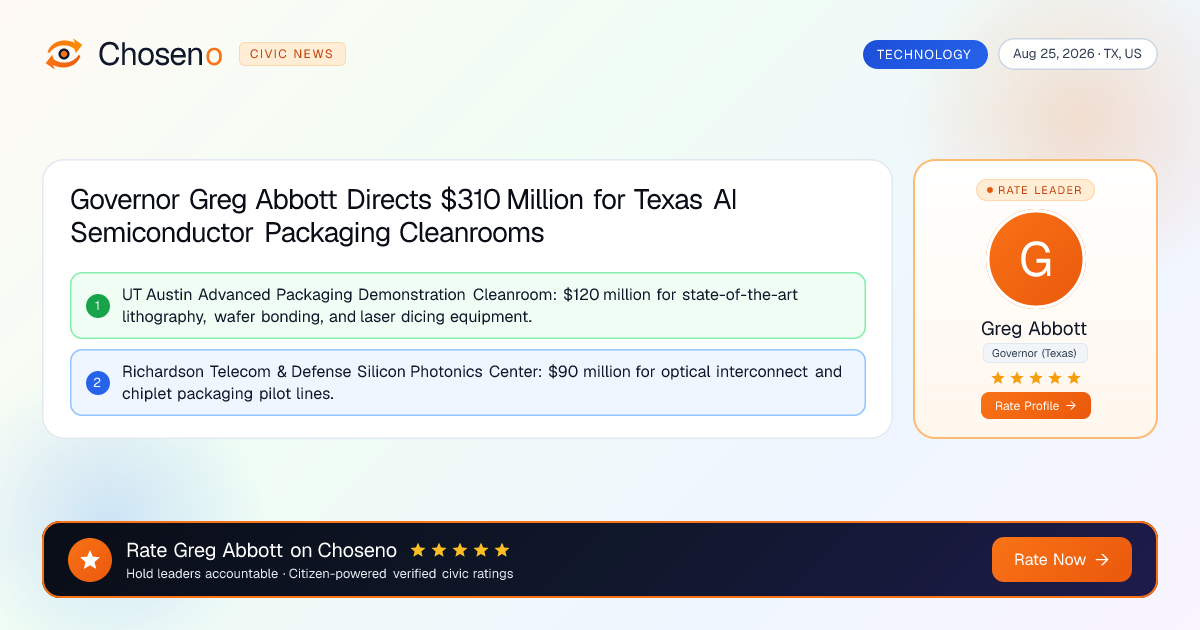
Governor Greg Abbott Directs $310 Million for Texas AI Semiconductor Packaging Cleanrooms
Texas Governor Greg Abbott and the Texas CHIPS Act Executive Committee allocate $310 million from the Texas Semiconductor Innovation Fund to construct advanced 2.5D/3D packaging cleanrooms and silicon photonics labs in Austin and Dallas.
Read full article
Technology
US Aug 25, 2026
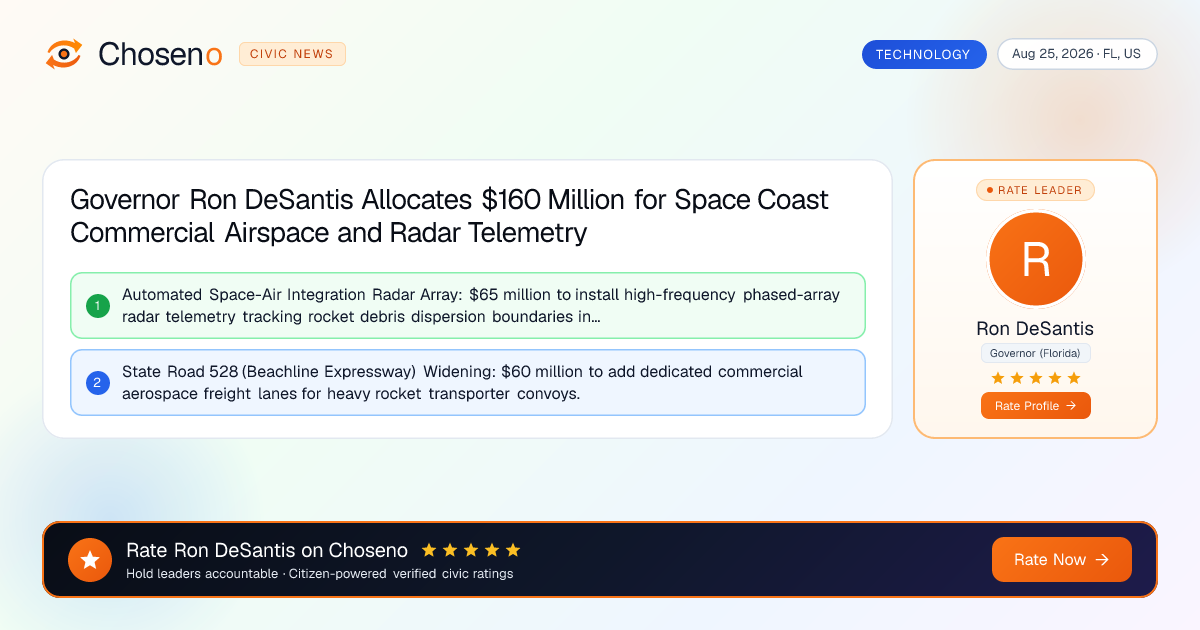
Governor Ron DeSantis Allocates $160 Million for Space Coast Commercial Airspace and Radar Telemetry
Florida Governor Ron DeSantis and FDOT announce $160 million to deploy automated Space-Air Integration radar networks and widen state aerospace transit highways connecting Orlando and Cape Canaveral.
Read full article
Technology
US Aug 25, 2026
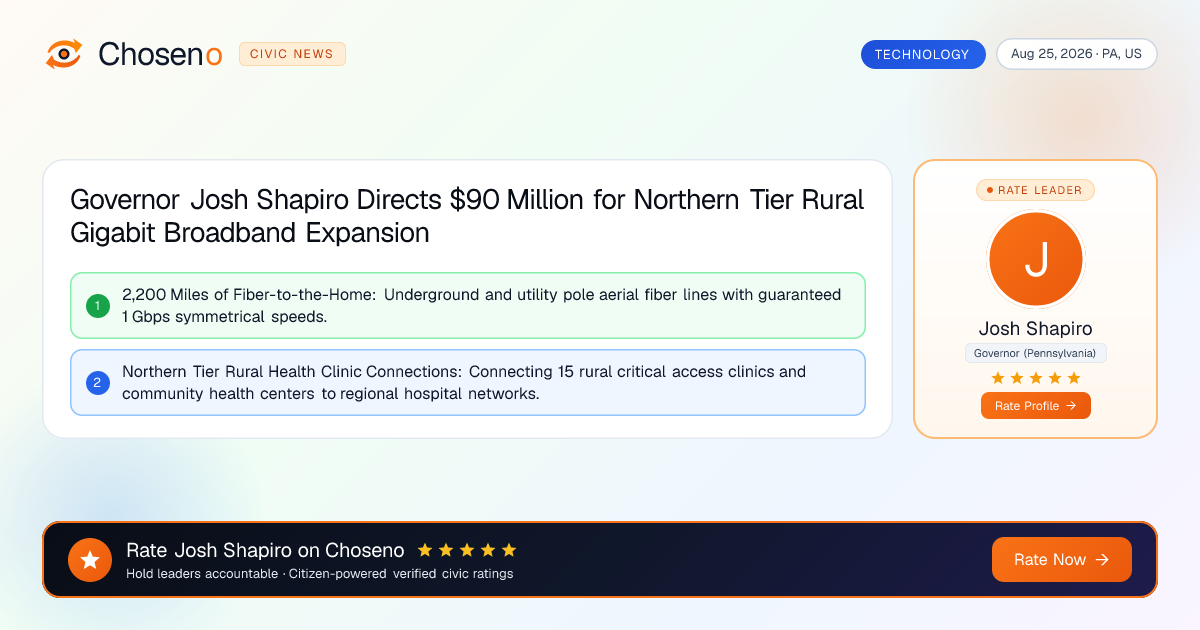
Governor Josh Shapiro Directs $90 Million for Northern Tier Rural Gigabit Broadband Expansion
Pennsylvania Governor Josh Shapiro and the Pennsylvania Broadband Development Authority announce $90 million in capital grants to construct 2,200 miles of fiber-optic broadband across Bradford, Tioga, Potter, and Susquehanna Counties.
Read full article