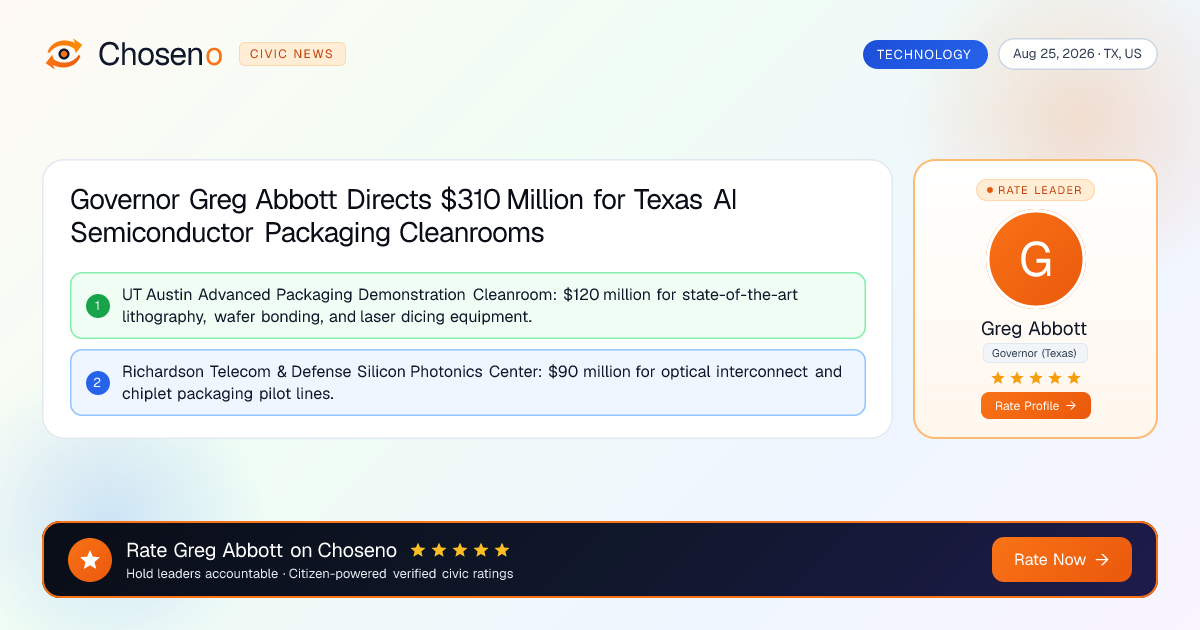
Governor Greg Abbott Directs $310 Million for Texas AI Semiconductor Packaging Cleanrooms
Texas Governor Greg Abbott and the Texas CHIPS Act Executive Committee allocate $310 million from the Texas Semiconductor Innovation Fund to construct advanced 2.5D/3D packaging cleanrooms and silicon photonics labs in Austin and Dallas.
Choseno Texas Politics Desk August 25, 2026 2 min read TX, US
★ Choseno Civic Briefing
Key Leaders
AUSTIN, Texas — Governor Greg Abbott and the Texas Semiconductor Innovation Consortium (TSIC) announced on Monday the distribution of $310 million in state capital matching grants through the Texas CHIPS Act to construct advanced 2.5D and 3D heterogeneous semiconductor packaging facilities, silicon photonics pilot lines, and specialized chiplet testing cleanrooms in Austin, Richardson, and Sherman.
The investment, matched by over $1.2 billion in private semiconductor capital, establishes the domestic backend manufacturing capacity required to assemble advanced artificial intelligence accelerators, high-bandwidth memory (HBM), and defense-grade microelectronics entirely within Texas.
Completing the Entire Semiconductor Supply Chain in the Silicon Hills While Texas is home to leading semiconductor wafer fabrication mega-sites for Samsung, Texas Instruments, and NXP, advanced packaging—where microscopic silicon dies are interconnected onto silicon interposers—has historically been concentrated overseas in East Asia.
"Texas is the semiconductor capital of the United States, and we are ensuring that the entire microchip supply chain—from initial design and raw silicon fabrication to advanced packaging and testing—happens right here in the Lone Star State," Governor Abbott said during an announcement at the University of Texas at Austin Microelectronics Research Center. "This $310 million investment secures American technological dominance in artificial intelligence, protects our national security, and creates thousands of high-wage engineering and manufacturing jobs for Texans."
Semiconductor Innovation Awards The $310 million program includes:
- UT Austin Advanced Packaging Demonstration Cleanroom: $120 million for state-of-the-art lithography, wafer bonding, and laser dicing equipment.
- Richardson Telecom & Defense Silicon Photonics Center: $90 million for optical interconnect and chiplet packaging pilot lines.
- Sherman & Austin Semiconductor Workforce Consortium: $60 million partnering with Texas State Technical College and community colleges to train 2,500 cleanroom technicians.
- University Innovation Grants: $40 million for semiconductor materials research at Texas A&M and UT Dallas.
Semiconductor industry CEOs, university chancellors, and building trades unions commended the state investment, emphasizing that domestic packaging capability secures critical AI hardware supply chains.
Rate the people mentioned in this article
Related Coverage in Technology
See all Technology newsTechnology
US Aug 25, 2026
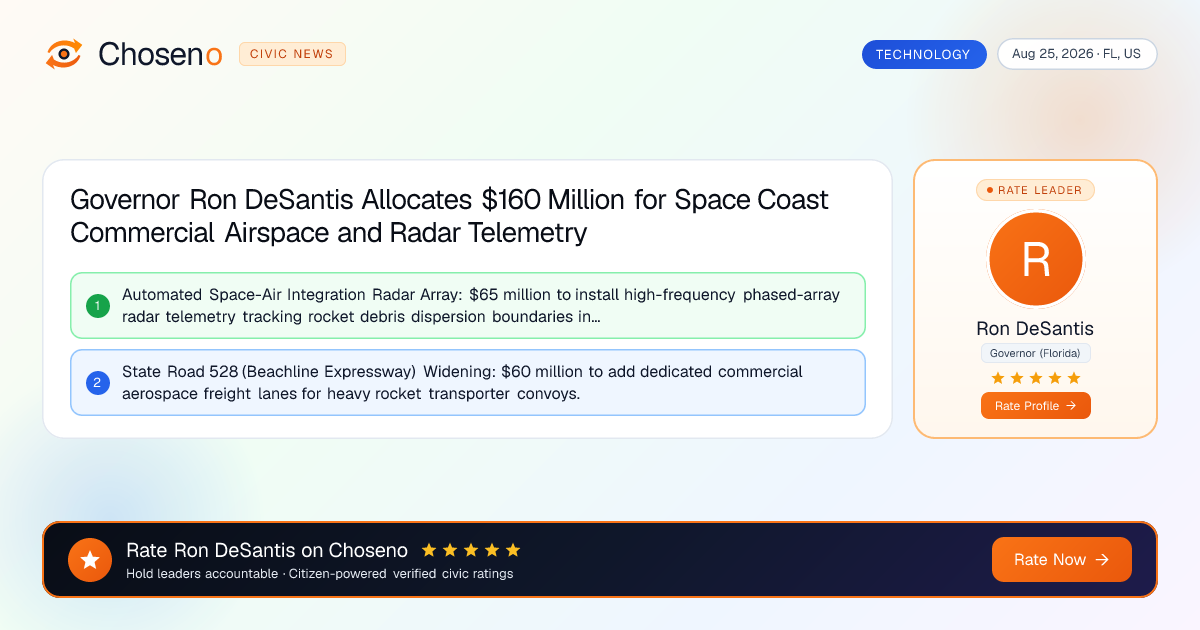
Governor Ron DeSantis Allocates $160 Million for Space Coast Commercial Airspace and Radar Telemetry
Florida Governor Ron DeSantis and FDOT announce $160 million to deploy automated Space-Air Integration radar networks and widen state aerospace transit highways connecting Orlando and Cape Canaveral.
Read full article
Technology
US Aug 25, 2026
Governor Josh Shapiro Directs $90 Million for Northern Tier Rural Gigabit Broadband Expansion
Pennsylvania Governor Josh Shapiro and the Pennsylvania Broadband Development Authority announce $90 million in capital grants to construct 2,200 miles of fiber-optic broadband across Bradford, Tioga, Potter, and Susquehanna Counties.
Read full article

Technology
CA Aug 25, 2026
Industry Minister François-Philippe Champagne Directs $320 Million for Canadian AI Safety Institute and Supercomputing Compute
Innovation Minister François-Philippe Champagne announces $320 million from the AI Compute Access Fund to finance sovereign high-performance AI supercomputers and establish the Canadian Artificial Intelligence Safety Institute in Montreal and Toronto.
Read full article