BREAKING
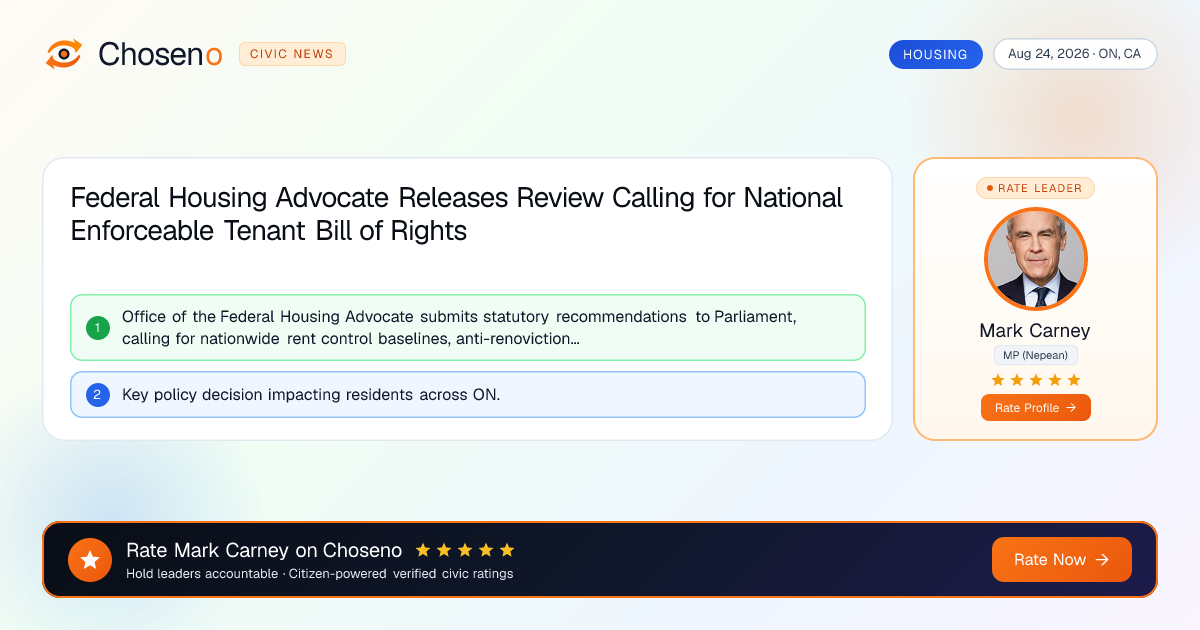
Federal Housing Advocate Releases Review Calling for National Enforceable Tenant Bill of Rights
Office of the Federal Housing Advocate submits statutory recommendations to Parliament, calling for nationwide rent control baselines, anti-renoviction penalties, and a federal tenant ombudsperson.
Choseno National Housing & Human Rights Desk August 24, 2026 1 min read ON, CA
★ Choseno Civic Briefing
Key Leaders
OTTAWA, ON — The Office of the Federal Housing Advocate formally delivered its 2026 Statutory Review to Parliament, urging the Government of Canada to condition federal housing infrastructure transfers on provincial adoption of a binding, enforceable Canadian Renters' Bill of Rights.
Establishing National Standards for Tenant Protections
The advocate's report recommends tying Canada Housing Infrastructure Fund grants to provincial commitments that mandate standard lease agreements, require transparent nationwide rent registry portals to track historic unit prices, and establish severe financial penalties for bad-faith 'renovictions' and landlord-use evictions. The statutory report also calls for the creation of a Federal Tenant Ombudsperson to investigate systemic human rights violations in institutional corporate-owned rental portfolios.
Federal Housing Advocate Marie-Josée Houle stated that housing is a fundamental human right recognized under Canadian law, requiring national standards to protect tenants from predatory financialization and unlawful displacement.
Tenant Rights Federations and Landlord Perspectives
ACORN Canada and the Canadian Housing and Renewal Association (CHRA) strongly endorsed the advocate's recommendations, highlighting that millions of Canadian renters spend over 50% of income on shelter.
Provincial rental housing provider associations argued that rent control baselines should remain under provincial jurisdiction to encourage private rental construction.
Parliamentary Committee Review
The House of Commons Standing Committee on Human Resources and Housing will review the advocate’s findings in October 2026.
Rate the people mentioned in this article

Related Coverage in Housing
See all Housing newsHousing
CA Aug 24, 2026
Mayor Olivia Chow and Federal Housing Ministers Announce $140 Million Infill Rental Acceleration
Toronto City Council and federal infrastructure agencies deploy $140 million in housing accelerator funds to fast-track 2,200 non-profit and co-op rental apartments on municipal lands.
Read full article

Housing
US Aug 24, 2026
Hawaiʻi County Council Enacts Bill 157 Establishing Emergency Housing Reconstruction Standards
Hawaiʻi County Council votes 9–0 to pass Bill 157, waiving building permit fees and establishing fast-track structural replacement rules for homes damaged by tropical storm flooding.
Read full article

Housing
US Aug 24, 2026
Governor Josh Green Issues Emergency Proclamation Unlocking $25 Million in Housing Relief Grants
Hawaii Governor Josh Green enacts an Emergency Proclamation, mobilizing $25 million in state emergency funds to provide direct rental assistance and property stabilization grants for displaced families.
Read full article