Mayor Olivia Chow and Federal Housing Ministers Announce $140 Million Infill Rental Acceleration
Toronto City Council and federal infrastructure agencies deploy $140 million in housing accelerator funds to fast-track 2,200 non-profit and co-op rental apartments on municipal lands.
Choseno Urban Affairs Bureau August 24, 2026 1 min read ON, CA

★ Choseno Civic Briefing
Key Leaders
TORONTO, ON — Toronto Mayor Olivia Chow joined federal housing representatives to announce a $140 million capital funding agreement under the Housing Accelerator Fund, expediting construction on five municipally owned surplus land parcels.
Dedicated Non-Profit and Co-Op Rental Housing
The initiative will deliver 2,200 purpose-built rental apartments across Scarborough, Etobicoke, and downtown transit nodes, with 40% permanently designated as deeply affordable units for seniors and working families. Mayor Chow highlighted that leveraging city-owned parking lots and transit hubs cuts development timeline delays by up to 18 months.
Mayor Chow emphasized that building non-profit and public-backed housing is essential to restoring affordability for Toronto workers who are being priced out of the urban core.
Council Approvals and Development Deadlines
Toronto City Council approved zoning amendments exempting non-profit builders from municipal development charges for projects completed within 24 months.
Non-profit housing federations praised the elimination of municipal development fees.
Groundbreaking Milestones
Site preparation on the first two residential sites at Victoria Park and Bloor West begins in October 2026.
Rate the people mentioned in this article

Related Coverage in Housing
See all Housing newsHousing Breaking
US Aug 24, 2026
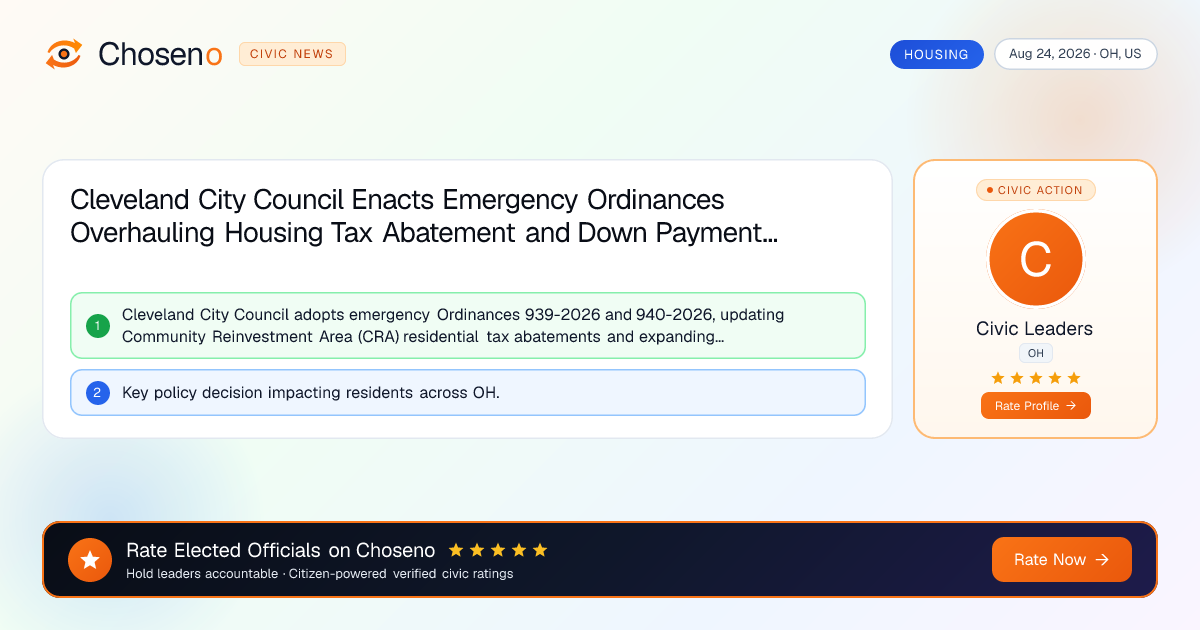
Cleveland City Council Enacts Emergency Ordinances Overhauling Housing Tax Abatement and Down Payment Grants
Cleveland City Council adopts emergency Ordinances 939-2026 and 940-2026, updating Community Reinvestment Area (CRA) residential tax abatements and expanding homebuyer construction gap grants.
Read full article
Housing
US Aug 24, 2026
San Jose City Council Advances Policy Overhaul to Accelerate 25,000 Transit-Oriented Homes
San Jose City Council approves the Urban Village Growth Framework, upzoning low-density commercial strip malls along VTA light rail lines to accommodate 25,000 multi-family homes.
Read full article

Housing
CA Aug 24, 2026
Edmonton City Council Passes Housing Bylaws 21532, 21533, and 21563 for Mixed-Use Urban Infill
Edmonton City Council enacts three land-use zoning bylaws unlocking medium-scale housing, pocket parklands, and transit-connected mixed-use density in Clareview and Gorman.
Read full article