Former South Carolina Governor David Beasley Launches 'Breaking Bread Together' Initiative to Address National Political Divide
Former South Carolina Governor and Nobel laureate David Beasley launched 'Breaking Bread Together,' a national civic initiative partnering with local community organizations to bridge deepening political polarization through structured community meals and dialogue.
Choseno Civic News Desk September 5, 2026 2 min read US
COLUMBIA, S.C. — Warning that toxic partisanship and social fragmentation pose acute threats to the stability of American democratic institutions, former South Carolina Governor David Beasley announced the national rollout of a non-partisan civic campaign titled "Breaking Bread Together" on September 4 in Columbia.
The initiative, organized in collaboration with regional non-profits, faith-based congregations, community colleges, and municipal civic associations, seeks to convene structured community dinners uniting registered Democrats, Republicans, and non-affiliated independent voters in open dialogue. By encouraging participants to share family perspectives and discuss local policy concerns around communal tables, the project aims to counter pervasive mutual distrust and foster constructive neighborhood problem-solving.
Beasley, who served as South Carolina's 113th governor from 1995 to 1999 before serving as the Executive Director of the United Nations World Food Programme—accepting the 2020 Nobel Peace Prize on behalf of the agency—pointed to recent social research documenting historic levels of affective polarization across the United States. Survey data from the Pew Research Center indicates that majorities of both major political parties view members of the opposing party not merely as political rivals with differing legislative views, but as dishonest, morally compromised, and actively hostile to democratic norms.
"Throughout decades of public service in South Carolina and in humanitarian crisis zones across the globe, I have seen firsthand that when human beings sit down together to break bread, defensive barriers drop and common humanity emerges," Beasley stated during the announcement in Columbia. "The United States cannot thrive as a healthy republic when neighbors view one another as existential enemies. 'Breaking Bread Together' provides a proven, decentralized framework to rebuild civic friendship, listen with humility, and rediscover shared values across our communities."
The launch comes at a pivotal moment in South Carolina and national politics, where statewide leaders under incumbent Governor Henry McMaster are preparing for mid-decade legislative debates and upcoming national election cycles. While national broadcast media and online algorithms frequently amplify incendiary ideological disputes, municipal leaders across the Palmetto State have expressed support for grassroots efforts that ground public engagement in face-to-face civic relationships.
Organizers confirmed that pilot "Breaking Bread Together" gatherings will launch across South Carolina—including community forums scheduled in Columbia, Greenville, and Charleston—before expanding to partner networks across the Southeast and Midwest later this autumn. Each forum will feature trained facilitators tasked with guiding discussions toward local community priorities, such as public school support, workforce retention, and neighborhood safety, while steering away from national talking points.
Civic leaders praised the initiative as a timely reinvestment in democratic civil society, emphasizing that enduring community solutions require building bridges across political and cultural divides.
Rate the people mentioned in this article

Related Coverage in State & Federal Governance
See all State & Federal Governance newsState & Federal Governance
US Sep 5, 2026
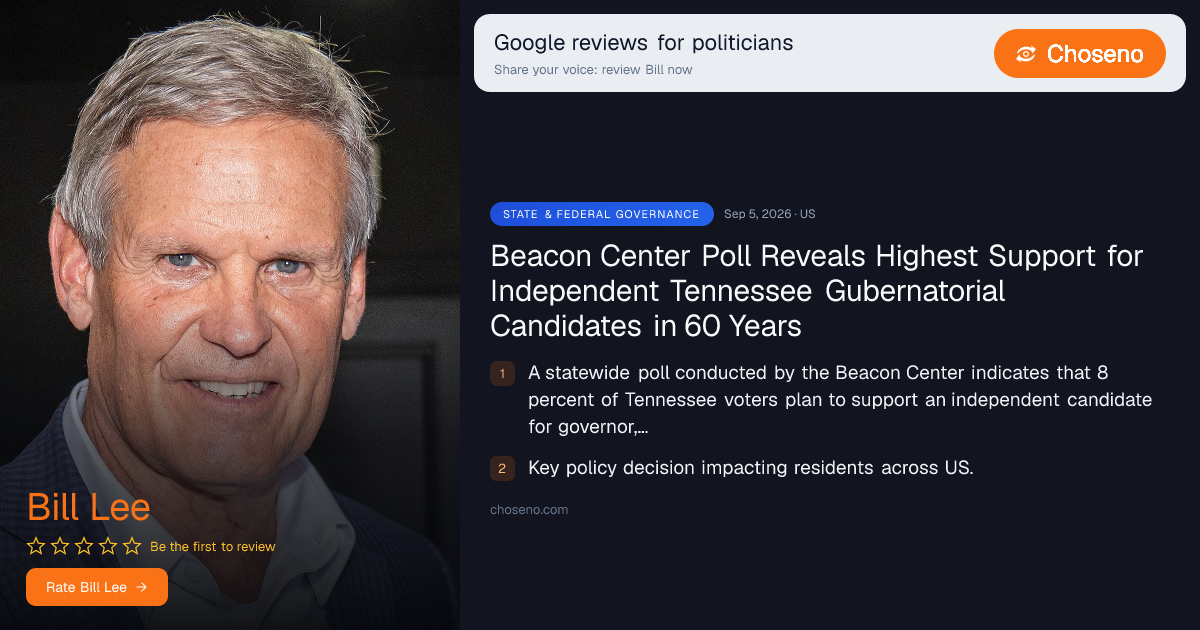
Beacon Center Poll Reveals Highest Support for Independent Tennessee Gubernatorial Candidates in 60 Years
A statewide poll conducted by the Beacon Center indicates that 8 percent of Tennessee voters plan to support an independent candidate for governor, representing the strongest non-major-party support recorded in the state in sixty years as contenders vie to succeed Governor Bill Lee.
Read full article
State & Federal Governance
US Sep 5, 2026
North Dakota Senate Rejects SB 2406 Banning Non-Disclosure Agreements in Municipal Data Center Negotiations
The North Dakota Senate voted 32-15 to reject Senate Bill 2406, preserving the authority of state and municipal economic development officials to utilize non-disclosure agreements during commercial negotiations with artificial intelligence data center developers.
Read full article
State & Federal Governance
US Sep 5, 2026
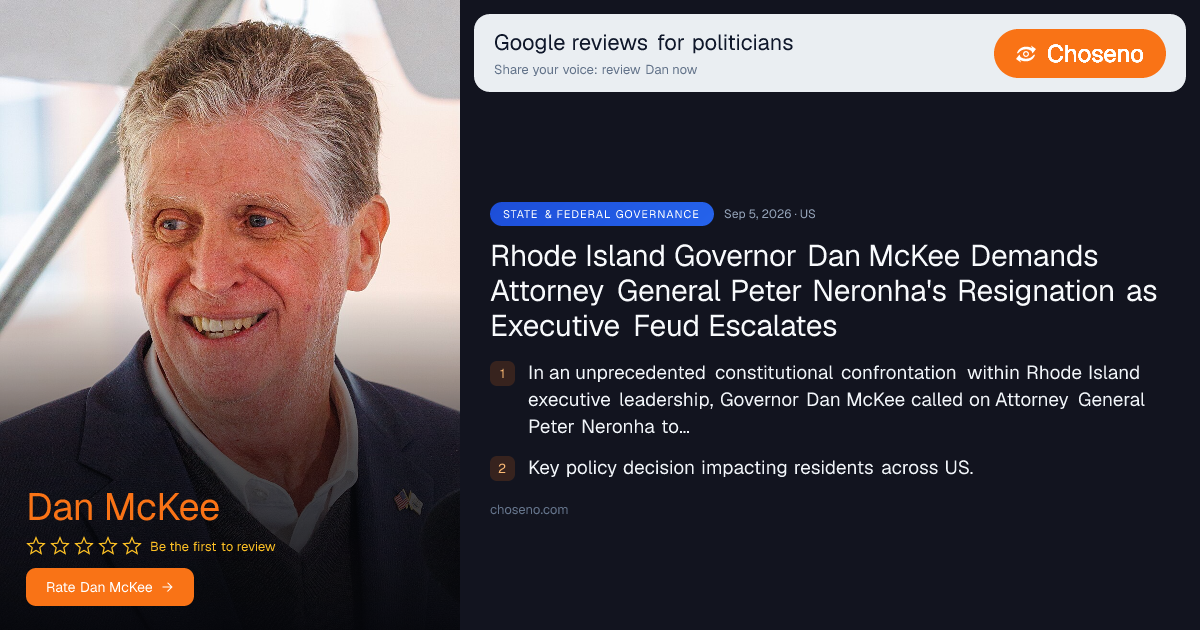
Rhode Island Governor Dan McKee Demands Attorney General Peter Neronha's Resignation as Executive Feud Escalates
In an unprecedented constitutional confrontation within Rhode Island executive leadership, Governor Dan McKee called on Attorney General Peter Neronha to resign immediately, alleging the state's chief legal officer has politicized investigative proceedings ahead of the upcoming primary election.
Read full article