Beacon Center Poll Reveals Highest Support for Independent Tennessee Gubernatorial Candidates in 60 Years
A statewide poll conducted by the Beacon Center indicates that 8 percent of Tennessee voters plan to support an independent candidate for governor, representing the strongest non-major-party support recorded in the state in sixty years as contenders vie to succeed Governor Bill Lee.
Choseno Civic News Desk September 5, 2026 2 min read US
NASHVILLE, Tenn. — In a notable departure from decades of polarized two-party dominance across the Volunteer State, a comprehensive statewide survey released by the Beacon Center of Tennessee shows that approximately 8 percent of registered voters plan to support an independent candidate in the upcoming 2026 gubernatorial election.
According to an analysis published by the Kingsport Times News on September 4, the polling figures represent the highest level of voter backing recorded for independent gubernatorial contenders in Tennessee in sixty years. Historical election archives maintained by the Tennessee Secretary of State indicate that the last time an independent candidate garnered more than 8 percent of the statewide vote was in 1966, an anomalous race in which the absence of a Republican candidate allowed an independent slate to capture 18.8 percent.
The findings arrive as political maneuvering intensifies across East, Middle, and West Tennessee to succeed term-limited Republican Governor Bill Lee. With Governor Lee completing his second four-year term in Nashville, both major parties are anticipating fiercely contested primary contests next year, creating an environment where moderate suburban voters and working-class independents are expressing openness to unaffiliated options.
Researchers at the Beacon Center, a Nashville-based public policy organization, noted that voter appetite for independent alternatives is being driven by compounding voter fatigue with national political polarization, persistent concerns regarding school voucher legislation, and disputes over state infrastructure funding distributions between growing metropolitan hubs and rural counties.
"Tennessee has long functioned as a conservative stronghold, but an 8 percent polling floor for independent candidates suggests meaningful segments of the electorate are looking beyond traditional party labels," political analysts noted in reviewing the survey. "While third-party and independent candidates face steep statutory ballot-access hurdles and immense fundraising disparities compared to major party nominee apparatuses, even a modest independent vote share can alter general election margins in competitive legislative and congressional districts."
The poll examined voter sentiment across key demographic blocs, finding that self-described independents, younger voters, and suburban women exhibited the highest willingness to consider third-party platforms. While potential Republican contenders—including members of Tennessee’s federal congressional delegation—continue to command strong baseline support across rural counties, respondents expressed heightened sensitivity toward state sales tax relief on groceries, property tax assessments, and healthcare infrastructure retention in Appalachian communities.
Democratic strategists, meanwhile, are monitoring the data to determine whether independent candidacies could draw moderate suburban voters away from Democratic nominees or split conservative-leaning voters disillusioned with establishment party structures.
With formal candidate petition deadlines scheduled for early 2026, campaign organizers for multiple independent exploratory committees confirmed plans to begin signature gathering across all 95 Tennessee counties, aiming to qualify for a general election ballot that could feature the most diverse field of candidates in modern state history.
Rate the people mentioned in this article

Related Coverage in State & Federal Governance
See all State & Federal Governance newsState & Federal Governance
US Sep 5, 2026
North Dakota Senate Rejects SB 2406 Banning Non-Disclosure Agreements in Municipal Data Center Negotiations
The North Dakota Senate voted 32-15 to reject Senate Bill 2406, preserving the authority of state and municipal economic development officials to utilize non-disclosure agreements during commercial negotiations with artificial intelligence data center developers.
Read full article
State & Federal Governance
US Sep 5, 2026
Former South Carolina Governor David Beasley Launches 'Breaking Bread Together' Initiative to Address National Political Divide
Former South Carolina Governor and Nobel laureate David Beasley launched 'Breaking Bread Together,' a national civic initiative partnering with local community organizations to bridge deepening political polarization through structured community meals and dialogue.
Read full article
State & Federal Governance
US Sep 5, 2026
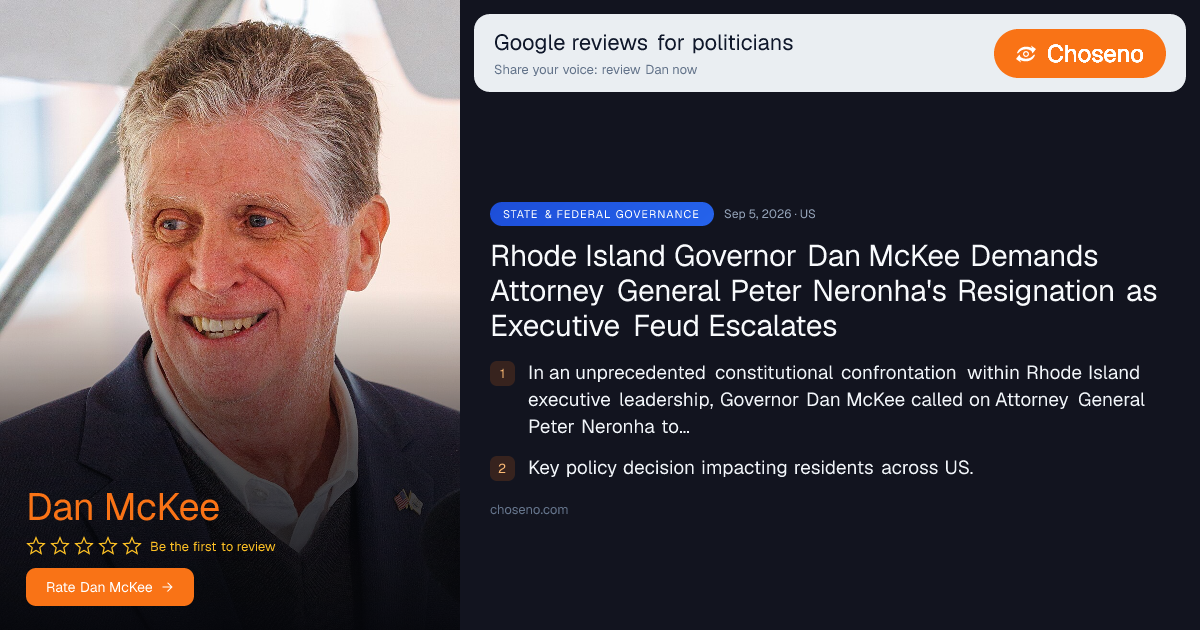
Rhode Island Governor Dan McKee Demands Attorney General Peter Neronha's Resignation as Executive Feud Escalates
In an unprecedented constitutional confrontation within Rhode Island executive leadership, Governor Dan McKee called on Attorney General Peter Neronha to resign immediately, alleging the state's chief legal officer has politicized investigative proceedings ahead of the upcoming primary election.
Read full article