Governor Greg Abbott Launches Project Watershed 250 to Shield Municipal Water Systems from Cyber Threats
Texas Governor Greg Abbott and federal cybersecurity leadership launched Project Watershed 250, a statewide defensive initiative providing complimentary cyber monitoring and vulnerability assessments to 250 municipal water systems.
Choseno Civic News Desk September 4, 2026 2 min read TX, US
Texas Governor Greg Abbott, joined by state emergency officials and federal cybersecurity leadership, has formally launched Project Watershed 250, an aggressive critical infrastructure security initiative designed to harden municipal water and wastewater treatment facilities across the state against foreign state-sponsored cyber intrusions.
The program, unveiled during an infrastructure security briefing in Brazos County, offers no-cost cyber defense tools, automated endpoint monitoring, and on-site technical vulnerability assessments to 250 small and medium-sized municipal water utility districts and rural water supply corporations. The rollout responds directly to national intelligence warnings concerning malicious cyber operations targeting industrial control systems (ICS) and supervisory control and data acquisition (SCADA) networks that govern municipal drinking water distribution.
Unlike large metropolitan utility authorities in Houston, Dallas, or Austin that maintain dedicated in-house information security departments, hundreds of rural municipal utility districts (MUDs) across Texas operate on constrained municipal budgets with minimal specialized digital defense personnel. Project Watershed 250 bridges this operational gap by deploying state-funded software sensors and establishing direct incident response channels with the Texas Department of Information Resources (DIR) and the Texas Division of Emergency Management (TDEM).
Access to clean, dependable drinking water is fundamental to the survival and economic prosperity of our communities, Governor Abbott stated. As foreign adversaries and rogue cyber syndicates increasingly probe municipal control systems, Texas is taking preemptive action to safeguard local water infrastructure from digital sabotage and extortion.
Under the statutory framework, participating utilities receive comprehensive operational technology (OT) network mapping, automated threat telemetry reporting, and tabletop crisis drills simulating ransomware disruptions and chemical dosing manipulation attempts. The Texas Commission on Environmental Quality (TCEQ) will coordinate technical compliance support to ensure water district operators meet enhanced baseline security standards without incurring unfunded regulatory mandates.
Water district trustees and rural county judges in Central and East Texas commended the initiative, noting that interconnected groundwater distribution systems require collective defensive posture to protect public health and industrial supply chains across expanding suburban growth corridors.
Rate the people mentioned in this article

Related Coverage in Infrastructure
See all Infrastructure newsInfrastructure
CA Sep 5, 2026
British Columbia Lawmaker Scott McInnis Demands Urgent Safety Interventions on Trans-Canada Highway Corridor
British Columbia MLA Scott McInnis has petitioned provincial transportation authorities for immediate safety upgrades and accelerated infrastructure investments along Highway 1 between Field and Sicamous. Following a series of serious collisions on the mountain corridor, Minister of Transportation and Transit Mike Farnworth agreed to convene a high-level ministerial meeting to examine emergency mitigations and capital improvement timelines.
Read full article

Infrastructure
US Sep 4, 2026
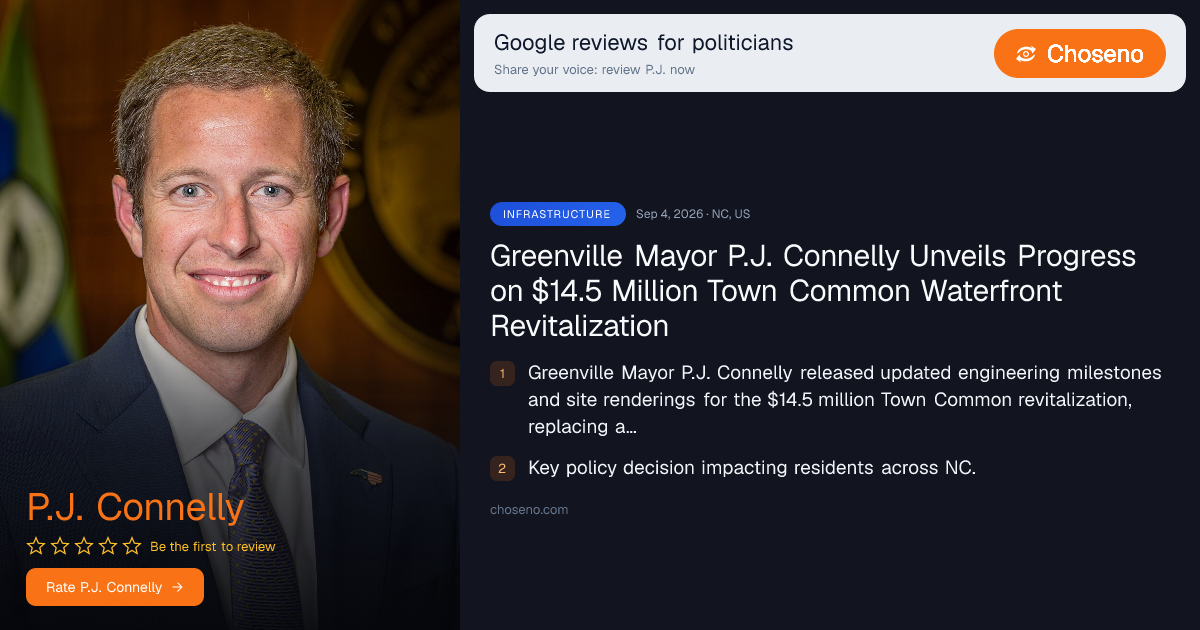
Greenville Mayor P.J. Connelly Unveils Progress on $14.5 Million Town Common Waterfront Revitalization
Greenville Mayor P.J. Connelly released updated engineering milestones and site renderings for the $14.5 million Town Common revitalization, replacing a 1960s-era timber bulkhead with reinforced flood mitigation infrastructure and expanded Tar River recreational paths.
Read full article
Infrastructure
US Aug 28, 2026
Nashville International Airport Renaming Proposal Garners Support from Tennessee Governor
A public initiative to rename Nashville's primary commercial airport after country music icon Dolly Parton has gained endorsement from Tennessee's governor. The proposal reflects ongoing state and municipal deliberations regarding major civic infrastructure and cultural branding.
Read full article