Governor Kathy Hochul Highlights Statewide Workforce Reforms, Inflation-Indexed Wages, and Prenatal Leave Protections
Governor Kathy Hochul marked Labor Day by highlighting comprehensive New York State workforce accomplishments, including statutory minimum wage increases indexed to inflation, implementation of the nation first mandatory paid prenatal leave law, and the full elimination of the state unemployment insurance debt.
Choseno Civic News Desk September 8, 2026 3 min read New York, US
Governor Kathy Hochul marked the statewide observance of Labor Day by detailing a comprehensive package of workforce investments, wage protections, and employee benefit expansions enacted across New York State. Addressing organized labor leadership, municipal officials, and economic development stakeholders, the governor highlighted legislative and administrative actions designed to lower household living costs, enhance workplace safety standards, and expand middle-class career training pipelines from Long Island to Western New York.
Central to the state workforce agenda is the phased rollout of New York landmark minimum wage schedule, which increases hourly compensation across New York City, Long Island, and Westchester County before indexing future annual adjustments directly to the regional Consumer Price Index for Urban Wage Earners. State economic planners emphasized that tying wage adjustments to inflation ensures that low-wage service, caregiving, and retail workers do not see their real purchasing power eroded during periods of sustained macroeconomic price volatility, providing vital financial stability to hundreds of thousands of working families.
The administration also emphasized the formal implementation of the nation first statewide paid prenatal personal leave mandate. Under the statutory reform, private-sector employers across New York are required to provide twenty hours of dedicated paid leave annually for pregnant employees to attend prenatal examinations, medical monitoring visits, and specialist consultations without sacrificing their accumulated sick leave or vacation balances. Public health researchers and healthcare advocates commended the policy as a vital intervention to reduce maternal health complications and improve pediatric health outcomes across underserved urban and rural communities throughout the Empire State.
In addressing employer concerns and state fiscal balance sheets, Hochul highlighted the successful full repayment of New York federal Unemployment Insurance Trust Fund debt. The multi-billion-dollar debt, originally accrued during the height of emergency pandemic-era layoffs, had triggered federal interest surcharges on local employers across all business classifications. By completely retiring the outstanding obligation through dedicated state general fund reserves, state fiscal authorities eliminated automatic federal tax assessments on small businesses while safeguarding reserve fund solvency for future economic cycles.
State labor enforcement apparatuses have similarly accelerated investigations into systemic wage theft and employer misclassification across construction, hospitality, and seasonal agricultural sectors. The New York State Department of Labor reported recovering tens of millions of dollars in unpaid wages, overtime compensation, and withheld tips on behalf of exploited workers over the past fiscal year, while expanding direct-entry union apprenticeship partnerships across semiconductor manufacturing, offshore wind installation, and advanced infrastructure construction.
Business associations and labor federations across the state acknowledged the multifaceted workforce policy developments, while continuing to debate legislative proposals regarding workers compensation cost formulas and commercial regulatory mandates. State legislative leaders indicated that as the Legislature prepares for the upcoming winter session in Albany, committee hearings will focus on monitoring the operational rollout of prenatal leave benefits and ensuring that state-funded capital infrastructure projects strictly adhere to prevailing wage standards. Administrative agencies will coordinate with regional trade councils to expand vocational training access, assist youth career transitions, and ensure robust compliance with newly enacted workplace safety mandates statewide. State labor commissioners pledged to maintain close communication with community stakeholders as implementation continues.
Rate the people mentioned in this article

Related Coverage in Governance
See all Governance newsGovernance
US Sep 8, 2026
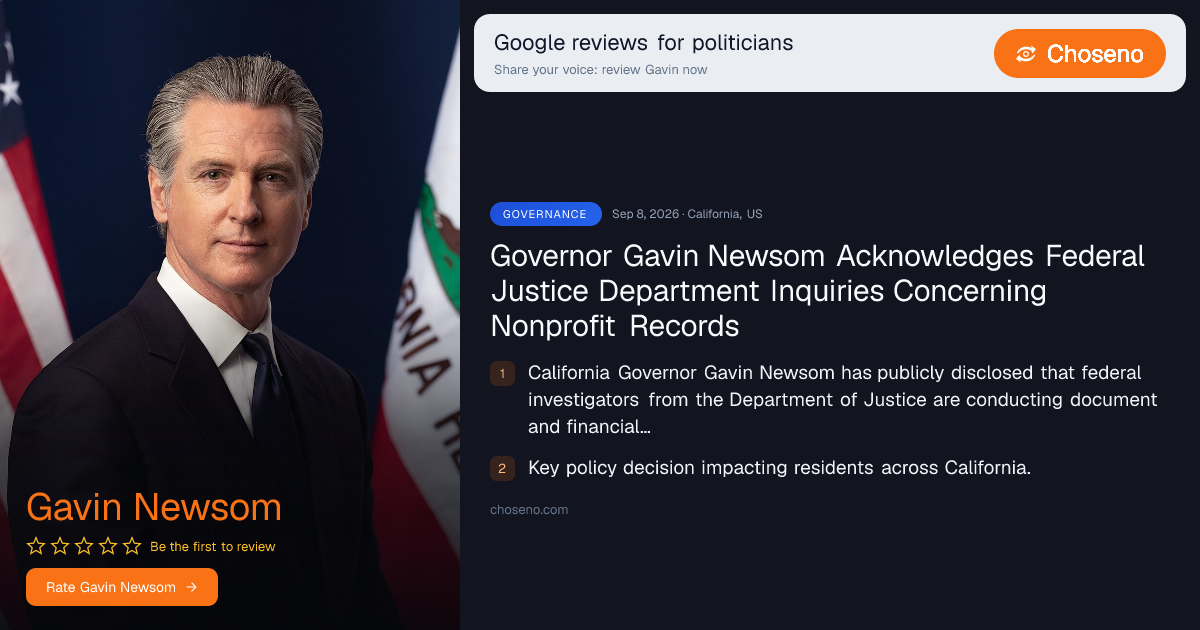
Governor Gavin Newsom Acknowledges Federal Justice Department Inquiries Concerning Nonprofit Records
California Governor Gavin Newsom has publicly disclosed that federal investigators from the Department of Justice are conducting document and financial inquiries involving him and First Partner Jennifer Siebel Newsom, prompting a fierce dispute over federal oversight impartiality and nonprofit compliance.
Read full article
Governance
US Sep 7, 2026
New Jersey Governor Mikie Sherrill Reaches Agreement With 17 Public Sector Unions Waiving Health Premium Hikes
New Jersey Governor Mikie Sherrill and 17 state employee labor unions have finalized an agreement waiving scheduled 2027 health benefit contribution rate increases and creating an advisory working group to overhaul the State Health Benefits Program.
Read full article
Governance
CA Sep 7, 2026
Prime Minister Mark Carney Convenes Fall Cabinet Planning Forum in Banff to Accelerate Infrastructure and Trade Strategy
Prime Minister Mark Carney is gathering federal cabinet ministers in Banff, Alberta, for a two-day strategic planning forum dedicated to expediting national infrastructure, addressing North American trade pressures, and advancing legislative priorities ahead of Parliament resuming.
Read full article