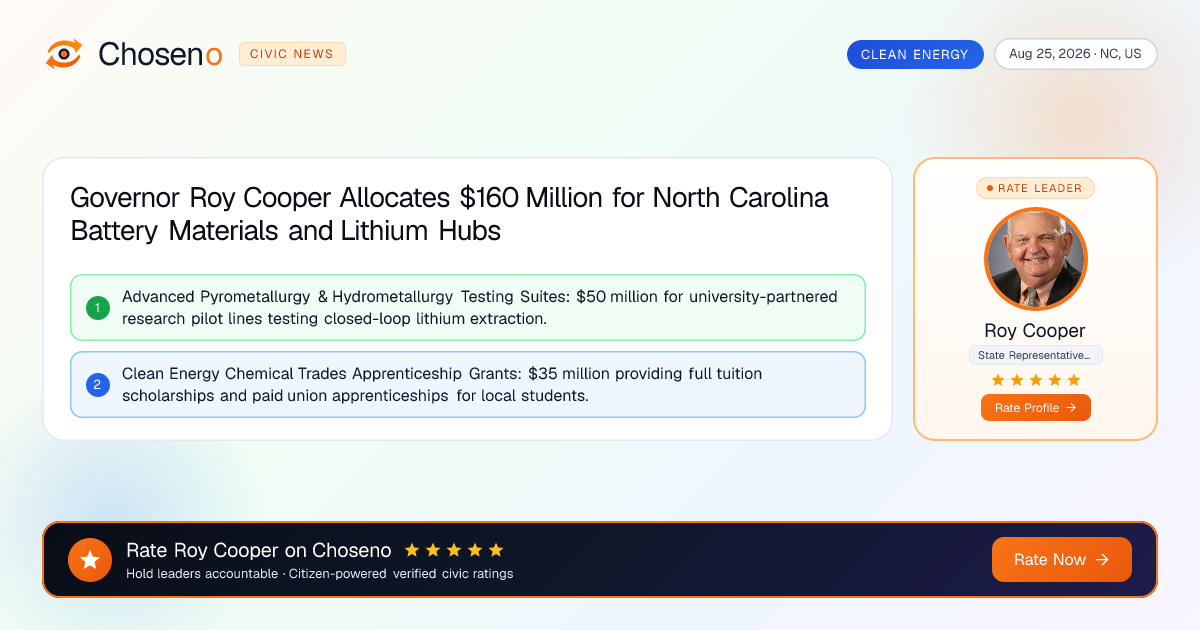
Governor Roy Cooper Allocates $160 Million for North Carolina Battery Materials and Lithium Hubs
North Carolina Governor Roy Cooper announces $160 million in state clean technology grants to establish the Carolina Battery Materials Innovation Academy and construct specialized chemical engineering testing labs in Gaston and Cleveland Counties.
Choseno North Carolina Bureau August 25, 2026 2 min read NC, US
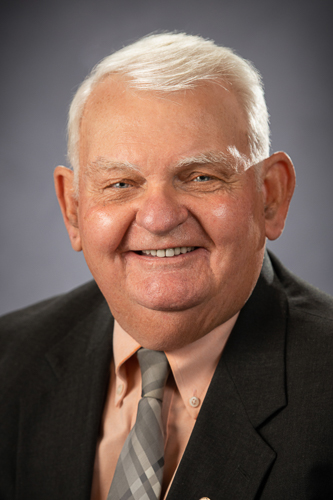
★ Choseno Civic Briefing
Key Leaders
GASTONIA, N.C. — Governor Roy Cooper announced on Monday the distribution of $160 million in state clean technology and workforce development grants through the North Carolina Department of Commerce to construct the Carolina Battery Materials Innovation Academy and establish advanced metallurgical chemical pilot laboratories in Gaston and Cleveland Counties.
The investment anchors North Carolina's position at the heart of the "Battery Belt," leveraging the historic Carolina Tin-Spodumene Belt—one of the few rich hard-rock lithium deposits in North America—to train over 3,000 certified chemical processing technicians, hydrometallurgical operators, and clean energy engineers annually.
Powering America's Domestic Electric Vehicle Battery Revolution North Carolina has attracted over $14 billion in private electric vehicle and battery manufacturing investments from Toyota, Albemarle, and Piedmont Lithium. However, refining raw spodumene ore into 99.5 percent pure battery-grade lithium hydroxide requires specialized chemical engineering labor.
"North Carolina is leading the clean energy transition, and we are building the entire electric vehicle battery supply chain right here in our state," Governor Cooper said during an announcement at Gaston College. "From harvesting lithium to refining battery-grade materials and manufacturing electric vehicles, North Carolina workers are powering the future. This $160 million investment creates a world-class training academy, giving our students the skills to step into high-paying chemical engineering careers and securing American energy independence."
Training Hubs and Pilot Lab Allocations The $160 million program finances:
- Carolina Battery Materials Innovation Academy: $75 million for advanced chemical pilot processing plants and analytical spectrometry cleanrooms at Gaston College and Cleveland Community College.
- Advanced Pyrometallurgy & Hydrometallurgy Testing Suites: $50 million for university-partnered research pilot lines testing closed-loop lithium extraction.
- Clean Energy Chemical Trades Apprenticeship Grants: $35 million providing full tuition scholarships and paid union apprenticeships for local students.
Clean energy executives, community college presidents, and building trades labor leaders praised the governor's proactive investment, emphasizing that turn-key workforce pipelines attract international chemical manufacturing capital.
Rate the people mentioned in this article
Related Coverage in Clean Energy
See all Clean Energy newsClean Energy
US Aug 25, 2026
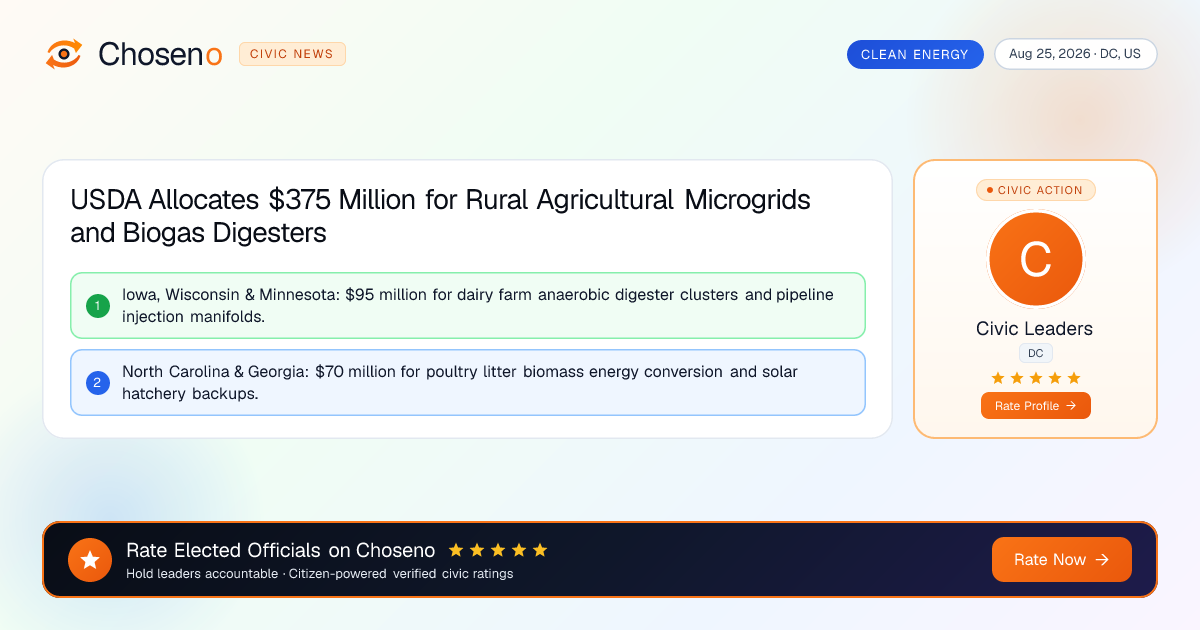
USDA Allocates $375 Million for Rural Agricultural Microgrids and Biogas Digesters
Agriculture Secretary Tom Vilsack awards $375 million through the Rural Energy for America Program to construct on-farm anaerobic methane digesters and solar-battery microgrids across 600 rural dairy and crop farms.
Read full article
Clean Energy
CA Aug 25, 2026
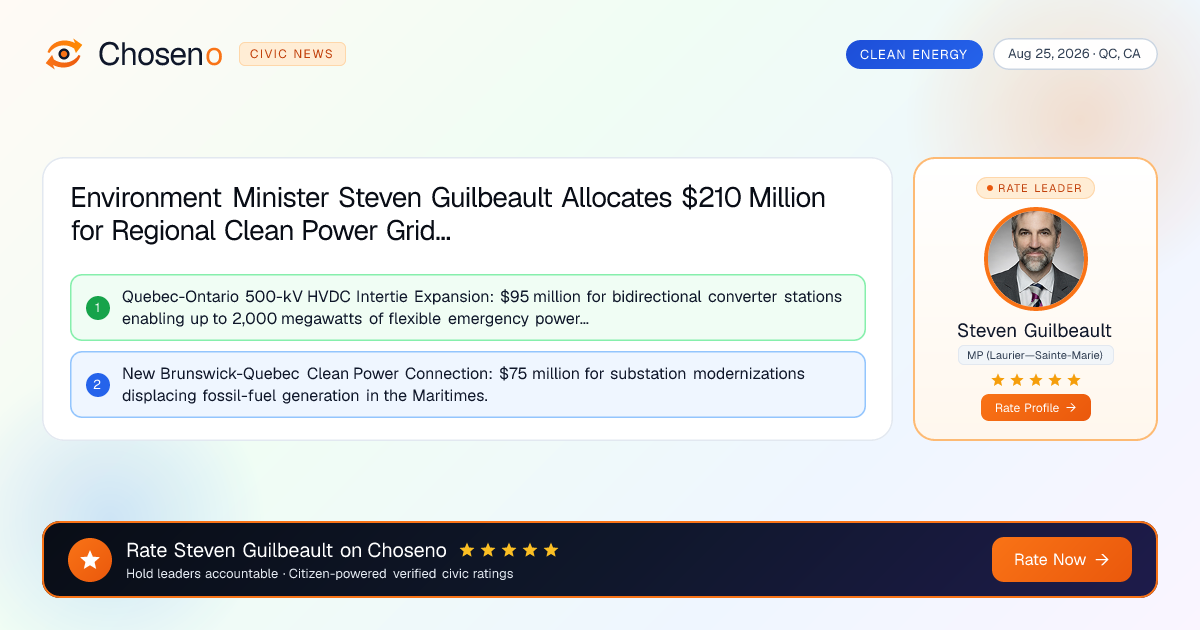
Environment Minister Steven Guilbeault Allocates $210 Million for Regional Clean Power Grid Interconnections
Environment Minister Steven Guilbeault announces $210 million under the Smart Renewables and Electrification Pathways Program to construct interprovincial clean transmission interties connecting Quebec, Ontario, and New Brunswick.
Read full article
Clean Energy
CA Aug 25, 2026
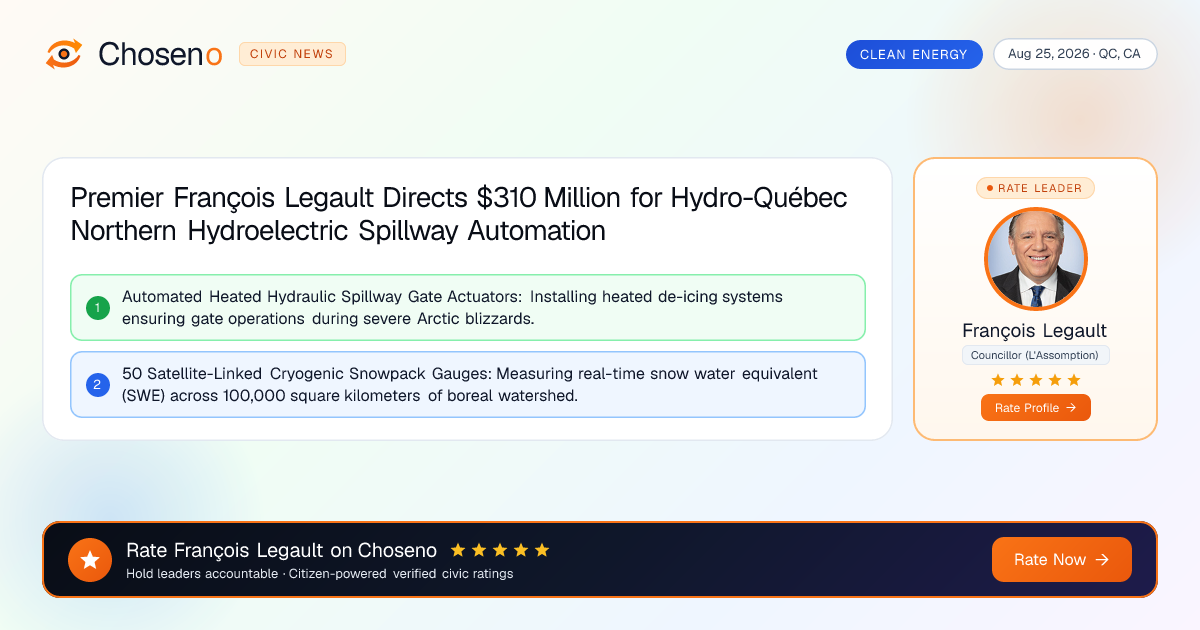
Premier François Legault Directs $310 Million for Hydro-Québec Northern Hydroelectric Spillway Automation
Quebec Premier François Legault and Economy Minister Pierre Fitzgibbon announce a $310 million capital contract through Hydro-Québec to automate remote flood spillway gates and install AI water level sensors at the Caniapiscau Reservoir.
Read full article