Premier Kinew Urges Federal Negotiators to Stand Firm on Agricultural and Manufacturing Protections
Manitoba Premier Wab Kinew cautions Ottawa against making agricultural and industrial concessions in Washington trade talks, advocating for robust supply-managed dairy protections.
Choseno Prairie Affairs Desk August 20, 2026 1 min read MB, CA
★ Choseno Civic Briefing
WINNIPEG, MB — Premier Wab Kinew addressed reporters at the Manitoba Legislative Building Thursday afternoon following a first ministers’ conference call on cross-border trade negotiations, warning the federal government that Canadian negotiators must not sacrifice domestic producers to secure a quick trade resolution.
Supply Management and Provincial Manufacturing Safeguards
Premier Kinew expressed skepticism regarding proposed federal compromises that could open Canadian dairy market access or weaken protective retaliatory tariffs without securing permanent, ironclad exemptions for Prairie manufacturing and heavy bus fabrication exports. Manitoba’s agricultural producers and aerospace manufacturers account for billions in annual export value, making trade predictability vital to the provincial economy.
Kinew emphasized that while averting catastrophic 50 percent U.S. tariffs is an urgent priority, Canada must demonstrate resolve rather than capitulating to unilateral trade demands.
Cross-Border Trucking and Agri-Food Security
The Premier also highlighted ongoing efforts to ensure streamlined logistics at the Emerson-Pembina land border crossing, noting that delays in agricultural supply chains harm farmers on both sides of the 49th parallel.
Manitoba Keystone Agricultural Producers and farm commodity groups supported the Premier’s firm stance, stating that family dairy and poultry operations form the backbone of rural Prairie communities.
Upcoming First Ministers Council Meeting
Provincial premiers will convene a special virtual meeting of the Council of the Federation once the final legal text of the Canada-U.S. trade accord is presented by federal ministers.
Sources
Rate the people mentioned in this article
Related Coverage in Trade
See all Trade news
Trade
CA Aug 20, 2026
Canada-U.S. Trade Envoys Reach Tentative Accord to Halt 50% Tariffs on Steel and Manufacturing
Trade Minister Dominic LeBlanc and U.S. Trade Representative Jamieson Greer conclude intense bilateral talks in Washington, establishing a framework to ease industrial tariffs.
Read full article
Trade
CA Aug 20, 2026
Premier Houston Directs Nova Scotia Liquor Corporation to Restock American Alcohol
Nova Scotia Premier Tim Houston instructs the NSLC to return American spirits and wines to retail shelves, supporting federal trade negotiators in Washington.
Read full article
Trade
CA Aug 20, 2026
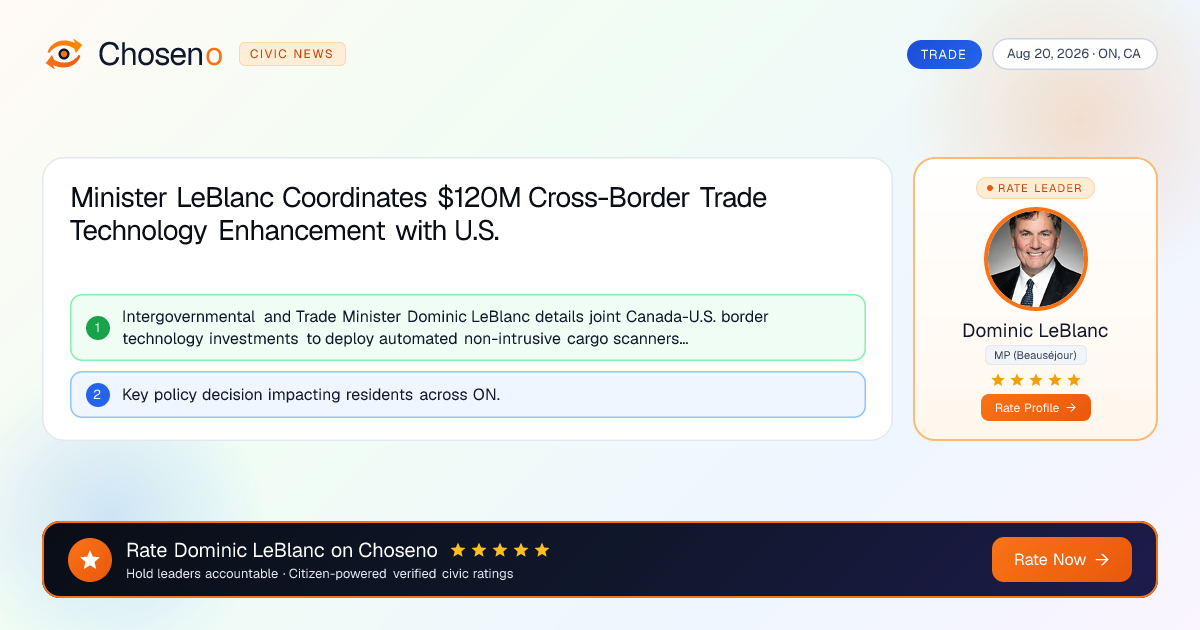
Minister LeBlanc Coordinates $120M Cross-Border Trade Technology Enhancement with U.S.
Intergovernmental and Trade Minister Dominic LeBlanc details joint Canada-U.S. border technology investments to deploy automated non-intrusive cargo scanners at high-volume crossings.
Read full article