Premier David Eby Directs $135 Million for BC Wildfire Night-Vision Helitack and Air Tanker Fleets
British Columbia Premier David Eby and Forests Minister Bruce Ralston announce $135 million to procure five heavy amphibious water-bombers and equip initial-attack helicopter crews with night-vision goggle telemetry for 24/7 wildfire suppression.
Choseno West Coast Bureau August 25, 2026 2 min read BC, CA

★ Choseno Civic Briefing
Key Leaders
KAMLOOPS, B.C. — British Columbia Premier David Eby and Minister of Forests Bruce Ralston announced on Monday the distribution of $135 million in provincial emergency management capital funding to expand the BC Wildfire Service aviation fleet, purchasing five amphibious water-scooping air tankers and equipping initial-attack helicopter strike teams with military-grade Night Vision Goggle (NVG) avionics for 24/7 aerial firefighting operations.
The investment directly implements recommendations from the Premier's Expert Task Force on Emergencies, enabling firefighting aircraft to drop water and retardant on active wildfire perimeters at night when lower temperatures, higher humidity, and reduced wind speeds make fire containment significantly more effective.
Crushing Wildfires at Night When Fire Behavior Calms Historically, aviation safety rules grounded firefighting aircraft at sunset, allowing smoldering fires to expand unchecked overnight before daytime winds rekindled aggressive crown fires.
"British Columbians have experienced consecutive summers of unprecedented wildfire destruction, and we are ensuring our brave wildland firefighters have the modern equipment needed to defend our communities day and night," Premier David Eby said at the BC Wildfire Service Provincial Air Tanker Center in Kamloops. "Wildfire behavior cools down at night, and that is precisely when aerial suppression is most effective. This $135 million investment equips our pilots with night-vision technology, buys five modern water-bombers, and gives us the round-the-clock aerial firepower needed to knock down fires before they threaten towns."
Aviation Fleet and Tactical Deployments The $135 million package finances:
- Five Amphibious Water-Scooping Air Tankers: Custom-built Canadian De Havilland DHC-515 water bombers capable of refilling 6,000 litres from lakes in 12 seconds.
- 12 Night-Vision Initial Attack Helicopters: Equipping medium-lift Bell 412 helicopters with NVG cockpit avionics, thermal forward-looking infrared (FLIR) cameras, and water-drop buckets.
- Kamloops & Prince George Aviation Training Simulators: $15 million to install full-motion flight simulators for night firefighting certification.
Wildfire firefighters, municipal mayors in the BC Interior, and First Nations forestry leaders praised the decisive funding, emphasizing that 24/7 aerial response stops lightning-sparked fires in remote terrain before they merge into uncontrollable complexes.
Rate the people mentioned in this article

Related Coverage in Public Safety
See all Public Safety newsPublic Safety
US Aug 25, 2026
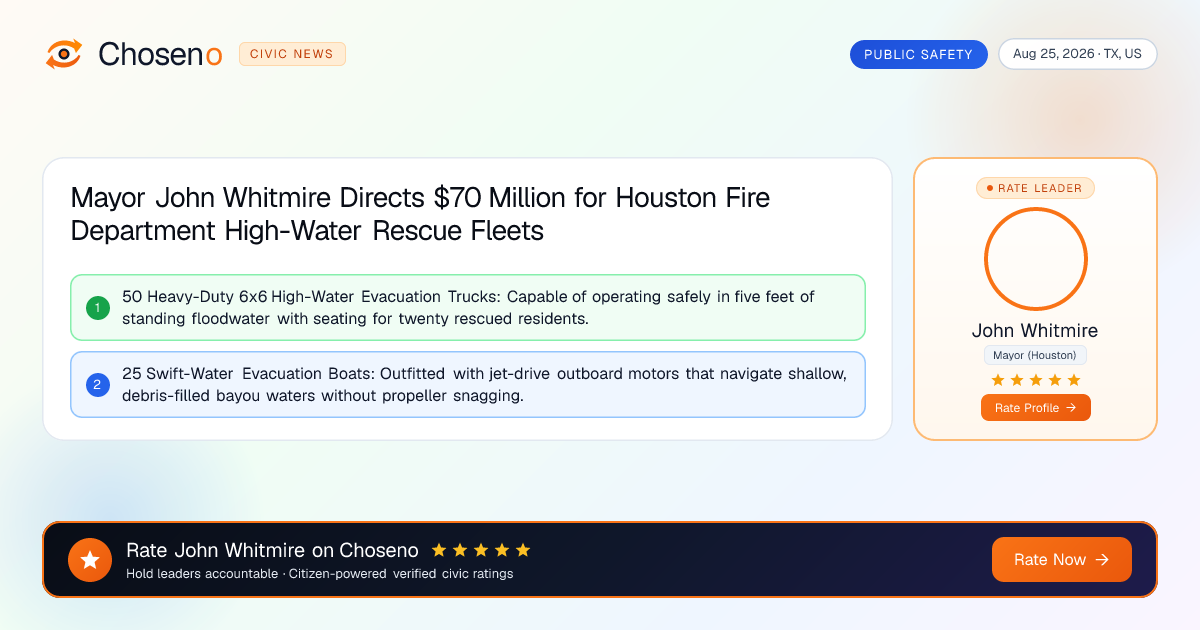
Mayor John Whitmire Directs $70 Million for Houston Fire Department High-Water Rescue Fleets
Houston Mayor John Whitmire and the Houston City Council approve a $70 million emergency vehicle procurement contract to purchase fifty heavy high-water rescue trucks, swift-water evacuation boats, and modern aerial fire engines.
Read full article
Public Safety
US Aug 25, 2026
Mayor Cherelle Parker Allocates $80 Million for Philadelphia Community Foot Patrols and Crisis Units
Philadelphia Mayor Cherelle Parker and the Philadelphia Police Department authorize an $80 million public safety package to deploy 300 dedicated walking foot-patrol officers and co-deployed mental health crisis intervention teams in forty business districts.
Read full article

Public Safety
US Aug 25, 2026
Governor Greg Abbott Directs $175 Million for Texas Wildfire Containment Aircraft and Firebreaks
Texas Governor Greg Abbott and the Texas A&M Forest Service announce $175 million to procure five amphibious firefighting air tankers and construct 800 miles of mechanical fuelbreak corridors across the Texas Panhandle and Hill Country.
Read full article