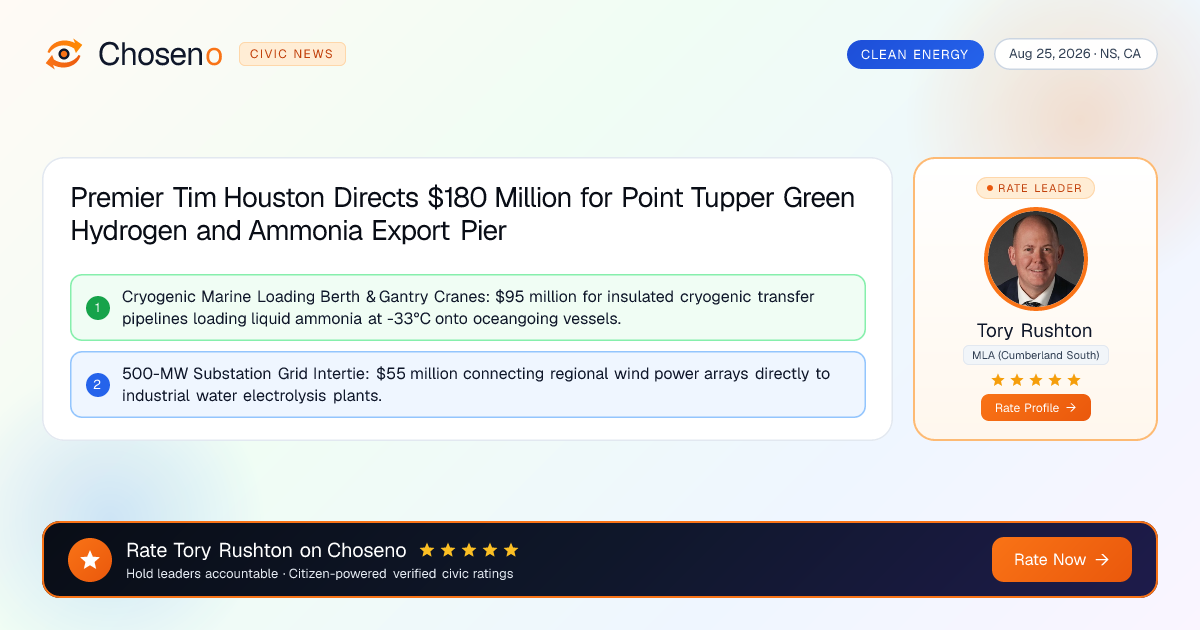
Premier Tim Houston Directs $180 Million for Point Tupper Green Hydrogen and Ammonia Export Pier
Nova Scotia Premier Tim Houston and Natural Resources Minister Tory Rushton allocate $180 million to construct heavy cryogenic loading berths, green hydrogen storage spheres, and high-voltage grid interties at the Port of Point Tupper.
Choseno Atlantic Canada Bureau August 25, 2026 2 min read NS, CA
★ Choseno Civic Briefing
Key Leaders
POINT TUPPER, N.S. — Premier Tim Houston and Minister of Natural Resources and Renewables Tory Rushton announced on Monday the distribution of $180 million in provincial infrastructure matching capital through the Nova Scotia Clean Energy Fund to construct specialized cryogenic marine loading berths, high-pressure hydrogen storage spheres, and high-voltage grid interties at the Strait of Canso in Point Tupper, Cape Breton.
The project leverages Point Tupper's naturally ice-free deepwater harbor—boasting a 27-meter (90-foot) natural draft capable of accommodating ultra-large cryogenic gas carrier ships—to create Atlantic Canada's premier green hydrogen and green ammonia export hub, powered by vast onshore and offshore Atlantic wind farms.
Positioning Nova Scotia as a Global Clean Hydrogen Energy Exporter European industrial nations are aggressively transitioning from fossil natural gas to green hydrogen and zero-emission ammonia to decarbonize heavy chemical manufacturing, steel foundries, and maritime shipping fleets, creating an enormous international market for Canadian green fuels.
"Nova Scotia has world-class wind resources, the deepest ice-free port in North America, and the skilled workforce needed to power the global clean energy economy," Premier Tim Houston said during an announcement at the Port of Point Tupper. "This $180 million investment builds the critical port and grid infrastructure to produce green hydrogen right here in Cape Breton and ship clean energy across the Atlantic to our international allies, creating hundreds of high-wage jobs for Nova Scotians and generating sustainable wealth for our communities."
Export Port and Clean Energy Architecture The $180 million package finances:
- Cryogenic Marine Loading Berth & Gantry Cranes: $95 million for insulated cryogenic transfer pipelines loading liquid ammonia at -33°C onto oceangoing vessels.
- 500-MW Substation Grid Intertie: $55 million connecting regional wind power arrays directly to industrial water electrolysis plants.
- Environmental Water & Marine Baseline Monitoring: $30 million partnering with the Mi'kmaq First Nations and Cape Breton University to ensure marine ecosystem protection in the Strait of Canso.
Cape Breton business leaders, building trades unions, and international shipping executives commended the provincial funding, pointing out that dedicated export infrastructure establishes Nova Scotia as a dominant clean fuel hub in the Atlantic basin.
Rate the people mentioned in this article

Related Coverage in Clean Energy
See all Clean Energy newsClean Energy
US Aug 25, 2026
Department of Energy Directs $420 Million for Mid-Atlantic Subsea HVDC Offshore Grid Interties
Energy Secretary Jennifer Granholm and the Department of Energy announce $420 million in Grid Resilience and Innovation Grants to construct high-voltage direct current (HVDC) subsea transmission links connecting offshore wind leases off New Jersey, New York, and Delaware to the PJM regional grid.
Read full article
Clean Energy
US Aug 25, 2026
Mayor Michelle Wu Directs $60 Million for Boston Public Schools Solar and Heat Pump Retrofits
Boston Mayor Michelle Wu and City Council authorize $60 million from the municipal capital budget to install commercial rooftop solar arrays, high-efficiency geothermal heat pumps, and modern ventilation systems across 20 public school buildings.
Read full article

Clean Energy
US Aug 25, 2026
Governor Jay Inslee Directs $170 Million for Hybrid-Electric Puget Sound Ferries
Washington Governor Jay Inslee and WSDOT allocate $170 million in Climate Commitment Act revenue to build two 144-car hybrid-electric passenger-vehicle ferries and install rapid shore-charging terminals across Puget Sound.
Read full article