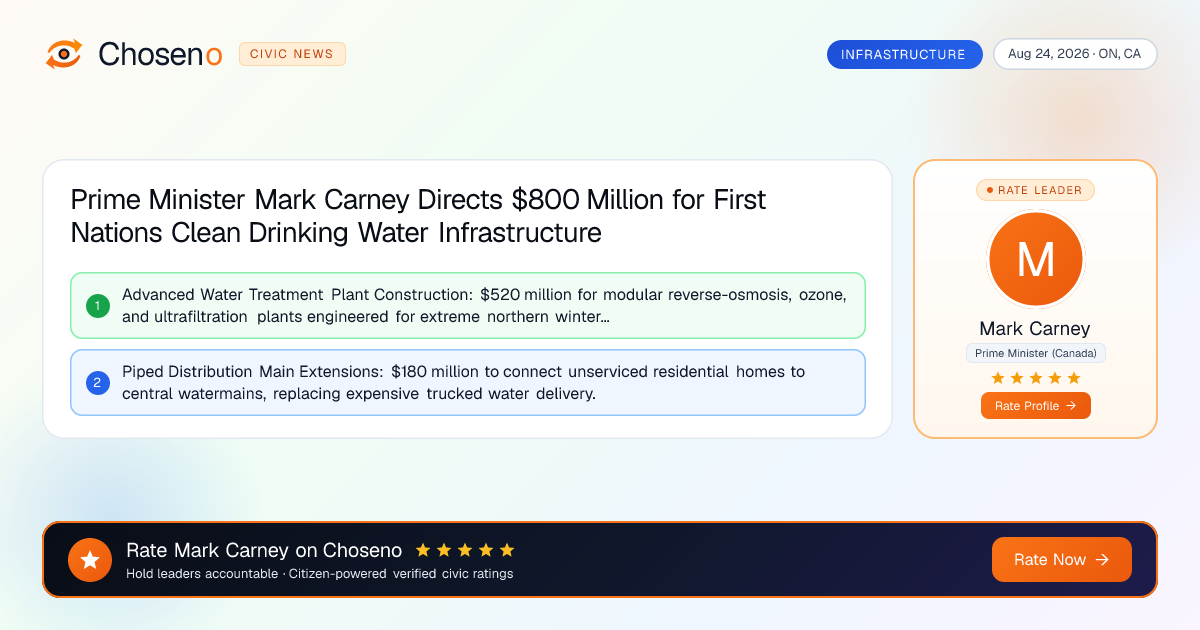
Prime Minister Mark Carney Directs $800 Million for First Nations Clean Drinking Water Infrastructure
Prime Minister Mark Carney and Indigenous Services Minister Patty Hajdu allocate $800 million to construct modern water treatment plants and eliminate long-term drinking water advisories in thirty First Nations communities.
Choseno National Affairs Bureau August 24, 2026 2 min read ON, CA
★ Choseno Civic Briefing
Key Leaders
OTTAWA — Prime Minister Mark Carney and Minister of Indigenous Services Patty Hajdu announced on Monday the distribution of $800 million in dedicated federal capital grants to finance the engineering, construction, and long-term operations of advanced municipal water treatment plants and piped distribution networks across thirty First Nations communities in Ontario, Manitoba, Saskatchewan, and British Columbia.
The investment, administered in direct co-development partnerships with First Nations leadership, fulfills the federal statutory commitment to permanently eliminate long-term drinking water advisories on reserves and establish sustainable, community-controlled water utility corporations.
Permanently Securing Clean Drinking Water on Reserves While the federal government has lifted over 145 long-term drinking water advisories over the past decade, remote northern and fly-in communities have faced significant infrastructure replacement costs and certified water plant operator recruitment challenges.
"Access to safe, clean drinking water is a fundamental human right that must be guaranteed to every person living in Canada," Prime Minister Mark Carney said in Thunder Bay. "For generations, First Nations communities were left with substandard water systems that broke down and failed. This $800 million investment builds state-of-the-art water treatment facilities, replaces aging underground pipes, and provides permanent, long-term funding to train and pay certified First Nations water operators, guaranteeing clean water out of the tap forever."
Community Infrastructure and Operator Training Endowments Key components of the $800 million allocation include:
- Advanced Water Treatment Plant Construction: $520 million for modular reverse-osmosis, ozone, and ultrafiltration plants engineered for extreme northern winter climates.
- Piped Distribution Main Extensions: $180 million to connect unserviced residential homes to central watermains, replacing expensive trucked water delivery.
- First Nations Water Operator Training & Salary Parity: $100 million dedicated to funding competitive salary grids and accredited certification programs for local Indigenous water treatment engineers.
Assembly of First Nations (AFN) leaders and community chiefs commended the binding multi-year funding commitment, emphasizing that modern water infrastructure is foundational to community health, economic development, and self-determination.
Rate the people mentioned in this article

Related Coverage in Infrastructure
See all Infrastructure newsInfrastructure
US Aug 24, 2026
USDOT Awards $500 Million to Eliminate Freight Rail Chokepoints and Modernize Rail Corridors
Federal Railroad Administration allocates $500 million under the Consolidated Rail Infrastructure and Safety Improvements (CRISI) program, adding double-tracks and upgrading signaling across 10 major freight routes.
Read full article
Infrastructure
US Aug 24, 2026
USDOT Awards $320 Million to Rehabilitate 14 Major Interstate Bridges Across 8 States
Federal Highway Administration allocates $320 million in Bridge Investment Program (BIP) grants to replace corroded bridge decks, install seismic retrofits, and widen freight lanes.
Read full article
Infrastructure
US Aug 24, 2026
USDOT Awards $140 Million to Electrify Port Cranes and Modernize Cargo Terminals
Maritime Administration announces $140 million in Port Infrastructure Development Program (PIDP) grants to construct electric container berths and rail yards in Savannah, Houston, and Seattle.
Read full article