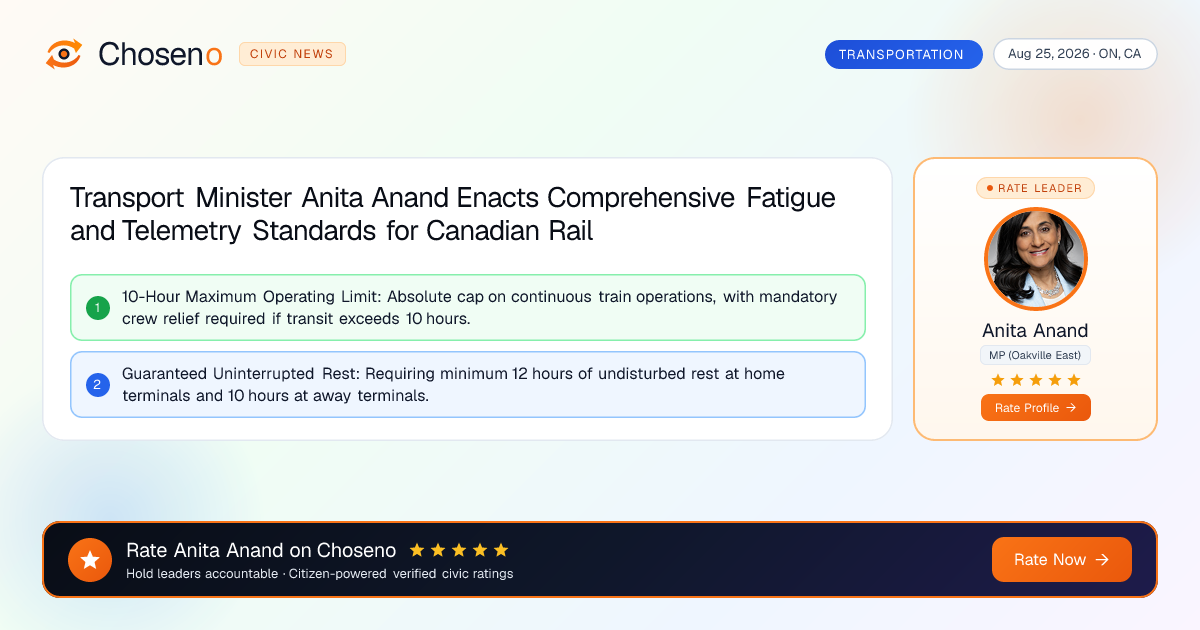
Governor Greg Abbott Directs $275 Million for Port of Corpus Christi Deepwater Channel Completion
Texas Governor Greg Abbott and Port of Corpus Christi officials announce $275 million in state maritime infrastructure funding to complete dredging the ship channel to 54 feet, accommodating fully loaded Very Large Crude Carriers.
Choseno Texas Politics Desk August 25, 2026 2 min read TX, US
★ Choseno Civic Briefing
Key Leaders
CORPUS CHRISTI, Texas — Governor Greg Abbott and Port of Corpus Christi Commission Chairman Kent Britton announced on Monday the allocation of $275 million in state maritime infrastructure funding from the Texas Transportation Commission to complete the final phase of the Corpus Christi Ship Channel Deepening and Widening Project.
The deepwater engineering initiative, executed in partnership with the U.S. Army Corps of Engineers, deepens the 36-mile commercial navigation channel from 47 feet to an authorized depth of 54 feet mean lower low water (MLLW) and widens the channel to 530 feet, making Corpus Christi the deepest navigation channel on the entire U.S. Gulf Coast.
Securing American Energy Export Dominance and Global Trade The Port of Corpus Christi is the nation's number-one crude oil export gateway, moving over 200 million tons of energy and agricultural cargo annually. Deepening the channel allows two-way traffic for fully laden Very Large Crude Carriers (VLCCs) and Liquefied Natural Gas (LNG) tankers without requiring expensive offshore lightering operations.
"Texas is the economic engine of America, and our deepwater ports connect Texas energy and manufactured goods to consumers across the globe," Governor Abbott said at the Port of Corpus Christi. "By investing $275 million to finish deepening the Corpus Christi Ship Channel, we are ensuring our state remains the undisputed energy export leader of the world, creating thousands of high-paying maritime and industrial jobs, and strengthening our national economic security."
Engineering Milestones and Environmental Mitigation The $275 million package finances:
- Final 12 Miles of Deep Channel Dredging: Removing 15 million cubic yards of marine silt and clay from the Port Aransas junction to the inner harbor.
- Beneficial Use Dredge Material Placement: Using dredged sediment to construct 3,000 acres of protected coastal wetlands, bird nesting islands, and seagrass beds in Redfish Bay.
- Advanced Vessel Telemetry & Marine Pilot Tug Assist: Installing computerized channel depth monitors and ultra-high-bollard-pull escort tug docking stations.
Maritime industry executives, chemical manufacturing leaders, and building trades labor unions commended the state investment, emphasizing that deepwater access cements Texas's competitive advantage in international trade.
Rate the people mentioned in this article
Related Coverage in Transportation
See all Transportation newsTransportation
US Aug 25, 2026
FAA Mandates Automated Runway Status Lights at Top 40 Commercial Hub Airports
Federal Aviation Administration Administrator Mike Whitaker issues a binding safety directive requiring forty major commercial airports to install automated in-pavement Runway Status Lights (RWSL) to prevent surface runway incursions.
Read full article

Transportation
US Aug 25, 2026
Governor Josh Shapiro Allocates $110 Million for Pennsylvania Municipal Bridge Replacements
Pennsylvania Governor Josh Shapiro and PennDOT award $110 million in direct state infrastructure grants to repair or replace 120 deteriorated, weight-restricted municipal and county bridges across thirty-five counties.
Read full article
Transportation
CA Aug 25, 2026
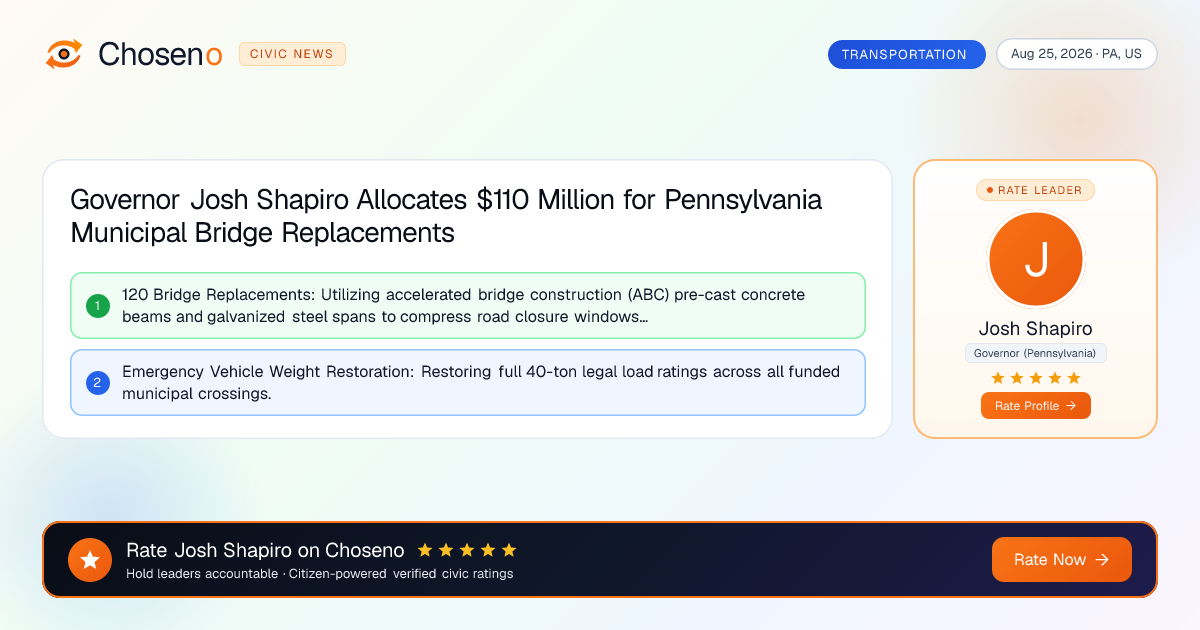
Transport Minister Anita Anand Enacts Comprehensive Fatigue and Telemetry Standards for Canadian Rail
Transport Minister Anita Anand issues binding amendments to the Railway Safety Act, mandating maximum 10-hour duty shifts, mandatory 12-hour rest periods, and synchronized in-cab telemetry recorders on all Class 1 freight trains operating in Canada.
Read full article