Governor Gavin Newsom Weighs Landmark Workplace AI and Anti-Retaliation Labor Bills
Governor Gavin Newsom considers landmark end-of-session employment legislation, including the 'No Robo Bosses Act' banning automated firing, AI layoff notices, and a $10,000 penalty for immigration retaliation.
Choseno California Labor & Technology Law Desk September 5, 2026Updated September 6, 2026 3 min read CA, US
SACRAMENTO, Calif. — California Governor Gavin Newsom faces an end-of-session deadline to sign or veto a consequential package of workplace and labor statutes enacted by the California Legislature, headlined by first-in-the-nation legislation regulating artificial intelligence in workplace management and expanding protections against immigration-related employer retaliation. The slate of bills establishes a comprehensive regulatory blueprint for employers navigating automated decision-making and digital surveillance across the state.
At the forefront of the legislative package is Senate Bill 947, authored by Senator McNerney and colloquially dubbed the No Robo Bosses Act. If signed into law, the measure will take effect on July 1, 2027, establishing that California employers may not rely solely on automated decision systems or artificial intelligence algorithms to discipline or discharge an employee. The statute mandates that any disciplinary action or termination must involve independent human evaluation supported by corroborating factual evidence.
Furthermore, SB 947 strictly prohibits the deployment of automated systems designed to predict worker behavior, infer protected demographic characteristics, gauge emotional states, or identify employees who engage in legally protected organizing or whistleblowing. Employers who primarily rely upon automated algorithmic recommendations to reprimand a worker must provide written disclosure and grant the employee access to the underlying data. The legislation is complemented by Senate Bill 951, which updates the California Worker Adjustment and Retraining Notification (Cal-WARN) Act to mandate that employers disclose whether mass layoffs or facility closures are driven by artificial intelligence automation replacing human labor.
Lawmakers also approved significant restrictions on digital workplace monitoring through Assembly Bills 1331 and 1883, which outlaw electronic surveillance in employee restrooms and ban the use of biometric or neural monitoring technologies claiming to measure worker sentiment or emotional states. Violations are enforceable through the Labor Commissioner, with statutory civil penalties of up to $500 per infraction.
In the realm of worker protections, Assembly Bill 2495 substantially expands statutory prohibitions against immigration-related workplace retaliation under Labor Code Section 1019. The legislation extends civil liability to any employer conduct related to a person's perceived immigration status that tends to coerce workers or dissuade them from asserting wage, safety, or administrative rights, regardless of their actual legal status. Notably, AB 2495 introduces a new civil penalty of up to $10,000 per affected employee, payable directly to the worker, creating substantial legal exposure for retaliatory threats during scheduling or wage disputes.
Concurrently, Governor Newsom is reviewing Assembly Bill 2721, a contentious measure requiring hotel operators with knowledge of federal immigration enforcement room bookings by Immigration and Customs Enforcement (ICE) or Customs and Border Protection (CBP) to notify hotel staff and arriving guests. The measure faced intense opposition from the Asian American Hotel Owners Association and hospitality groups, positioning it as a key candidate for an executive veto.
Business federations, including the California Chamber of Commerce, have voiced concern regarding the cumulative administrative costs and litigation risks created by the algorithmic transparency rules, cautioning that human-review mandates could complicate standard automated scheduling and productivity software. Conversely, organized labor unions and privacy advocates argue that statutory guardrails are essential to prevent opaque algorithmic bias and protect worker dignity in an increasingly automated economy. Governor Newsom has until September 30 to issue final executive decisions on the enrolled bills.
Rate the people mentioned in this article

Related Coverage in Civil Rights & Technology
See all Civil Rights & Technology newsCivil Rights & Technology
US Sep 4, 2026
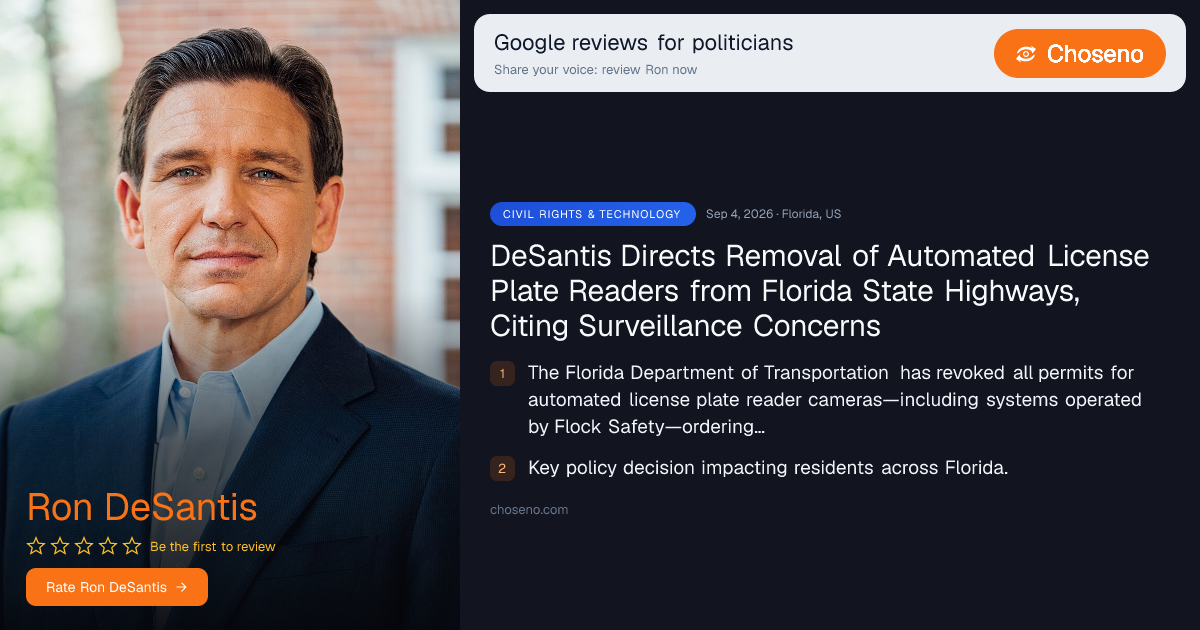
DeSantis Directs Removal of Automated License Plate Readers from Florida State Highways, Citing Surveillance Concerns
The Florida Department of Transportation has revoked all permits for automated license plate reader cameras—including systems operated by Flock Safety—ordering law enforcement agencies to dismantle surveillance devices along state highway rights-of-way within 30 days.
Read full article
Civil Rights & Technology
US Sep 4, 2026
Flock Surveillance Cameras Spark Bipartisan Clashes in Wisconsin and Pennsylvania Governor Races
Candidates for governor in Wisconsin, Pennsylvania, and Rhode Island clash over automated license plate readers, proposing bans, funding freezes, and stricter oversight amid rising privacy concerns.
Read full article