DeSantis Directs Removal of Automated License Plate Readers from Florida State Highways, Citing Surveillance Concerns
The Florida Department of Transportation has revoked all permits for automated license plate reader cameras—including systems operated by Flock Safety—ordering law enforcement agencies to dismantle surveillance devices along state highway rights-of-way within 30 days.
Choseno Civic News Desk September 4, 2026 3 min read Florida, US
TALLAHASSEE, Fla. — The administration of Florida Governor Ron DeSantis has ordered the statewide removal of automated license plate reader (ALPR) cameras from all state highway corridors, delivering a major regulatory blow to automated surveillance vendors and triggering an intense debate between privacy advocates and municipal law enforcement agencies.
Under a formal directive issued by the Florida Department of Transportation (FDOT), the state has revoked all existing permits granted to local police departments and county sheriff offices allowing the installation of stationary vehicle surveillance cameras along state-maintained highway rights-of-way. Participating agencies have been given a strict 30-day timeline to dismantle and remove the devices, while FDOT has enacted an indefinite moratorium on new permit applications.
The executive action specifically targets camera networks operated by private vendor Flock Safety and competing providers, whose motion-activated solar-powered cameras photograph vehicle license plates, makes, models, and bumper characteristics, storing timestamped geographic records in networked searchable databases.
Governor DeSantis framed the directive as a vital safeguard for constitutional liberty, warning that unconstrained technological surveillance threatens to erode fundamental privacy protections for everyday motorists.
Floridians have a right to travel freely across our state highways without having their daily movements cataloged, tracked, and stored by third-party corporate databases or unchecked governmental surveillance networks, DeSantis stated in remarks outlining the policy shift. We will not allow Florida to drift into a digital, AI-driven surveillance state that treats law-abiding citizens as suspects by default.
The administration is calling on the Florida Legislature to codify comprehensive statutory guardrails during the upcoming legislative session in Tallahassee, proposing an AI Bill of Rights that would establish clear prohibitions on warrantless vehicular tracking and limit inter-agency data sharing with out-of-state jurisdictions.
The sudden ban has drawn divergent reactions across the state's civic and law enforcement landscape. Civil liberties groups, conservative constitutionalists, and digital privacy organizations have widely praised the decision, pointing out that automated camera networks routinely compile billions of vehicular data points without individualized suspicion or judicial warrants. Privacy experts have raised repeated concerns about data breaches, unauthorized lookups by personnel, and the potential for surveillance data to be weaponized against political dissidents or out-of-state travelers.
Conversely, several municipal police chiefs and county sheriffs across Florida expressed deep dismay over the state mandate. Law enforcement leadership maintains that ALPR technology has become indispensable for locating abducted children during Amber Alerts, tracking stolen motor vehicles, apprehending fleeing felony suspects, and solving violent crimes. Police officials noted that removing cameras from high-traffic state thoroughfares creates blind spots that complicate regional investigations.
Flock Safety issued a statement defending its technology, emphasizing that its platforms retain vehicle data for a default of 30 days before automatic deletion and do not employ facial recognition capabilities. The company advocated for legislative privacy standards rather than blanket removals from state infrastructure.
While the state directive applies strictly to highway corridors under FDOT jurisdiction—leaving local municipal roads, county thoroughfares, and private shopping plazas untouched—several local governments have begun reevaluating their municipal surveillance contracts in response to the state’s executive posture.
As local agencies scramble to meet the 30-day removal deadline, Florida’s aggressive posture on highway surveillance is expected to spark copycat legislative efforts in other state capitols seeking to balance modern policing capabilities with digital privacy rights.
Rate the people mentioned in this article

Related Coverage in Civil Rights & Technology
See all Civil Rights & Technology newsCivil Rights & Technology
US Sep 5, 2026
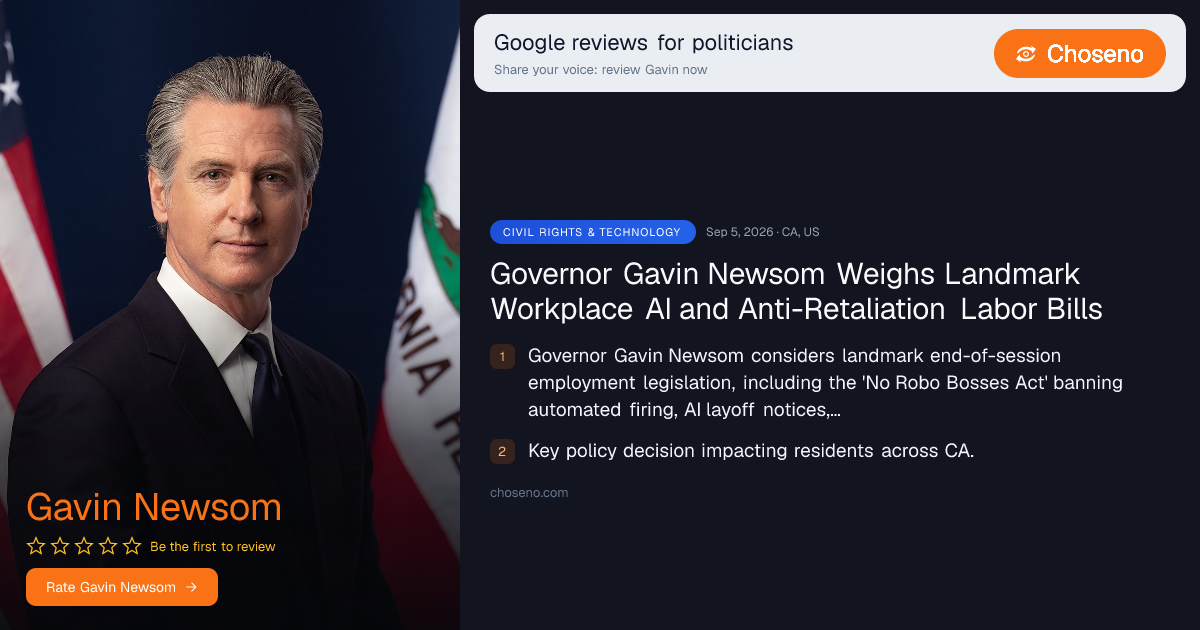
Governor Gavin Newsom Weighs Landmark Workplace AI and Anti-Retaliation Labor Bills
Governor Gavin Newsom considers landmark end-of-session employment legislation, including the 'No Robo Bosses Act' banning automated firing, AI layoff notices, and a $10,000 penalty for immigration retaliation.
Read full article
Civil Rights & Technology
US Sep 4, 2026
Flock Surveillance Cameras Spark Bipartisan Clashes in Wisconsin and Pennsylvania Governor Races
Candidates for governor in Wisconsin, Pennsylvania, and Rhode Island clash over automated license plate readers, proposing bans, funding freezes, and stricter oversight amid rising privacy concerns.
Read full article