Flock Surveillance Cameras Spark Bipartisan Clashes in Wisconsin and Pennsylvania Governor Races
Candidates for governor in Wisconsin, Pennsylvania, and Rhode Island clash over automated license plate readers, proposing bans, funding freezes, and stricter oversight amid rising privacy concerns.
Choseno Technology & Civil Liberties Desk September 4, 2026Updated September 6, 2026 3 min read WI, US
What do you think of the people in this story? Rate them anonymously — tap a face below.
MADISON, Wis. — Automated license plate readers and artificial intelligence surveillance networks have emerged as a prominent policy battleground across key 2026 electoral contests, with gubernatorial candidates in battleground states increasingly pledging to restrict, defund, or outright ban the pervasive technology. The political debate, driven by growing public concern over warrantless tracking and Big Tech data harvesting, has placed private surveillance contractor Flock Safety at the center of competitive campaigns from the Midwest to the Atlantic coast.
In Wisconsin's closely watched open gubernatorial election, the controversy has ignited sharp clashes between Democratic nominee David Crowley and Republican nominee United States Representative Tom Tiffany. Crowley, who currently serves as Milwaukee County Executive, pointed to an administrative directive he issued limiting Flock camera deployment across county parkways and properties, pledging that as governor he would enact enforceable statutory transparency safeguards and strict privacy protections to ensure residents are not subjected to warrantless government tracking.
Conversely, Representative Tiffany called for an immediate statewide freeze on state funding allocations for Flock networks. Tiffany proposed establishing a specialized legislative task force to draft stringent data retention limits, implement criminal penalties for law enforcement misuse, restrict inter-agency data sharing, and construct firewalls against data exploitation by foreign adversaries. The exchange spurred cross-party recriminations, with state Democrats pointing to Tiffany's earlier remarks questioning the nature of the systems, while Republicans scrutinized Crowley's historical municipal votes supporting urban public safety technology.
The surveillance backlash has transcended partisan lines across several other gubernatorial races. In Pennsylvania, Democratic Governor Josh Shapiro confirmed he would support a comprehensive statewide ban on automated license plate readers, an aggressive stance echoed by his Republican challenger, State Treasurer Stacy Garrity, who denounced the camera networks as an unacceptable intrusion into private constitutional liberties. In Rhode Island, Governor Dan McKee enacted an executive pause halting new camera installations along state rights-of-way pending a comprehensive review of data storage and access protocols.
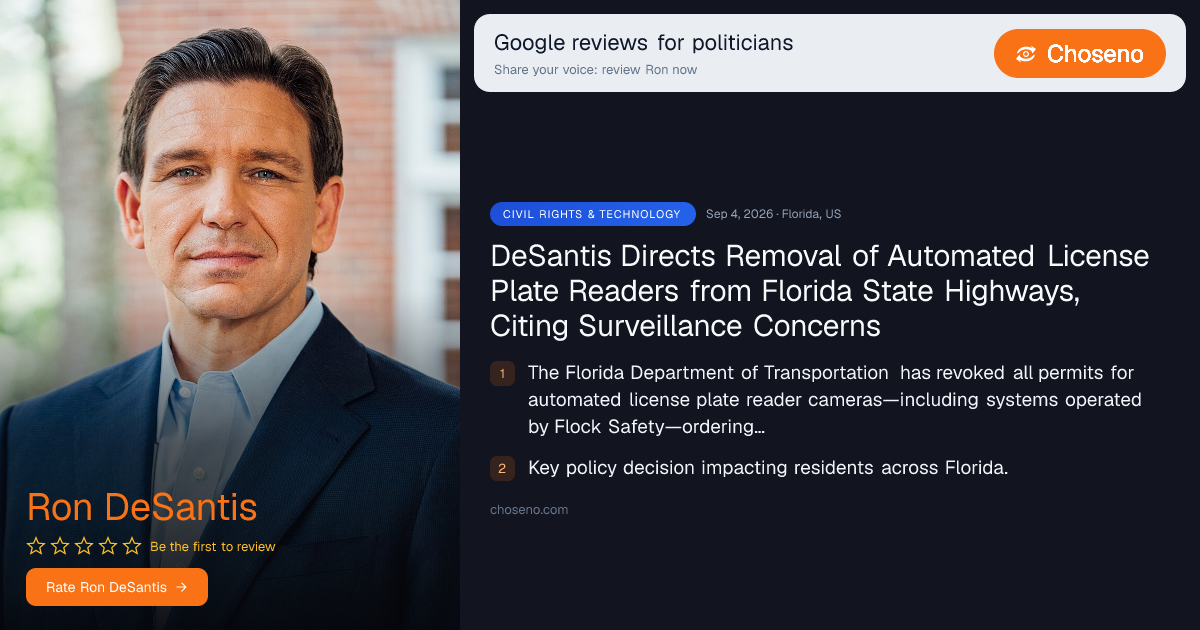
The political momentum follows recent executive actions in Florida, where Governor Ron DeSantis directed state transportation officials to revoke highway permits and dismantle automated license plate readers along state rights-of-way. Civil liberties organizations, including the Institute for Justice and state ACLU affiliates, have intensified litigation challenging the networks, warning that storing billions of vehicular location records in searchable private databases creates an unchecked digital dragnet. Investigative reports documenting instances where officers accessed vehicle tracking databases for personal stalking have further heightened legislative scrutiny.
Flock Safety, whose camera systems currently operate across thousands of municipalities nationwide, has vigorously defended the technology, asserting that its vehicle-identification networks assist law enforcement in resolving major crimes and locating missing individuals. Law enforcement advocacy groups, including the National Organization of Black Law Enforcement Executives, cautioned against broad statutory bans, arguing that eliminating automated plate readers deprives detectives of an invaluable investigatory tool and suggesting that robust auditing rules and accountability penalties represent a superior policy alternative.
As midterm campaigns enter their final stretch, the debate underscores an evolving realignment surrounding surveillance, privacy, and public safety. Candidates across both political parties increasingly view opposition to automated tracking not only as a defense of Fourth Amendment liberties, but as part of a broader populist skepticism toward unregulated artificial intelligence infrastructure and expanding corporate-government data partnerships.
Rate the people mentioned in this article


Related Coverage in Civil Rights & Technology
See all Civil Rights & Technology newsCivil Rights & Technology
US Sep 5, 2026
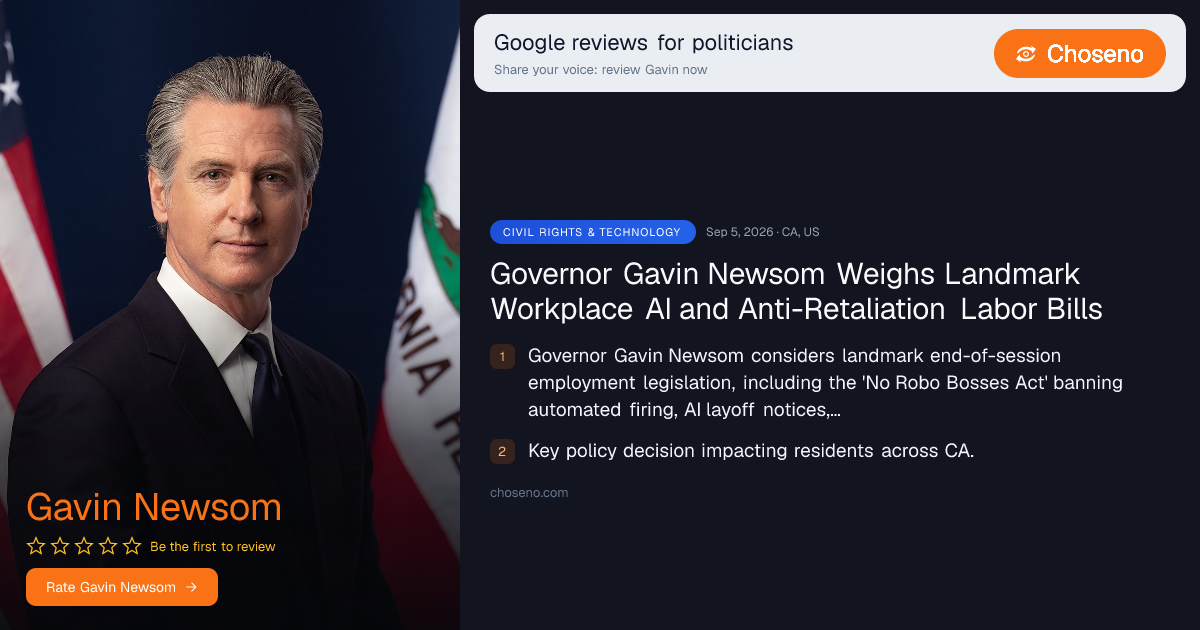
Governor Gavin Newsom Weighs Landmark Workplace AI and Anti-Retaliation Labor Bills
Governor Gavin Newsom considers landmark end-of-session employment legislation, including the 'No Robo Bosses Act' banning automated firing, AI layoff notices, and a $10,000 penalty for immigration retaliation.
Read full article
Civil Rights & Technology
US Sep 4, 2026
DeSantis Directs Removal of Automated License Plate Readers from Florida State Highways, Citing Surveillance Concerns
The Florida Department of Transportation has revoked all permits for automated license plate reader cameras—including systems operated by Flock Safety—ordering law enforcement agencies to dismantle surveillance devices along state highway rights-of-way within 30 days.
Read full article