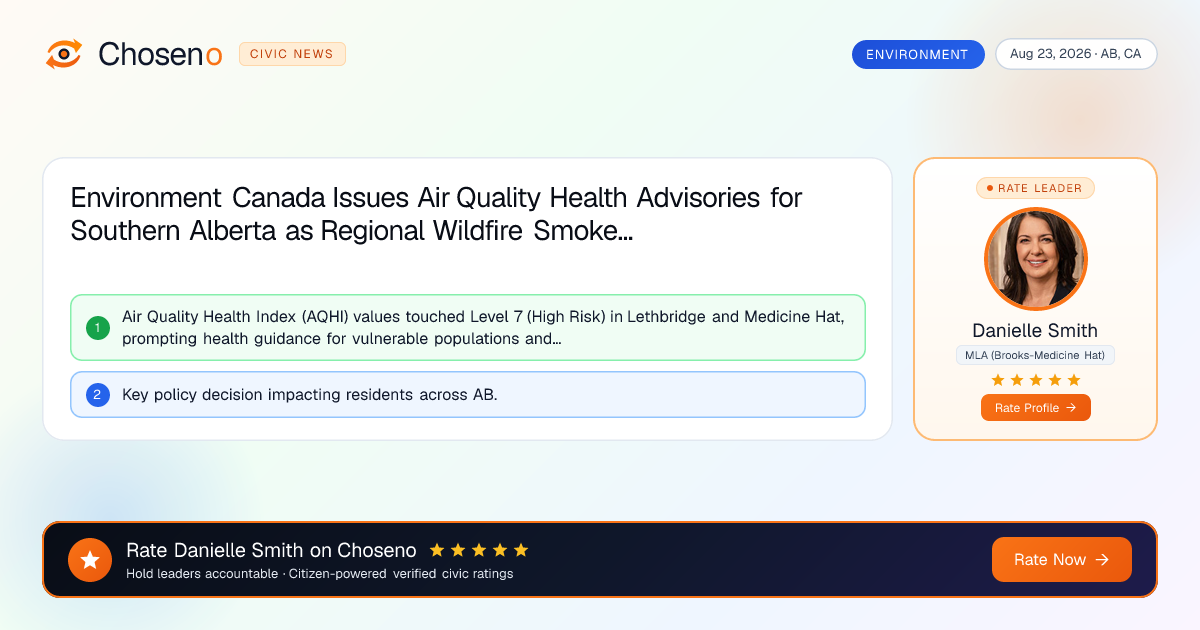
Environment Canada Issues Air Quality Health Advisories for Southern Alberta as Regional Wildfire Smoke Drifts East
Air Quality Health Index (AQHI) values touched Level 7 (High Risk) in Lethbridge and Medicine Hat, prompting health guidance for vulnerable populations and outdoor workers.
Choseno Prairie Bureau August 23, 2026 1 min read AB, CA
★ Choseno Civic Briefing
Key Leaders
LETHBRIDGE, AB — Environment and Climate Change Canada (ECCC) in conjunction with Alberta Health Services (AHS) issued Special Air Quality Statements on Sunday afternoon for Lethbridge, Medicine Hat, Brooks, and the Crowsnest Pass as dense wildfire smoke from regional fires reduced air quality to high-risk levels.
Particulate Concentrations and Atmospheric Inversion
Shifting upper-level westerly atmospheric winds transported elevated fine particulate matter (PM2.5) plumes from complex wildfires in the northern Great Basin and southeastern British Columbia across the Rocky Mountains into southern Alberta. The Air Quality Health Index (AQHI) reached Level 7 to Level 8 across regional monitoring stations in Lethbridge and Taber.
A surface temperature inversion trapped smoke particulates near ground level, reducing horizontal visibility along Highway 3 and the Trans-Canada Highway to under two kilometers.
"Wildfire smoke can be harmful to everyone's health even at low concentrations," Environment Canada stated in its meteorological advisory. "People with lung disease, heart disease, older adults, and children are at higher risk of experiencing adverse symptoms."
Public Health Guidance and Community Respite
Alberta Health Services advised affected residents to keep indoor air clean by closing windows, operating high-efficiency particulate air (HEPA) filtration units, and postponing strenuous outdoor cardiovascular exercise.
Municipal recreation facilities and public libraries in Lethbridge and Medicine Hat activated designated clean-air public cooling and respite spaces with advanced commercial HVAC filtration.
Forecast Clearing
ECCC meteorologists anticipate that a developing cold frontal trough tracking south from central Alberta on Monday will generate surface wind shear that gradually disperses regional smoke plumes by Tuesday morning.
Sources
Rate the people mentioned in this article

Related Coverage in Environment
See all Environment newsEnvironment
US Aug 23, 2026
National Hurricane Center Tracks Three Tropical Waves as Atlantic Basin Approaches Climatological Peak
Hurricane forecasters identified an 80% probability of tropical depression development within 48 hours for a low-pressure system emerging off the West African coast.
Read full article
Environment
US Aug 23, 2026
Miami City Commission Authorizes $12M Engineering Study for Biscayne Bay Multi-Layer Storm Surge Barriers
Miami and the U.S. Army Corps of Engineers initiated technical design reviews for submerged breakwaters, mangrove revetments, and automated surge gates to protect downtown.
Read full article

Environment
US Aug 23, 2026
Phoenix City Council Approves Expansion of Solar-Reflective Cool Pavement Across 120 Lane-Miles
Phoenix authorized municipal funding to apply solar-reflective pavement coatings across high-heat residential neighborhoods, reducing ambient nighttime surface temperatures by up to 12°F.
Read full article