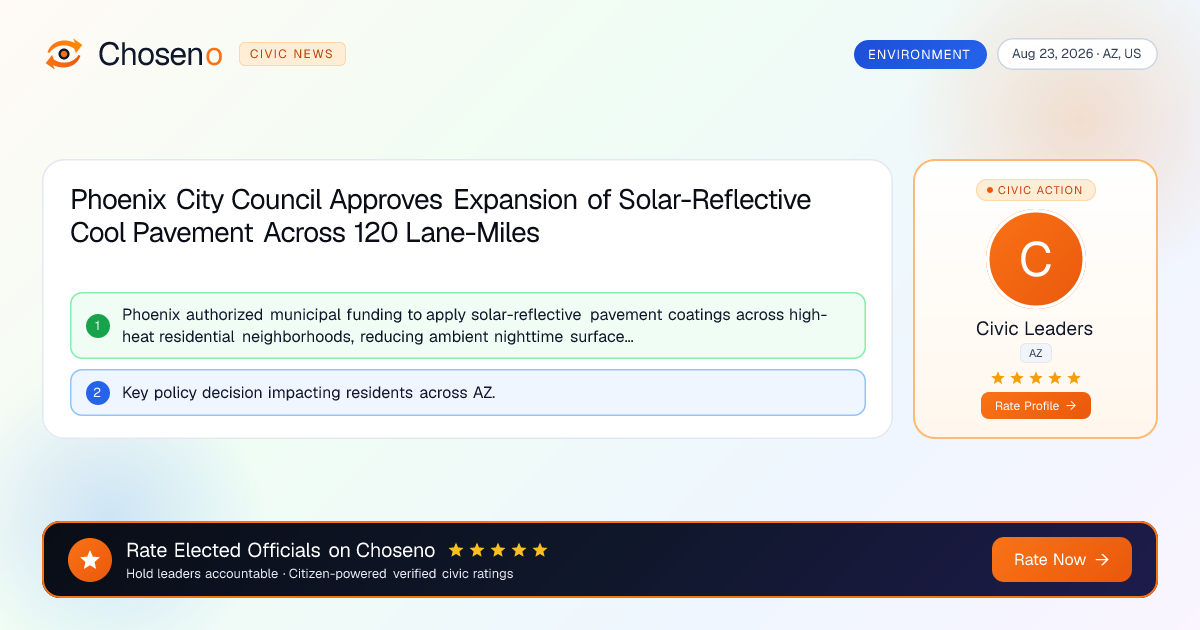
National Hurricane Center Tracks Three Tropical Waves as Atlantic Basin Approaches Climatological Peak
Hurricane forecasters identified an 80% probability of tropical depression development within 48 hours for a low-pressure system emerging off the West African coast.
Choseno Tropical Meteorology Desk August 23, 2026 1 min read FL, US
★ Choseno Civic Briefing
Key Leaders
MIAMI, FL — The National Hurricane Center (NHC) issued its Sunday afternoon Tropical Weather Outlook, highlighting three separate areas of low-pressure interest across the tropical Atlantic basin as the 2026 hurricane season enters its historical peak.
Meteorological Tracking and Development Probability
The primary system of concern, designated Invest 98L, is a well-organized tropical wave located approximately 500 miles southwest of the Cabo Verde Islands. Environmental conditions—characterized by sea surface temperatures of 84°F, low vertical wind shear, and high mid-level moisture—are highly conducive for cyclogenesis. The NHC assigned the system an 80% chance of developing into a named tropical depression within 48 hours as it tracks westward across the open Atlantic at 15 mph.
Two secondary low-pressure disturbances in the central tropical Atlantic and the western Caribbean Sea are exhibiting intermittent convective shower activity with lower development probabilities of 30% and 20% respectively.
"Climatologically, late August through September represents the most active window for transatlantic long-track tropical cyclones," NHC hurricane specialists noted. "Residents in coastal areas should review their family hurricane disaster plans."
Coastal Preparedness and Modeling
Global ensemble weather models (ECMWF and GFS) project that Invest 98L will continue its westward track toward the Lesser Antilles over the next five to seven days.
Emergency management agencies along the U.S. Gulf Coast, the Eastern Seaboard, and the Caribbean have reviewed mutual aid protocols and fuel distribution logistics.
Update Schedule
The National Hurricane Center issues comprehensive Tropical Weather Outlook updates four times daily at 2:00 a.m., 8:00 a.m., 2:00 p.m., and 8:00 p.m. EDT.
Related Coverage in Environment
See all Environment newsEnvironment
CA Aug 23, 2026
Environment Canada Issues Air Quality Health Advisories for Southern Alberta as Regional Wildfire Smoke Drifts East
Air Quality Health Index (AQHI) values touched Level 7 (High Risk) in Lethbridge and Medicine Hat, prompting health guidance for vulnerable populations and outdoor workers.
Read full article

Environment
US Aug 23, 2026
Miami City Commission Authorizes $12M Engineering Study for Biscayne Bay Multi-Layer Storm Surge Barriers
Miami and the U.S. Army Corps of Engineers initiated technical design reviews for submerged breakwaters, mangrove revetments, and automated surge gates to protect downtown.
Read full article

Environment
US Aug 23, 2026
Phoenix City Council Approves Expansion of Solar-Reflective Cool Pavement Across 120 Lane-Miles
Phoenix authorized municipal funding to apply solar-reflective pavement coatings across high-heat residential neighborhoods, reducing ambient nighttime surface temperatures by up to 12°F.
Read full article