Iowa District Court Places Farming Operations of Lieutenant Governor Candidate Derek Wulf in Receivership
An Iowa state court has placed the farming enterprise of State Representative and Republican lieutenant governor candidate Derek Wulf under court-ordered receivership following ongoing litigation and financial claims from agricultural lenders.
Choseno Civic News Desk September 5, 2026 2 min read US
What do you think of the people in this story? Rate them anonymously — tap a face below.
DES MOINES, Iowa — An Iowa state district court has appointed an independent receiver to assume operational control over Shallow Creek Land and Livestock, the farming enterprise owned and managed by Iowa State Representative Derek Wulf (R-Hudson), who is actively campaigning as the Republican nominee for lieutenant governor.
The judicial decree, which took effect on September 1, 2026, marks an escalation in a series of civil lawsuits and credit disputes filed against the Black Hawk County lawmaker by agricultural lending institutions and farm supply creditors over the past year. Under the receivership order, an appointed custodian will manage the farm's daily commercial transactions, secure livestock assets, oversee remaining grain inventories, and administer pending financial accounts to protect creditor interests.
Court filings indicate that the appointment followed Wulf’s failure to deliver a certified refinancing commitment letter required under a prior judicial standstill arrangement. Creditors, including agricultural lender Heartland, had petitioned the court for emergency intervention, submitting legal documents alleging financial non-disclosure, unauthorized transfers of encumbered cattle collateral, and payments attempted against inactive bank accounts. While multiple prior contract disputes involving the Hudson farm were resolved or settled out of court in early 2026, the court determined that formal receivership was warranted to safeguard outstanding agricultural loans.
Representative Wulf, who represents House District 76 in the Iowa General Assembly and has served as a legislative ally to Governor Kim Reynolds on rural economic and tax policy, has publicly defended his business record while acknowledging significant economic headwinds facing Midwestern agricultural producers.
"Like thousands of independent family farmers across Iowa and the Midwest, our family operation has faced unprecedented challenges over the last several seasons, including sharp input inflation, volatile cattle prices, and shifting credit markets," Wulf stated during recent public remarks regarding the litigation. "We have worked continuously with financial advisers and institutional lenders in good faith to restructure obligations, settle accounts, and maintain our agricultural heritage. We remain fully committed to seeing this restructuring through transparently."
Despite the candidate's explanation of broader agricultural economic pressures, the court ruling has quickly reverberated across Iowa's state political landscape. Opponents and civic watchdog groups have called on the campaign to provide comprehensive financial disclosures regarding outstanding personal liabilities and the funding mechanisms supporting the restructuring efforts, arguing that voters deserve complete transparency regarding the personal and commercial finances of candidates seeking executive office.
With Iowa state administrative leadership preparing for upcoming legislative and budget priorities in Des Moines, political observers anticipate the receivership proceedings will remain an active subject of scrutiny on the campaign trail as creditors and the court-appointed receiver submit their initial financial inventories to the district court.
Rate the people mentioned in this article

Related Coverage in State & Federal Governance
See all State & Federal Governance newsState & Federal Governance
US Sep 5, 2026
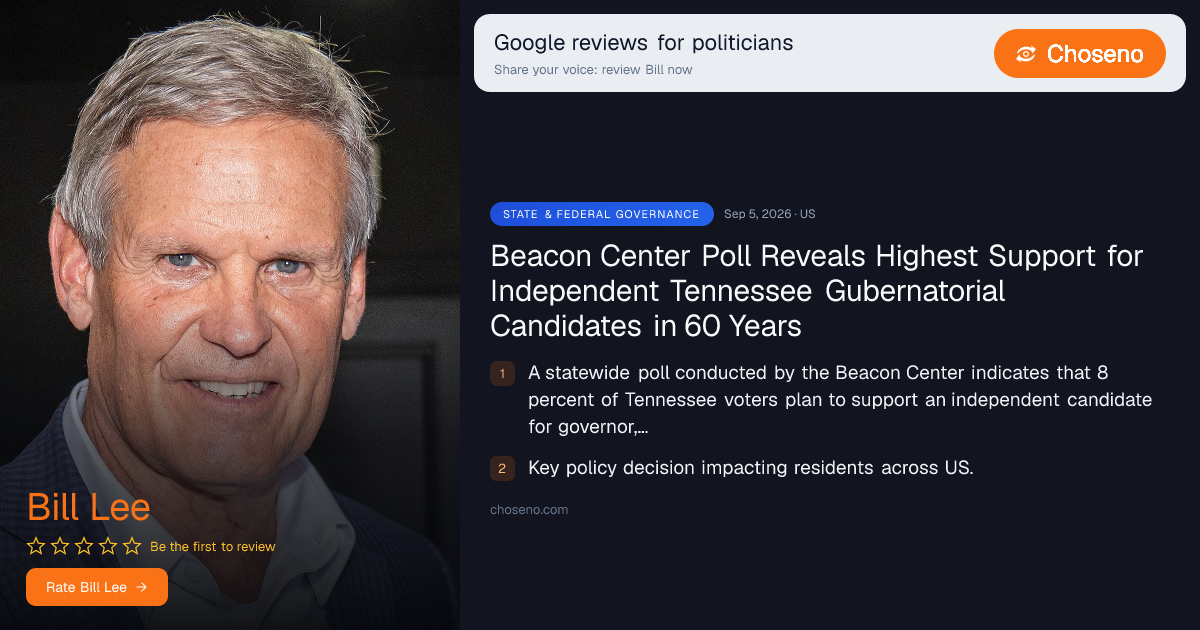
Beacon Center Poll Reveals Highest Support for Independent Tennessee Gubernatorial Candidates in 60 Years
A statewide poll conducted by the Beacon Center indicates that 8 percent of Tennessee voters plan to support an independent candidate for governor, representing the strongest non-major-party support recorded in the state in sixty years as contenders vie to succeed Governor Bill Lee.
Read full article
State & Federal Governance
US Sep 5, 2026
North Dakota Senate Rejects SB 2406 Banning Non-Disclosure Agreements in Municipal Data Center Negotiations
The North Dakota Senate voted 32-15 to reject Senate Bill 2406, preserving the authority of state and municipal economic development officials to utilize non-disclosure agreements during commercial negotiations with artificial intelligence data center developers.
Read full article
State & Federal Governance
US Sep 5, 2026
Former South Carolina Governor David Beasley Launches 'Breaking Bread Together' Initiative to Address National Political Divide
Former South Carolina Governor and Nobel laureate David Beasley launched 'Breaking Bread Together,' a national civic initiative partnering with local community organizations to bridge deepening political polarization through structured community meals and dialogue.
Read full article