Minnesota Gubernatorial Nominee Lisa Demuth Tours Iron Range Businesses to Champion Mining Supply Chain Expansion
Republican gubernatorial nominee Lisa Demuth visited industrial suppliers and precision fabrication shops across Minnesota's Iron Range, calling for expedited permitting and expanded domestic mineral extraction ahead of the November general election.
Choseno Civic News Desk September 5, 2026 2 min read US
What do you think of the people in this story? Rate them anonymously — tap a face below.
VIRGINIA, Minn. — Fresh off securing the Republican nomination for governor, Minnesota House Republican Leader Lisa Demuth conducted a comprehensive policy tour of Northern Minnesota small businesses and industrial fabricators on September 4, centering her campaign platform on the revitalisation and regulatory streamlining of the state's storied mining economy.
The tour traversed key communities across the Iron Range, including stops in Virginia, Hibbing, and surrounding St. Louis County industrial parks. Rather than focusing exclusively on extraction pits and processing plants, Demuth visited secondary suppliers, heavy equipment repair machine shops, and specialized engineering contractors whose operations depend directly on active mining contracts across northeastern Minnesota.
"We need to make sure that we're looking at all the pieces that support mining in the area, and it can be from the very smallest machine shop to a larger, long-standing industrial operation," Demuth stated during a roundtable discussion with local manufacturing executives and municipal leaders in Virginia. "These small businesses provide high-wage family jobs and form the backbone of communities across the Iron Range. Minnesota has the resources and workforce to be a national leader in safe, modern mineral extraction, but excessive state regulatory hurdles are stifling investment across our northern counties."
Demuth, who won the Republican primary in August after building widespread grassroots support among rural and suburban delegates, has made regulatory reform and commercial tax reductions central pillars of her gubernatorial campaign. Throughout her tour, she criticized executive branch environmental review timelines administered under Governor Tim Walz’s administration, arguing that protracted multi-agency litigation and delayed permitting have deterred domestic mining companies seeking to develop copper-nickel and precious metal deposits critical for domestic energy storage and manufacturing technologies.
The debate over Iron Range mining policy stands as a defining ideological divide in the general election contest, where Demuth faces Democratic-Farmer-Labor (DFL) nominee U.S. Senator Amy Klobuchar. While Demuth advocates for predictable state permitting schedules and local economic development guarantees, DFL leaders and environmental coalitions have emphasized the imperative of rigorous statutory safeguards to protect the delicate hydrology of the Lake Superior basin and the Boundary Waters Canoe Area Wilderness from potential acid mine drainage.
Senator Klobuchar and state DFL officials have maintained that federal and state investments must balance clean energy transition incentives with iron ore production while enforcing uncompromised environmental compliance standards. Municipal leaders across the Range, meanwhile, have urged both state candidates to provide actionable plans for diversifying local tax bases, expanding workforce training at regional community colleges, and maintaining state infrastructure aids to support public services in resource-dependent communities.
With early voting set to begin across Minnesota later this month, both campaigns are escalating their regional outreach, acknowledging that voter turnout across the Iron Range could prove decisive in determining the executive leadership of the state in November.
Rate the people mentioned in this article


Related Coverage in State & Federal Governance
See all State & Federal Governance newsState & Federal Governance
US Sep 5, 2026
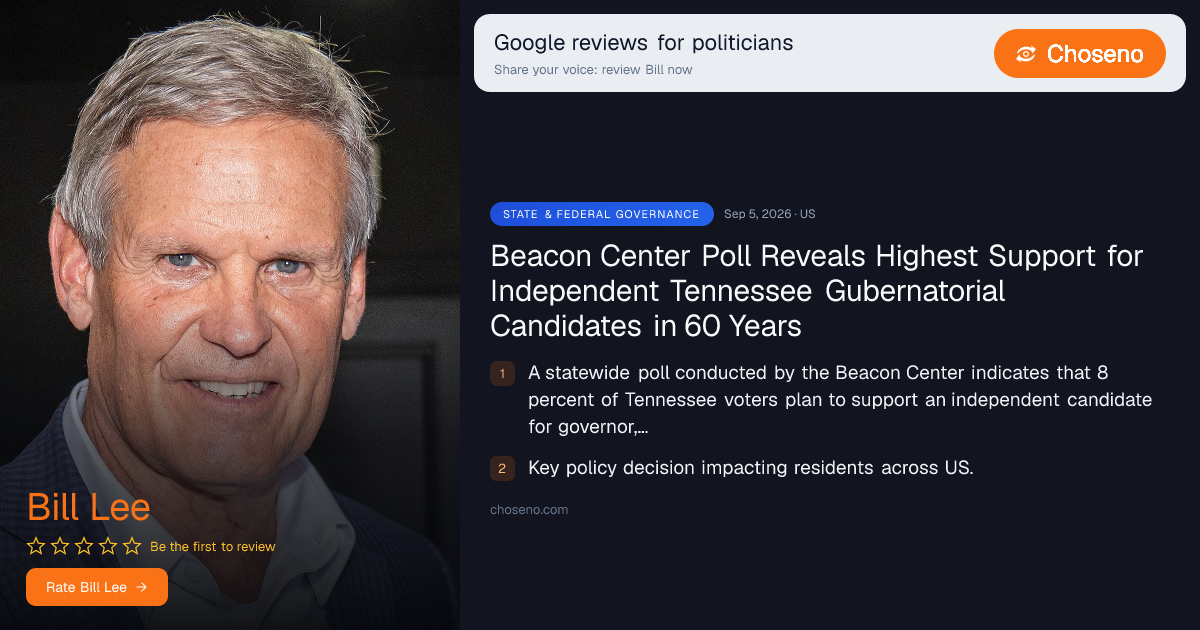
Beacon Center Poll Reveals Highest Support for Independent Tennessee Gubernatorial Candidates in 60 Years
A statewide poll conducted by the Beacon Center indicates that 8 percent of Tennessee voters plan to support an independent candidate for governor, representing the strongest non-major-party support recorded in the state in sixty years as contenders vie to succeed Governor Bill Lee.
Read full article
State & Federal Governance
US Sep 5, 2026
North Dakota Senate Rejects SB 2406 Banning Non-Disclosure Agreements in Municipal Data Center Negotiations
The North Dakota Senate voted 32-15 to reject Senate Bill 2406, preserving the authority of state and municipal economic development officials to utilize non-disclosure agreements during commercial negotiations with artificial intelligence data center developers.
Read full article
State & Federal Governance
US Sep 5, 2026
Former South Carolina Governor David Beasley Launches 'Breaking Bread Together' Initiative to Address National Political Divide
Former South Carolina Governor and Nobel laureate David Beasley launched 'Breaking Bread Together,' a national civic initiative partnering with local community organizations to bridge deepening political polarization through structured community meals and dialogue.
Read full article