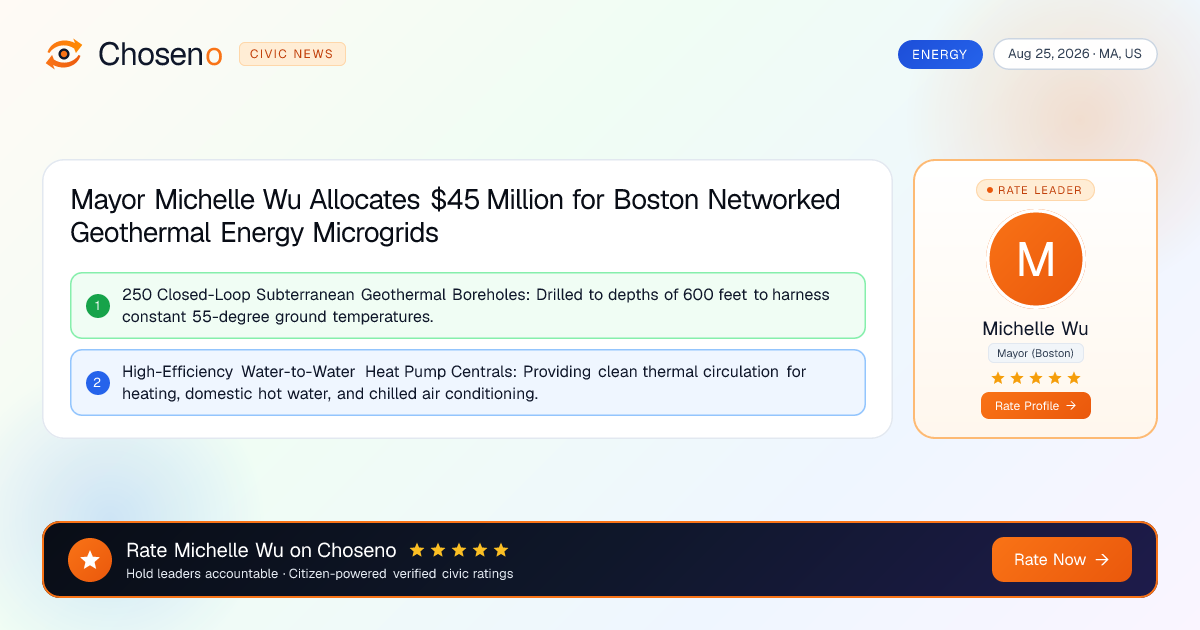
Mayor Michelle Wu Allocates $45 Million for Boston Networked Geothermal Energy Microgrids
Boston Mayor Michelle Wu and the Boston City Council approve $45 million in Green New Deal capital funding to construct shallow-bore networked geothermal district heating and cooling systems across Mattapan and East Boston public housing developments.
Choseno Boston Desk August 25, 2026 2 min read MA, US
★ Choseno Civic Briefing
Key Leaders
BOSTON — Mayor Michelle Wu and the Boston City Council announced on Monday the approval of a $45 million municipal capital appropriation through the Boston Green New Deal Infrastructure Fund to drill and install shallow-bore networked geothermal district energy systems connecting 1,200 municipal public housing units and community community centers in Mattapan and East Boston.
The municipal clean heating and cooling microgrids replace failing, fossil-fueled hydronic oil and gas boilers with ground-source heat pump loop fields drilled beneath municipal parks and parking lots, delivering zero-emission heating in winter and whole-home cooling during severe summer heat waves.
Eliminating Carbon Emissions and Slashing Utility Bills for Working Families Low-income urban residents often face acute energy burdens, spending over ten percent of their household income on inefficient heating, while lacking central air conditioning during dangerous summer temperature spikes.
"Access to clean, comfortable, and affordable heating and cooling is a fundamental right for every family in Boston," Mayor Michelle Wu said during an announcement at the Franklin Field public housing development in Dorchester. "By replacing fossil fuel boilers with networked geothermal loops drilled right under our feet, we are drastically cutting carbon emissions, improving indoor air quality, and lowering monthly energy bills for our residents. Boston is proving that cities can lead the transition to renewable energy while putting equity and climate justice first."
Geothermal District Features The $45 million capital program finances:
- 250 Closed-Loop Subterranean Geothermal Boreholes: Drilled to depths of 600 feet to harness constant 55-degree ground temperatures.
- High-Efficiency Water-to-Water Heat Pump Centrals: Providing clean thermal circulation for heating, domestic hot water, and chilled air conditioning.
- Local Green Trades Apprenticeships: $5 million dedicated for local union pipefitters and HVAC technician training programs in environmental justice neighborhoods.
Tenant advocacy groups, environmental health federations, and green building associations commended the municipal council action, highlighting that networked geothermal provides reliable, weather-resilient community energy.
Rate the people mentioned in this article
Related Coverage in Energy
See all Energy newsEnergy
CA Aug 25, 2026
Industry Minister François-Philippe Champagne Directs $380 Million for Canadian SMR Nuclear Tooling Hubs
Innovation Minister François-Philippe Champagne allocates $380 million through the Strategic Innovation Fund to scale nuclear-grade precision manufacturing lines for Small Modular Reactors (SMRs) across Ontario, Quebec, and Saskatchewan.
Read full article

Energy
CA Aug 25, 2026
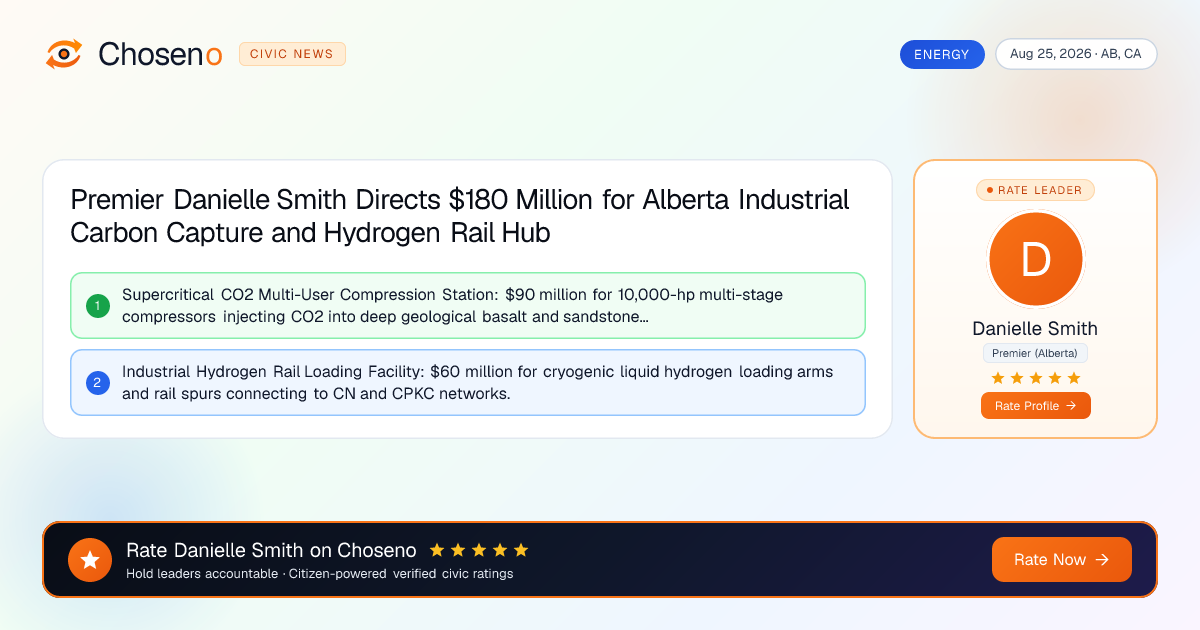
Premier Danielle Smith Directs $180 Million for Alberta Industrial Carbon Capture and Hydrogen Rail Hub
Alberta Premier Danielle Smith and Energy Minister Brian Jean allocate $180 million through the Alberta Petrochemicals Incentive Program to construct high-capacity CO2 compression hubs and dedicated hydrogen rail tanker loading racks in the Industrial Heartland.
Read full article
Energy
US Aug 25, 2026
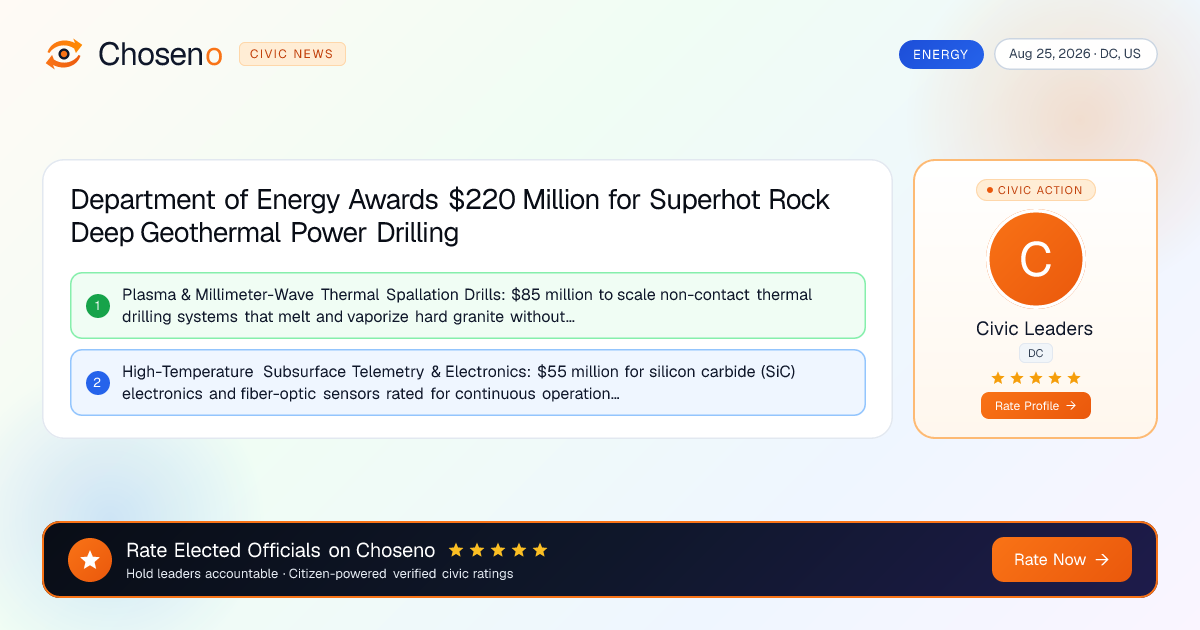
Department of Energy Awards $220 Million for Superhot Rock Deep Geothermal Power Drilling
Energy Secretary Jennifer Granholm and ARPA-E allocate $220 million to construct commercial deep-well drilling rigs capable of penetrating 500°C crystalline granite at depths of six kilometers for next-generation baseload geothermal electricity.
Read full article