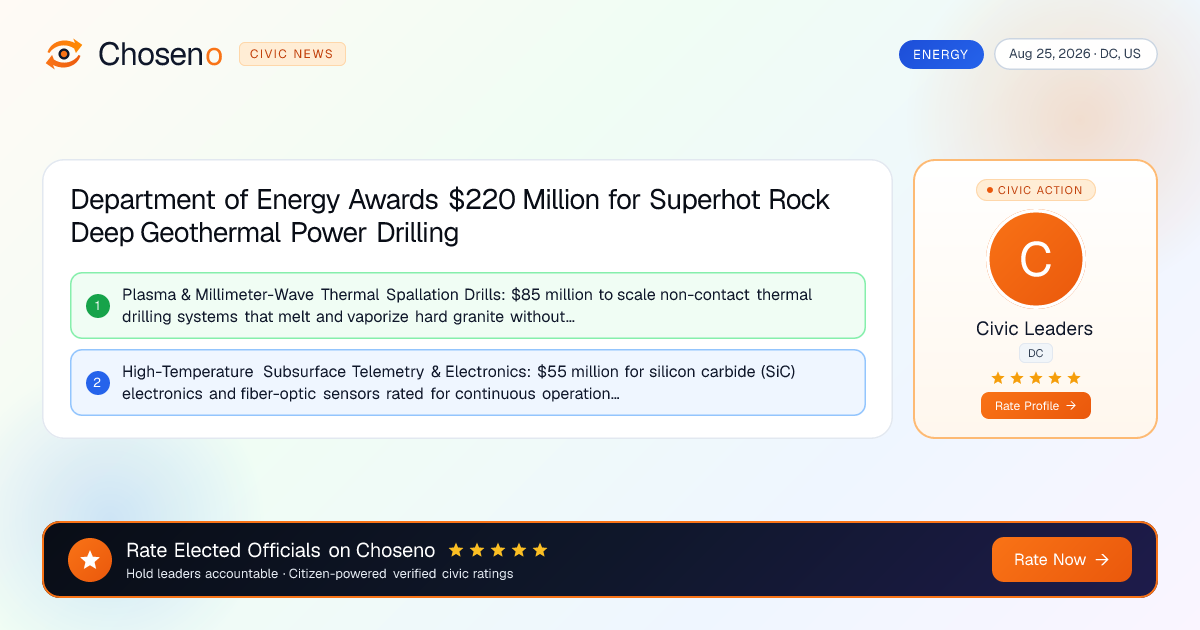
Premier Danielle Smith Directs $180 Million for Alberta Industrial Carbon Capture and Hydrogen Rail Hub
Alberta Premier Danielle Smith and Energy Minister Brian Jean allocate $180 million through the Alberta Petrochemicals Incentive Program to construct high-capacity CO2 compression hubs and dedicated hydrogen rail tanker loading racks in the Industrial Heartland.
Choseno Western Energy Bureau August 25, 2026 2 min read AB, CA
★ Choseno Civic Briefing
Key Leaders
FORT SASKATCHEWAN, Alta. — Premier Danielle Smith and Minister of Energy and Minerals Brian Jean announced on Monday the distribution of $180 million in provincial capital grants through the Alberta Petrochemicals Incentive Program (APIP) to construct commercial high-pressure carbon dioxide compression headers, supercritical CO2 trunkline tie-ins, and dedicated pressurized liquid hydrogen rail tanker loading facilities across Alberta's Industrial Heartland in Fort Saskatchewan and Strathcona County.
The multi-user infrastructure facility connects regional petrochemical refineries, fertilizer manufacturers, and blue hydrogen generation plants to deep saline aquifer permanent carbon sequestration formations, allowing industrial producers to permanently store up to 5 million metric tons of CO2 annually while exporting low-carbon hydrogen across North America.
Solidifying Alberta's Global Leadership in Low-Carbon Heavy Industry The Alberta Industrial Heartland represents Canada's largest hydrocarbon processing hub, where integrating open-access carbon capture and storage (CCS) trunklines allows existing heavy industries to decarbonize while attracting multibillion-dollar clean manufacturing investments.
"Alberta has the natural resources, the engineering talent, and the geological advantages to lead the world in low-carbon energy and petrochemical manufacturing," Premier Danielle Smith said in Fort Saskatchewan. "Global investors are looking for jurisdictions that can produce clean energy and manufactured products with the lowest carbon intensity. This $180 million investment builds open-access carbon capture and hydrogen export terminals, driving billions in private capital investment and creating thousands of high-paying jobs for Alberta workers."
Heartland Infrastructure Components The $180 million program funds:
- Supercritical CO2 Multi-User Compression Station: $90 million for 10,000-hp multi-stage compressors injecting CO2 into deep geological basalt and sandstone reservoirs.
- Industrial Hydrogen Rail Loading Facility: $60 million for cryogenic liquid hydrogen loading arms and rail spurs connecting to CN and CPKC networks.
- Subsurface Geological Monitoring Array: $30 million to deploy 4D seismic sensors and micro-seismic monitoring wells ensuring permanent sequestration integrity.
Industrial association leaders, municipal reeves, and energy labor unions commended the provincial government investment, highlighting that open-access carbon capture infrastructure secures long-term competitiveness for Alberta heavy industry.
Rate the people mentioned in this article

Related Coverage in Energy
See all Energy newsEnergy
CA Aug 25, 2026
Industry Minister François-Philippe Champagne Directs $380 Million for Canadian SMR Nuclear Tooling Hubs
Innovation Minister François-Philippe Champagne allocates $380 million through the Strategic Innovation Fund to scale nuclear-grade precision manufacturing lines for Small Modular Reactors (SMRs) across Ontario, Quebec, and Saskatchewan.
Read full article

Energy
US Aug 25, 2026
Mayor Michelle Wu Allocates $45 Million for Boston Networked Geothermal Energy Microgrids
Boston Mayor Michelle Wu and the Boston City Council approve $45 million in Green New Deal capital funding to construct shallow-bore networked geothermal district heating and cooling systems across Mattapan and East Boston public housing developments.
Read full article
Energy
US Aug 25, 2026
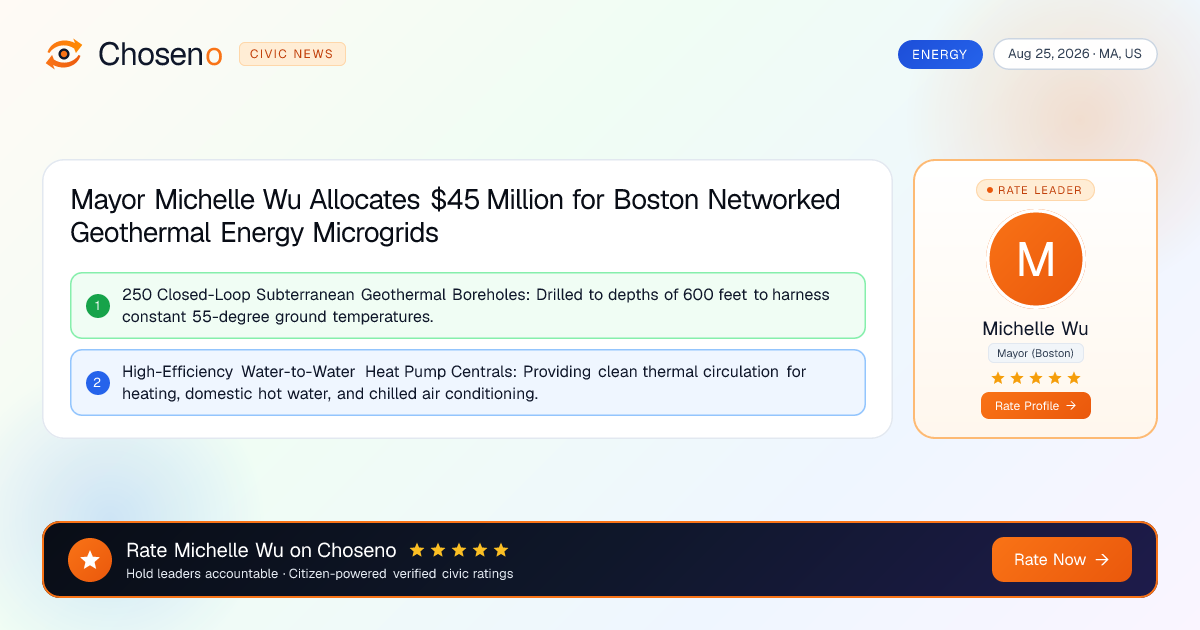
Department of Energy Awards $220 Million for Superhot Rock Deep Geothermal Power Drilling
Energy Secretary Jennifer Granholm and ARPA-E allocate $220 million to construct commercial deep-well drilling rigs capable of penetrating 500°C crystalline granite at depths of six kilometers for next-generation baseload geothermal electricity.
Read full article