North Dakota Governor Kelly Armstrong Enacts HB 1628 Banning Synthetic Kratom and Regulating Natural Sales
Governor Kelly Armstrong signed House Bill 1628 following a three-day special legislative session in Bismarck, enacting a statewide prohibition on synthetic kratom compounds while establishing strict licensing, testing, and age restrictions on natural botanicals.
Choseno Civic News Desk September 5, 2026 2 min read US
BISMARCK, N.D. — Capping an expedited three-day special legislative session convened to address escalating public health and consumer safety concerns, North Dakota Governor Kelly Armstrong signed House Bill 1628 into law on September 4, establishing a comprehensive statutory ban on synthetic kratom derivatives while instituting strict regulatory controls over natural botanical products.
The legislative enactment concludes a month of rapid administrative action in Bismarck. On August 3, Governor Armstrong had utilized statutory executive emergency powers to declare a statewide public health emergency, issuing an executive order that temporarily placed an immediate moratorium on the retail distribution of all kratom-based products across North Dakota. With the formal passage and executive signature of HB 1628, the governor formally rescinded the emergency decree, transitioning the state to a permanent statutory framework administered by the North Dakota Attorney General’s Office and state health authorities.
The newly enacted statute establishes a decisive legal distinction between synthetic chemical analogs and traditional whole-leaf botanicals. The law outright bans the manufacture, commercial distribution, possession, and sale of synthetic kratom formulations, specifically criminalizing dangerous concentrated compounds including 7-hydroxymitragynine (7-OH), mitragynine pseudoindoxyl, and novel designer analogs known in laboratory testing as MGM-15 and MGM-16.
For unadulterated, natural kratom products, HB 1628 institutes sweeping regulatory hurdles designed to prevent youth access and ensure product purity. The measure prohibits sales to any individual under the age of 21, requires all commercial retailers to obtain an annual operating license from the Attorney General, and establishes mandatory "truth-in-labeling" protocols. Under these guidelines, commercial products must undergo rigorous batch testing by state-accredited independent laboratories, with finished packaging clearly disclosing exact milligram concentrations of natural alkaloids while explicitly barring candy-style branding, cartoon imagery, or youth-oriented marketing.
"Our administration made it clear that North Dakota would not sit idly by while unverified, highly concentrated chemical compounds were sold openly in convenience stores and tobacco outlets across our state," Governor Kelly Armstrong stated in Bismarck. "While our initial preference was a total statutory ban on all iterations of these products, the Legislative Assembly worked collaboratively and decisively to craft robust legislation that eliminates dangerous synthetics, establishes stringent consumer safeguards, and protects North Dakota youth from predatory marketing."
State public health directors and medical professionals had testified before legislative committees that concentrated synthetic analogs act upon opioid receptors with unpredictable potency, leading to an increase in regional emergency department admissions, poison control calls, and severe addiction cases across the Upper Midwest.
Under the provisions of HB 1628, the North Dakota Department of Health and Human Services and state law enforcement agencies will begin compliance inspections across regional retail establishments immediately. Retailers found selling prohibited synthetic compounds or providing botanical products to underage consumers will face statutory misdemeanor and felony penalties, alongside mandatory license revocation.
Rate the people mentioned in this article

Related Coverage in State & Federal Governance
See all State & Federal Governance newsState & Federal Governance
US Sep 5, 2026
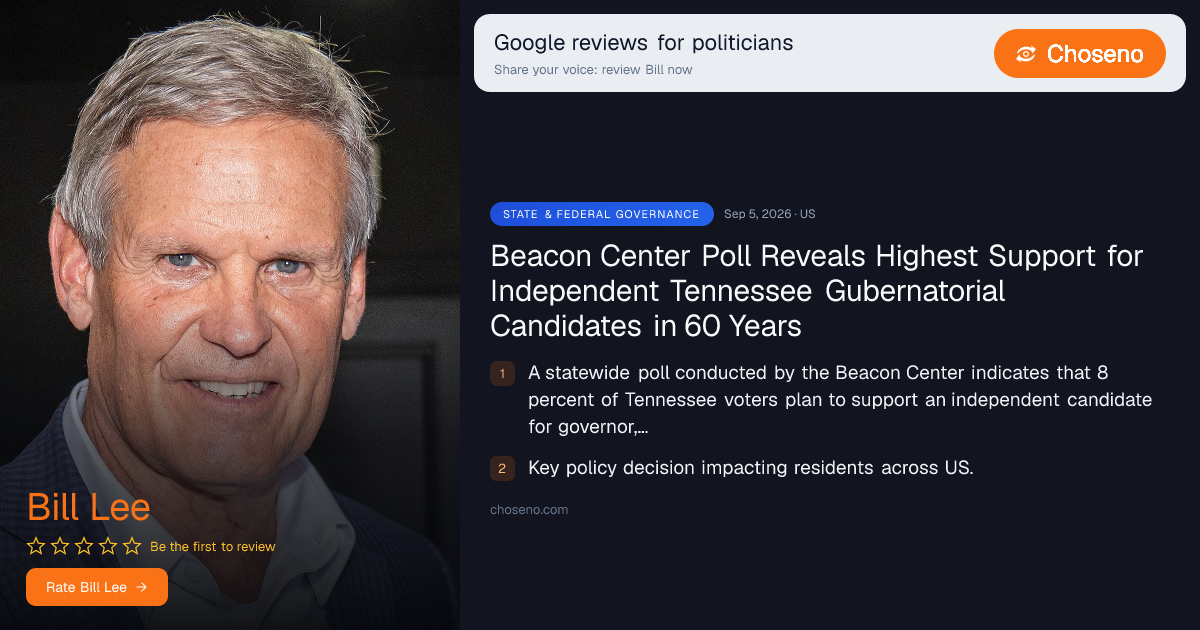
Beacon Center Poll Reveals Highest Support for Independent Tennessee Gubernatorial Candidates in 60 Years
A statewide poll conducted by the Beacon Center indicates that 8 percent of Tennessee voters plan to support an independent candidate for governor, representing the strongest non-major-party support recorded in the state in sixty years as contenders vie to succeed Governor Bill Lee.
Read full article
State & Federal Governance
US Sep 5, 2026
North Dakota Senate Rejects SB 2406 Banning Non-Disclosure Agreements in Municipal Data Center Negotiations
The North Dakota Senate voted 32-15 to reject Senate Bill 2406, preserving the authority of state and municipal economic development officials to utilize non-disclosure agreements during commercial negotiations with artificial intelligence data center developers.
Read full article
State & Federal Governance
US Sep 5, 2026
Former South Carolina Governor David Beasley Launches 'Breaking Bread Together' Initiative to Address National Political Divide
Former South Carolina Governor and Nobel laureate David Beasley launched 'Breaking Bread Together,' a national civic initiative partnering with local community organizations to bridge deepening political polarization through structured community meals and dialogue.
Read full article