Transport Canada Issues Emergency Aviation Directives Restricting Unauthorized Drones Near Wildfires
Federal aviation regulators enacted strict airspace exclusion zones and increased statutory fines up to $25,000 for unauthorized drone flights that disrupt aerial water bombers.
Choseno Aviation Safety Desk August 23, 2026 1 min read ON, CA
★ Choseno Civic Briefing
Key Leaders
OTTAWA, ON — Transport Canada and NAV CANADA published an emergency Aviation Security Notice on Sunday morning, reminding recreational and commercial drone operators that flying Remotely Piloted Aircraft Systems (RPAS) within five nautical miles of any active wildland fire is a federal offense.
Regulatory Enforcement and Aviation Hazards
The directive follows multiple incidents where unauthorized consumer drone incursions forced provincial wildfire management agencies to temporarily ground Canadair CL-415 water bombers and bird-dog lead planes over active fires in British Columbia and Alberta. Under Canadian Aviation Regulations (CARs) Section 601.15, all airspace within a five-nautical-mile radius and up to 3,000 feet above ground level of an active forest fire is restricted airspace.
Transport Canada clarified that individuals operating drones within fire exclusion zones face immediate summary fines of up to $25,000, aircraft seizure, and potential criminal prosecution under the Aeronautics Act.
"When a drone enters wildfire airspace, our firefighting aircraft are grounded immediately to prevent mid-air collisions," Transport Canada aviation safety officials said in Ottawa. "Delaying water drops puts wildland firefighters and communities at grave risk."
Coordination with Law Enforcement
Transport Canada has authorized regional RCMP detachments and municipal police services to utilize portable radio-frequency drone detection scanners to pinpoint pilot ground locations and issue immediate court appearance notices.
Provincial wildfire services urged the public to report unauthorized drone sightings near fire perimeters directly to local emergency dispatchers.
Public Awareness Campaign
Transport Canada launched digital public safety announcements across social platforms reminding outdoor recreationists to keep drones grounded during wildfire season.
Sources
Related Coverage in Public Safety
See all Public Safety newsPublic Safety
CA Aug 23, 2026
Severe South Coast Thunderstorm Halts Vancouver Airport Ground Operations and Knocks Out Power to Thousands
A rare tropical moisture surge triggered hundreds of cloud-to-ground lightning strikes across Metro Vancouver, shutting down YVR ramp operations and disrupting flights.
Read full article

Public Safety
US Aug 23, 2026
CAL FIRE Pre-Positions 24 Firefighting Strike Teams in Northern California Ahead of Dry Lightning Threat
State wildland fire officials placed strike teams and helitack crews on elevated alert across Shasta, Trinity, and Siskiyou counties as upper-level monsoonal moisture moves inland.
Read full article

Public Safety Breaking
US Aug 23, 2026
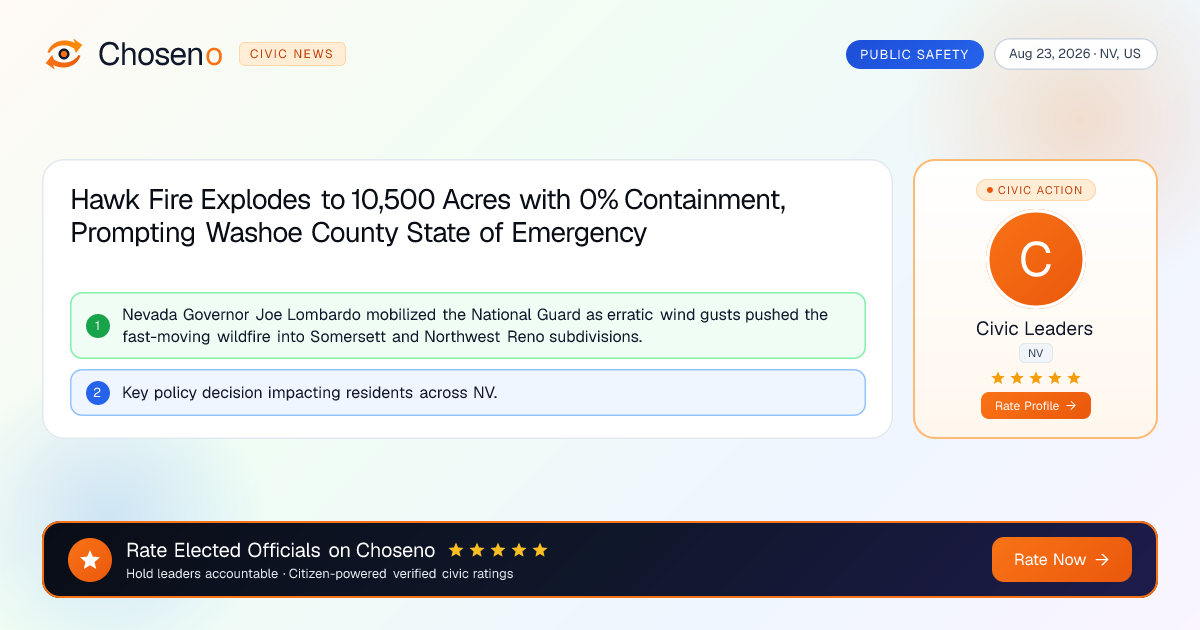
Hawk Fire Explodes to 10,500 Acres with 0% Containment, Prompting Washoe County State of Emergency
Nevada Governor Joe Lombardo mobilized the National Guard as erratic wind gusts pushed the fast-moving wildfire into Somersett and Northwest Reno subdivisions.
Read full article