BREAKING
Department of the Interior Awards $190 Million for Advanced Water Recycling and Purification Facilities
Bureau of Reclamation announces $190 million through Title XVI WaterSMART, funding eight large-scale water purification and brackish desalination plants across California, Arizona, Utah, and Nevada.
Choseno Western Water Resources & Desalination Bureau August 24, 2026 3 min read DC, US
★ Choseno Civic Briefing
Key Leaders
WASHINGTON, DC — Countering severe long-term hydrological drought across the Colorado River basin and strengthening urban water independence, the United States Department of the Interior (DOI) and the Bureau of Reclamation announced $190 million in competitive grant allocations on Monday under the Title XVI WaterSMART (Sustain and Manage America’s Resources for Tomorrow) program, funding eight major municipal advanced water recycling and desalination facilities across four Western states.
The federal capital matching grants finance the engineering, procurement, and construction of large-scale advanced water purification facilities that treat municipal wastewater to ultra-pure potable standards using microfiltration, reverse osmosis, and ultraviolet advanced oxidation with hydrogen peroxide. Once fully operational, the eight recipient water facilities will generate 125,000 acre-feet (approximately 40 billion gallons) of new drought-resilient municipal drinking water annually—enough to supply 500,000 households across Southern California, Phoenix, Las Vegas, and Salt Lake City without withdrawing a single additional drop from the depleted Colorado River reservoir system.
Major Western Water Purification Projects
The funding packages provide substantial cost-share capital to regional water wholesalers and municipal utilities. Key project awards include:
- Pure Water Southern California Regional Facility ($75 Million): Funding the construction of advanced tertiary filtration trains for the massive regional wastewater recycling plant in Carson, California, supplying 150 million gallons per day of purified water to replenish Southern California groundwater aquifers.
- Phoenix Metropolitan Advanced Water Purification Hub ($45 Million): Constructing advanced purification systems to recharge regional aquifers in Maricopa County, Arizona, offsetting severe Colorado River Tier 2 water supply curtailments.
- Las Vegas Valley Water District Brackish Desalination ($40 Million): Expanding reverse osmosis treatment capacity to purify brackish groundwater in Southern Nevada.
- Utah Jordan Valley Water Conservancy District Expansion ($30 Million): Building advanced membrane treatment systems to reclaim municipal wastewater and replenish the Great Salt Lake watershed.
"As the Western United States faces the ongoing realities of climate change and prolonged hydrological drought, expanding local water recycling is essential to securing our water future," Interior Secretary Deb Haaland stated. "These WaterSMART investments deploy cutting-edge water purification technology, protect the Colorado River system, and guarantee that Western communities have dependable, clean drinking water for generations to come."
Western Urban Water Agencies and Conservation Groups Endorse
The Metropolitan Water District of Southern California (MWD) and the Western Urban Water Coalition praised the major federal investments for creating local, climate-independent water supplies.
"Advanced water recycling is the single most cost-effective and environmentally sound way to drought-proof our major metropolitan regions," said Adel Hagekhalil, General Manager of MWD. "Federal WaterSMART grants accelerate our construction timelines, protect ratepayers from extreme rate shocks, and significantly reduce Southern California’s reliance on imported river water."
Environmental organizations, including the Environmental Defense Fund (EDF), commended the projects for leaving more natural water flows in Western river ecosystems to protect endangered fish and riparian wildlife.
Construction Milestones and Commissioning Dates
Civil site engineering and membrane equipment procurement for all eight water purification facilities will finalize in winter 2026. Facility construction and pilot testing will proceed through 2028, with commercial potable water deliveries scheduled to begin in early 2029.
Related Coverage in Environment
See all Environment newsEnvironment Breaking
US Aug 24, 2026
EPA Enacts Stricter Air Toxic Standards Slashing Cancer-Causing Emissions at 200 Chemical Plants
EPA Administrator Michael Regan finalizes Clean Air Act Section 112 rules, mandating fenceline monitoring and slashing ethylene oxide and chloroprene emissions by 80% across 200 synthetic chemical plants.
Read full article
Environment
US Aug 24, 2026
EPA Awards $130 Million to Clean Up and Redevelop 110 Contaminated Brownfield Sites
EPA Administrator Michael Regan announces $130 million in Brownfields Multipurpose, Assessment, and Cleanup grants, transforming abandoned industrial parcels into affordable housing and public parks.
Read full article
Environment
US Aug 24, 2026
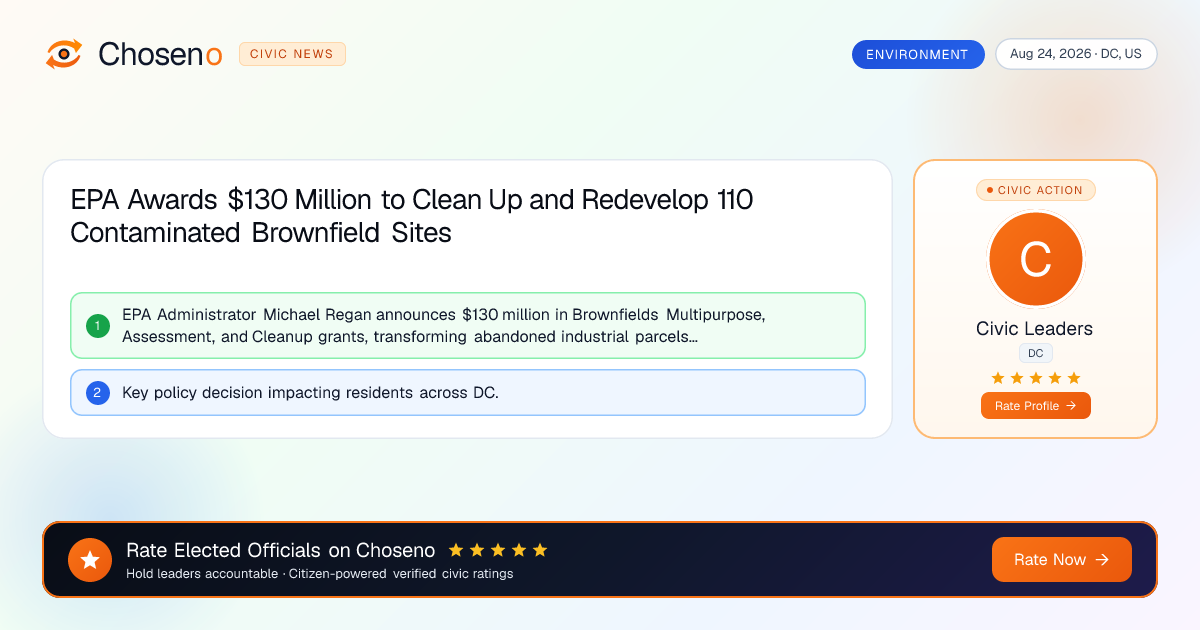
Department of the Interior Awards $85 Million to Rebuild Historic Trails and Visitor Facilities in 25 National Parks
National Park Service allocates $85 million through the National Parks and Public Land Legacy Restoration Fund, repairing backcountry trails, wastewater systems, and historic lodges in 25 parks.
Read full article