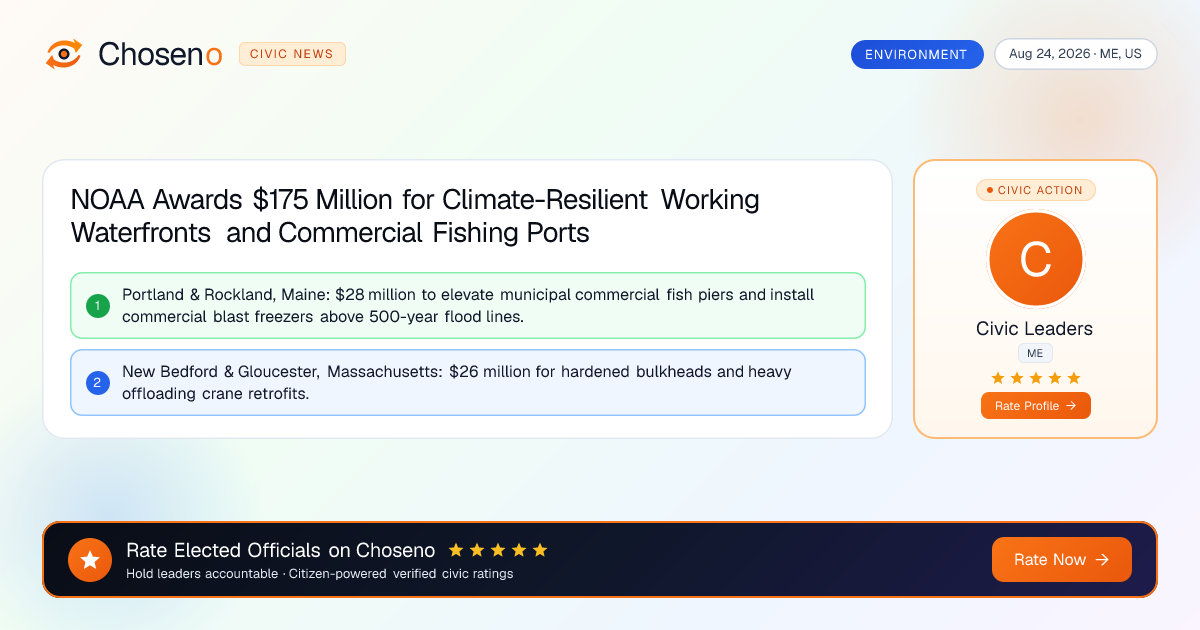
NOAA Awards $175 Million for Climate-Resilient Working Waterfronts and Commercial Fishing Ports
The National Oceanic and Atmospheric Administration awards $175 million in Climate-Ready Coasts grants to modernize commercial fishing piers, cold storage docks, and breakwaters in twenty coastal harbors.
Choseno Maritime & Environmental Desk August 24, 2026 2 min read ME, US
★ Choseno Civic Briefing
Key Leaders
PORTLAND, Maine — The National Oceanic and Atmospheric Administration (NOAA) announced on Monday the distribution of $175 million in Climate-Ready Coasts grants to finance structural storm-hardening, electrical shore-power retrofits, and elevated pier reconstructions across twenty commercial fishing harbors along the Atlantic, Gulf, and Pacific coasts.
The capital awards, funded through the Inflation Reduction Act, provide direct federal cost-share assistance to municipal port authorities, fishing cooperatives, and working waterfront trusts struggling to maintain commercial marine access following unprecedented winter storm surges and record sea-level highs.
Protecting Commercial Fishing Economies Working waterfronts account for more than $300 billion in annual economic activity and support 1.8 million domestic maritime jobs. However, escalating storm intensity and tidal flooding have caused severe structural damage to timber piers, commercial ice facilities, and offloading cranes.
"Our commercial fishermen and coastal working waterfronts are the heartbeat of American maritime communities," NOAA leadership stated in Portland. "These investments provide the engineered infrastructure needed to elevate docks, reinforce breakwaters, and install clean shore power, ensuring that our multi-billion-dollar domestic seafood supply chain remains resilient against extreme marine weather."
Major Coastal Port Allocations Key port infrastructure grants include:
- Portland & Rockland, Maine: $28 million to elevate municipal commercial fish piers and install commercial blast freezers above 500-year flood lines.
- New Bedford & Gloucester, Massachusetts: $26 million for hardened bulkheads and heavy offloading crane retrofits.
- Bayou La Batre, Alabama: $18 million for seafood processing dock floodwalls and storm surge surge gates.
- Coos Bay & Newport, Oregon: $22 million for seismic pier fortification and automated commercial crab vessel offloaders.
- Gulf Coast Shrimping Harbors (Louisiana/Texas): $30 million for elevated ice generation plants and marine fuel dock hardening.
Commercial fishing vessel captains and municipal harbor masters commended the grant package, emphasizing that preserving dedicated commercial berths protects independent fishermen from real estate displacement.
Related Coverage in Environment
See all Environment newsEnvironment
US Aug 24, 2026
EPA Enacts Stricter Air Toxic Standards Slashing Cancer-Causing Emissions at 200 Chemical Plants
EPA Administrator Michael Regan finalizes Clean Air Act Section 112 rules, mandating fenceline monitoring and slashing ethylene oxide and chloroprene emissions by 80% across 200 synthetic chemical plants.
Read full article
Environment
US Aug 24, 2026
EPA Awards $130 Million to Clean Up and Redevelop 110 Contaminated Brownfield Sites
EPA Administrator Michael Regan announces $130 million in Brownfields Multipurpose, Assessment, and Cleanup grants, transforming abandoned industrial parcels into affordable housing and public parks.
Read full article
Environment
US Aug 24, 2026
Department of the Interior Awards $190 Million for Advanced Water Recycling and Purification Facilities
Bureau of Reclamation announces $190 million through Title XVI WaterSMART, funding eight large-scale water purification and brackish desalination plants across California, Arizona, Utah, and Nevada.
Read full article