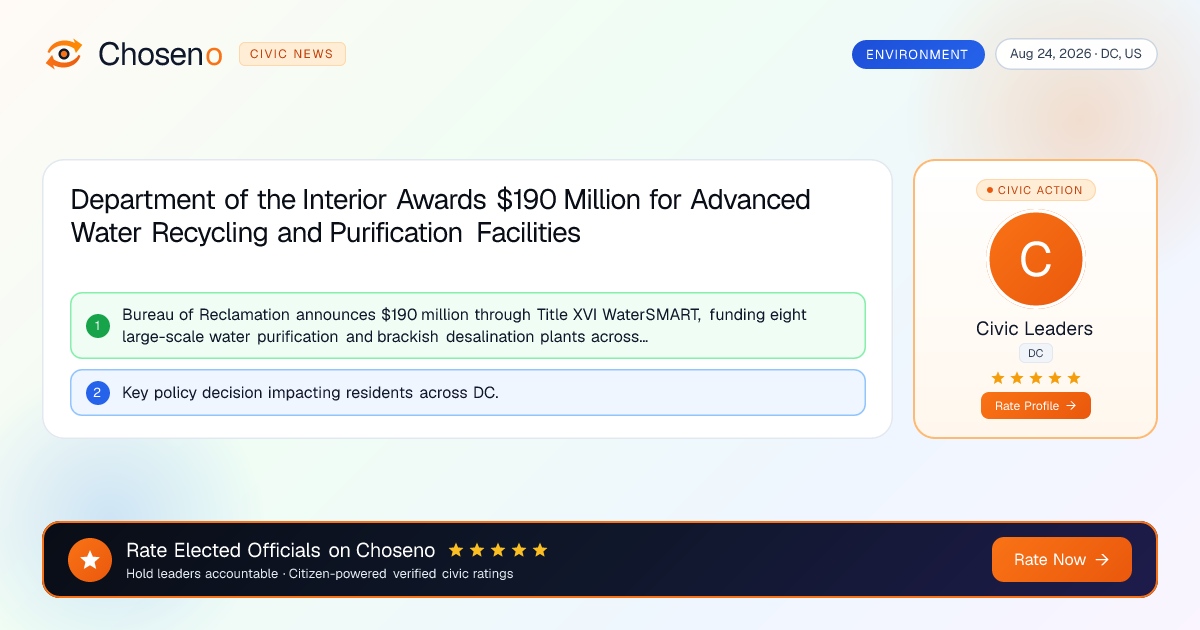
Premier David Eby Deploys $110 Million for Community Wildfire Firebreaks and Forest Fuel Thinning
British Columbia Premier David Eby and Forests Minister Bruce Ralston announce $110 million from the Community Resiliency Investment program to engineer 250 kilometers of wildfire buffer zones around high-risk rural communities.
Choseno BC Bureau August 24, 2026 2 min read BC, CA
★ Choseno Civic Briefing
Key Leaders
KAMLOOPS, B.C. — British Columbia Premier David Eby and Minister of Forests Bruce Ralston announced on Monday the distribution of $110 million in provincial emergency mitigation grants through the Community Resiliency Investment (CRI) program to construct engineered landscape-level firebreaks, perimeter buffer zones, and mechanical forest fuel-thinning treatments around forty high-risk rural and Indigenous communities across the B.C. Interior.
The proactive mitigation funding expands the BC Wildfire Service's year-round prevention mandate, directing mechanical harvesting crews to remove combustible forest underbrush, thin dense lodgepole pine stands, and establish wide, defensible fire guards along community municipal boundaries.
Shifting from Wildfire Response to Year-Round Structural Defense With British Columbia experiencing increasingly severe wildfire seasons driven by prolonged summer droughts, provincial emergency management officials emphasized that proactive forest fuel management is the most effective defense against interface wildfires penetrating residential communities.
"The threat of catastrophic wildfires is the new reality in British Columbia, and we must take aggressive action year-round to protect our homes, our businesses, and our communities," Premier David Eby said at the Kamloops Fire Centre. "This $110 million investment puts boots on the ground and heavy machinery in the woods to clear hazardous forest fuel, build 250 kilometers of defensive firebreaks, and give our courageous firefighters the tactical advantage they need to stop wildfires before they reach community doorsteps."
First Nations Partnerships and Prescribed Burning A dedicated $35 million envelope of the program is allocated directly to First Nations emergency management trusts to support cultural burning, traditional prescribed fire stewardship, and local community forestry training.
Priority wildfire defense corridors funded include:
- Central Interior (Kamloops, Kelowna, Merritt, Williams Lake): $45 million for landscape fireguards and mechanical slash chipping.
- Kootenay & Boundary Regions (Cranbrook, Castlegar): $30 million for interface buffer zone widening.
- Northern B.C. & Peace River (Fort St. John, Burns Lake): $20 million for all-season emergency access and fireguard road clearing.
- Cultural and Prescribed Fire Initiatives: $15 million for indigenous burning coordination.
Municipal mayors, regional district directors, and forestry union executives praised the long-term investment, pointing out that mechanical thinning creates rural logging employment while safeguarding critical community infrastructure.
Rate the people mentioned in this article
Related Coverage in Environment
See all Environment newsEnvironment
US Aug 24, 2026
EPA Enacts Stricter Air Toxic Standards Slashing Cancer-Causing Emissions at 200 Chemical Plants
EPA Administrator Michael Regan finalizes Clean Air Act Section 112 rules, mandating fenceline monitoring and slashing ethylene oxide and chloroprene emissions by 80% across 200 synthetic chemical plants.
Read full article
Environment
US Aug 24, 2026
EPA Awards $130 Million to Clean Up and Redevelop 110 Contaminated Brownfield Sites
EPA Administrator Michael Regan announces $130 million in Brownfields Multipurpose, Assessment, and Cleanup grants, transforming abandoned industrial parcels into affordable housing and public parks.
Read full article
Environment
US Aug 24, 2026
Department of the Interior Awards $190 Million for Advanced Water Recycling and Purification Facilities
Bureau of Reclamation announces $190 million through Title XVI WaterSMART, funding eight large-scale water purification and brackish desalination plants across California, Arizona, Utah, and Nevada.
Read full article